
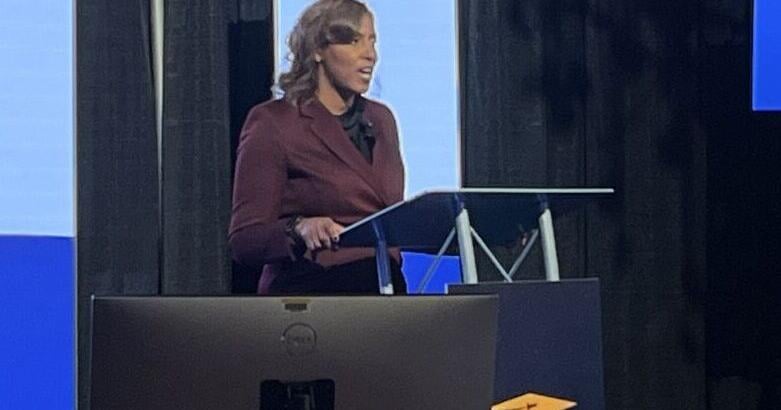
Prince William County schools celebrated the launch of its new strategic plan Monday night, which will bring universal pre-K, augmented and virtual reality and more by 2030.
The school system’s current strategic plan – Vision 2025 – sunsets at the close of the year, and the new plan, dubbed Elevate 2030, seeks to build on some of the progress from the past four years.
That progress includes a 94.8% on time-graduation rate, a 6.7% drop in chronic absenteeism, a 2.2% drop in the dropout rate and a 10% decrease in dropout rate for English learner students.
Over the last four years, students have made strides in Standards of Learning performance, improving in math, writing and science.
The new strategic plan includes the same four key commitment areas as the previous plan: learning and achievement for all, positive climate and culture, family and community engagement and organizational coherence.
Superintendent LaTanya McDade was joined by School Board members, members of the Board of County Supervisors and other stakeholders at Brentsville Hall to present the new plan. McDade laid out some of the key goals and strategies to meet those goals for each commitment area.
“Now is the moment for us to lead, with vision, to spark innovation and to boldly shape the future that awaits our students, embracing advancements, not just in technology, but across education,” McDade said. “With Elevate 2030, we are focused on our path forward and imagining the future that we collectively have the opportunity to create.”
Achievement for all
The division is maintaining its goal of a 95% on-time graduation rate, which McDade said it chose to keep because of changes under the Federal Graduation Indicator.
“When we take the new changes under the Federal Graduation Indicator and stack that against what we were measuring when we got the 94.8%, under the new criterias, we would be only at 91,” McDade said.
The school system is also aiming for an overall 85% SOL pass rate, with a 10% increase in the number of students reaching an advanced pass rate in literacy, math and science. Another goal included in the new plan is that, by 2030, 80% of students will be reading on grade level by second grade.
The division also set goals in this category related to post-secondary success. Those include:
A 6% increase in enrollment at two- and four-year colleges
150 students will earn an associate degree
10% of students will receive the Seal of Biliteracy
All high schools will offer at least one career cluster in a high-wage, high-demand field
60% of students meeting the college-readiness benchmark
McDade also laid out the strategies the division has identified to meet its goals, including:
Global competencies and multilingual skills: Expanding international baccalaureate and Cambridge programs, growing dual-language immersion and introducing translation and interpretation coursework for students.
Career clusters and IT pathways: Implementing early career exploration, beginning in elementary school, all high schools will offer an IT pathway, and all students will have the opportunity to choose courses in an IT field.
Careers, entrepreneurship and student businesses: Provide school-based enterprises, such as school stores and student-run businesses, high schools will provide career preparation activities and middle schools will provide research-driven entrepreneurship courses
AR/VR and emerging technologies: Every school will have access to augmented and virtual reality technologies by 2030
Innovation zones and teacher learning: Award micro-credentials in computational thinking to students and teachers, 10 classrooms of innovation and one teacher-led model innovative instructional lab for teaching and instruction ideas
Universal preschool: All Prince William County families will have access to universal preschool by 2030
“There’s strong research favoring the long-term effects of preschool,” McDade said. “Georgetown University published [a] groundbreaking 20-year study concluding that students who attend pre-K are less likely to fail courses or be chronically absent in K-12.”

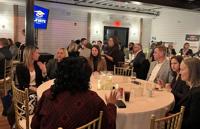
Community stakeholders gathered Monday night at Brentsville Hall for the soft launch of Elevate 2030, Prince William County schools’ new strategic plan.
Emily Seymour
School Board Chairman Dr. Babur Lateef told InsideNoVa he is “extremely excited” about the efforts to bring universal pre-K to the county.
Positive culture
The school system has several key goals it wants to achieve under the positive culture and climate commitment area. Those include further decreasing English learner dropout rates, having a mental health first aid-trained employee at every school, expanding school activities and athletics offerings, providing every student with access to outdoor learning environments and launching the H.O.M.E. initiative to dedicate affordable housing units for teachers.
The school system has a number of strategies for the goals, beginning with the Human Capital Framework, which it will use to create a “clear, fair and cohesive employee experience.”
The division will also be launching a principal residency program, an offshoot of the teacher residency program it already runs. By 2030, the division hopes 80% of residency graduates will be placed in leadership roles.
The H.O.M.E. residency program will be a public-private partnership that identifies 150 dedicated residential units, creating affordable housing options for school division staff.
In keeping with the further integration of artificial intelligence and technology, the school system will be using the strategy of “smart buildings.” Under this category, the school system hopes to reach a 25% reduction in greenhouse gas emissions by 2030 by upgrading buildings to cut energy costs.
Regarding outdoor learning environments, McDade said, “Simply put, learning has to go beyond the four classroom walls. And so by 2030 we’re ensuring that every PWCS student will have access to meaningful outdoor learning at their local school.”
Community engagement
For family and community engagement, the school system is aiming to add eight school-based food pantries annually, create three school-based health clinics and add over 150 mentors for students, with a focus on first-generation, college-going students.
Strategies in this pillar include:
School-based health clinics: Three clinics will be added by 2030, and 85% of students and families will receive essential wraparound services within four weeks of being referred.
Student mentors: 150 mentors to support 250 students annually, 50 diverse mentors to support 100 first-generation/underrepresented students, and 50 students will be offered summer internships or job shadowing.
Career exploration: The division will be opening its first family academy center, where students and families will have access to opportunities to become workforce ready.
Organization coherence
The final commitment area covered in the new strategic plan is organizational coherence, which McDade said is important because of the business side of the school system.
“We are an educational institution, but we’re also a $2 billion business,” she said.
Some of the goals in the coherence category revolve around AI. For example, the division set a goal that all educators, specialists and leaders complete advanced AI training and that all departments and instructional staff use AI dashboards for real-time decisions to boost student outcomes. Key strategies include:
Data dashboard and data literacy: All school system departments and staff will use AI-enabled analytics dashboards to make data-driven decisions
Enterprise resource planning (ERP): All core ERP systems will be modernized and integrated with AI capabilities
Return on investment: 50% of new annual investments will be reallocated from prior year operational spending by 2030
Advanced AI training: By 2030, all division staff will receive advanced AI training specific to their role
“This investment in staff development goes beyond basic digital literacy, but it equips our teams with the expertise needed to integrate artificial intelligence into their general practice, improving instruction, streamlining operations and enabling smarter decisions,” McDade said.
Lateef said in addition to his excitement about universal pre-K, he is most excited about the goals for academic achievement.
“You will see an ambitious agenda laid out in our next strategic plan,” Lateef said. “I think it puts Prince William County schools on a path to be one of the top school districts in the nation.”