
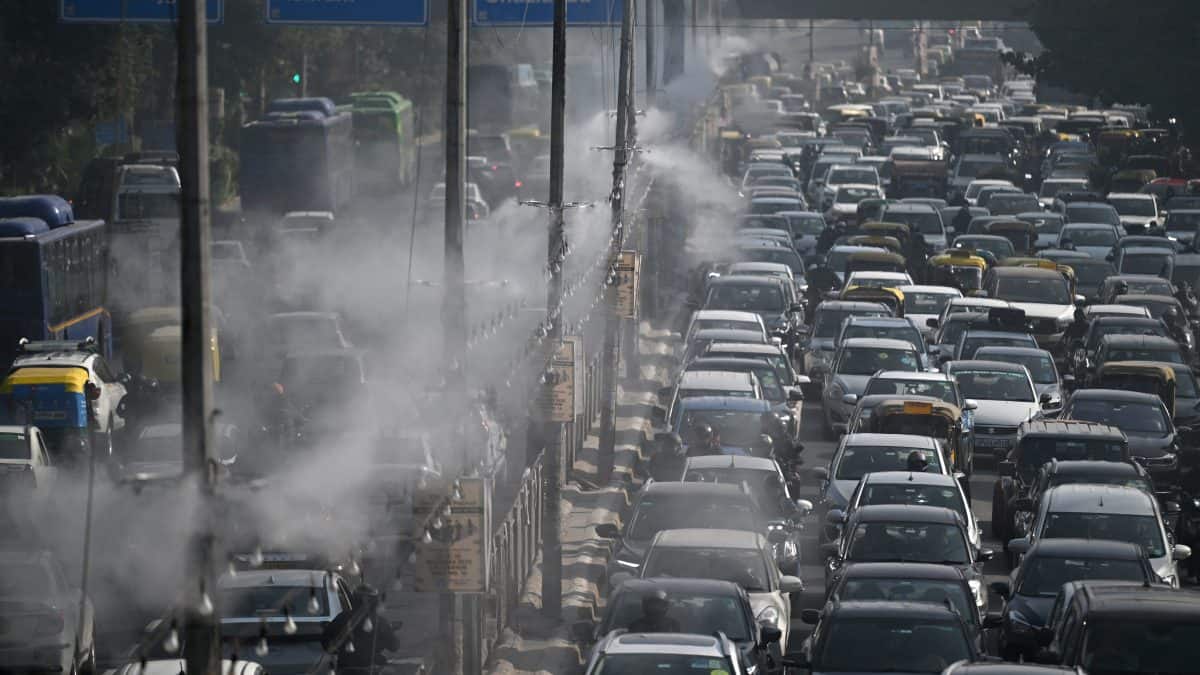
The scene in Delhi continues to be grave, with toxic smog hanging over parts of the city. The national capital witnessed an AQI of 328 on Wednesday morning, placing it in the ‘very poor’ category, according to data from the Central Pollution Control Board (CPCB). This is only marginally better than Tuesday, when the AQI was 354 at 4 pm. Yu Jing, the spokesperson for the Chinese embassy in India, took to social media today to explain how India, and particularly Delhi, could take steps to improve the situation
Delhi continues to grapple with pollution.
The national capital witnessed an AQI of 328 on Wednesday morning, placing it in the ‘very poor’ category, according to data from the Central Pollution Control Board (CPCB).
This is only marginally better than Tuesday, when the AQI was 354 at 4 pm. The scene in Delhi continues to be grave, with toxic smog hanging over parts of the city.
The Supreme Court meanwhile has slammed the ‘total failure’ of the authorities in solving the problem and said that long-term planning is required.
STORY CONTINUES BELOW THIS AD
“Let us think of pragmatic and practical solutions to the menace,” the bench comprising CJI Surya Kant said.
Yu Jing, the spokesperson for the Chinese embassy in India, took to social media to explain how Delhi could do so.
“Both China and India know the struggle with air pollution amid rapid urbanisation. While the challenge remains complex, China’s sustained efforts over the past decade have delivered noticeable improvements,” Yu wrote. “In the coming days, we’ll share a bite-sized series exploring how China tackled air pollution — step by step.”
Let’s take a closer look
Adopt stringent emission controls
Yu said the first thing Delhi must do is implement strict emission controls. Yu urged the national capital to adopt ultra-stringent regulations such as the China 6NI, which is on par with Euro 6 norms. Much of the blame for Delhi’s air can be laid on the shoulders of vehicular pollution.
Delhi’s Environment Minister Manjinder Sirsa has announced that starting tomorrow (December 18), only BS6 vehicles will be allowed to enter the national capital. India has already made it compulsory for all vehicles manufactured after April 1, 2020, to comply with BS-VI emission norms.
Representational image (Image credit: ANI)
She also urged lawmakers to ensure that high-emission, old vehicles are phased out. She also recommended that Delhi build among the world’s largest metro and bus networks. Of course, the Delhi Metro is already among the largest in the world. She also recommended that Delhi stop more cars from coming onto the roads through licence lotteries and odd-even driving rules. Again, the city has already experimented with odd-even rules. She recommended that Delhi speed up the shift to electric vehicle adoption and work with the Beijing–Tianjin–Hebei region on coordinated emissions cuts.
Restructuring industryYu said industrial restructuring is key to winning the war on pollution.
She said China did it by:
Shutting down or removing over 30,000 heavy industries.
She said relocating Shougang, one of China’s largest steelmakers, cut down inhalable particles by around 20 per cent.
China also transformed empty factories into parks, commercial zones, and hubs of tech and culture. The former Shougang site, for example, became a venue for the 2022 Winter Olympics.
China also relocated wholesale markets, logistics hubs, and some educational and medical institutions.
China also coordinated regional integration by shifting general manufacturing to Hebei, while retaining high-value research and development and services within Beijing.
Yu last month also put forth some policies that helped Chinese cities, including Beijing, vastly improve their air quality. She pointed to closing small and inefficient coal boilers, relocating or shuttering highly polluting industrial plants, and stricter emission standards for heavy industries and vehicles.
She also recommended investing in renewable energy sources such as wind, solar, and hydropower, using satellite data and real-time monitoring systems to track air quality, and strictly punishing non-compliance and data falsification.
Why this might be more difficult to do in Delhi
However, as has been pointed out, Delhi already has one of the world’s largest metros. The city has also experimented with odd-even days and other measures to try to bring down pollution. Experts say keeping transport curbs in the national capital year-round is impossible. Stubble burning continues to be a major issue as states play the blame game.
Experts said coming up with agricultural policies to solve stubble burning and investing in public transport infrastructure remain key to solving Delhi’s air pollution. Compliance remains a huge issue. According to a 2023 CAG audit, over 1,08,000 vehicles were issued PUC (pollution-under-control) certificates despite failing emission tests.
With inputs from agencies