
A newly discovered impact craters on Mars, captured in striking detail by NASA’s Mars Reconnaissance Orbiter. The image, taken by the orbiter’s HiRISE camera, reveals a dramatic blast zone radiating from a 30-meter-wide crater, with debris flung nearly 15 kilometers across the Martian surface.
This sudden geological event, estimated to have occurred between 2010 and 2012, provides scientists with valuable data about how frequently Mars is hit by space rocks and how these impacts shape the dusty, ever-changing Martian landscape. The contrast between the fresh blue-tinged crater and the planet’s typical reddish terrain makes it one of the most visually compelling impact sites observed in recent years.
When Mars Gets Hit: HiRISE Captures The Aftermath
HiRISE, short for High Resolution Imaging Science Experiment, is one of six instruments aboard the Mars Reconnaissance Orbiter, a NASA spacecraft that has been monitoring the planet since 2006. This specific impact site came to light when scientists noticed a change in surface appearance using the orbiter’s Context Camera. Later, the HiRISE camera was directed at the coordinates to capture the full extent of the event in high detail.
According to NASA, the blast pattern and exposed subsurface materials were so striking in the processed image that the site appeared blue due to the removal of the planet’s characteristic red dust.
The crater, located at 3.7 degrees north latitude and 53.4 degrees east longitude, is now being analyzed not only for its striking appearance but also for what it reveals about the frequency and power of recent Martian impacts.
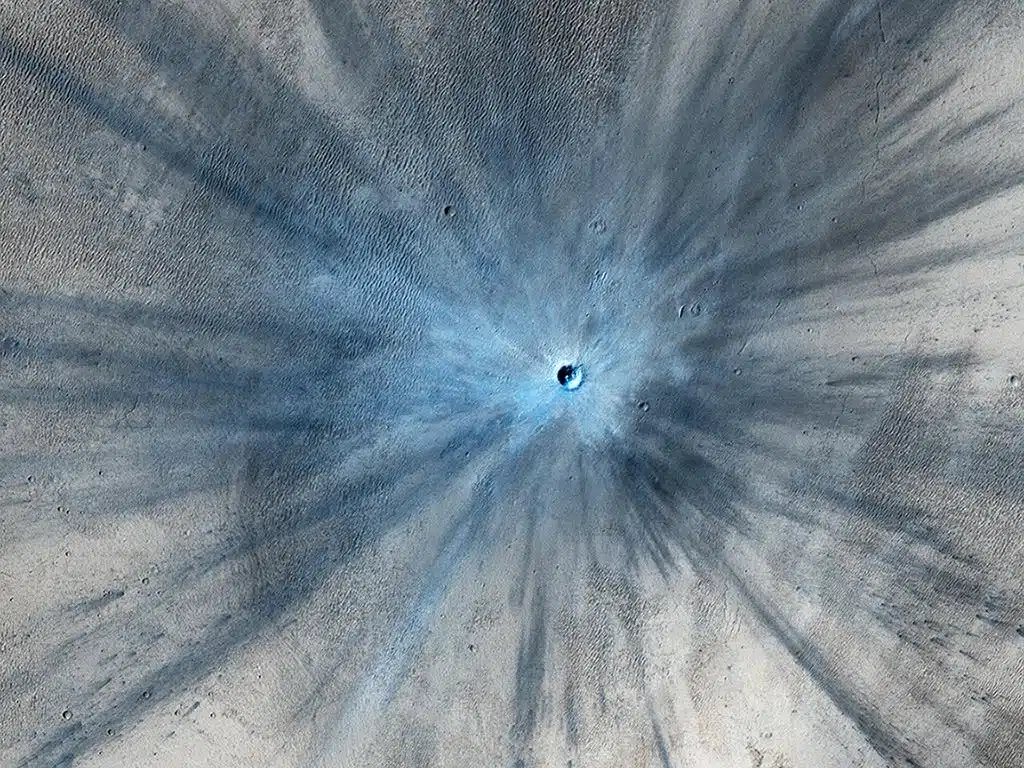 A spectacular new martian impact crater. Credit: NASA/JPL-Caltech/Univ. of Arizona
High-resolution Imaging Confirms Crater’s Timing And Origin
NASA scientists were able to narrow down the timing of the impact by comparing Context Camera images from July 2010 and May 2012. Somewhere between those two observations, the crater formed—its appearance sudden and unmistakable. Once spotted, the site was catalogued as ESP_034285_1835 and imaged in detail on November 19, 2013, by the HiRISE camera.
As stated in the review article, the terrain in which the crater formed is especially dusty. When the meteorite struck, it blasted away the upper layer of red dust, exposing darker materials underneath. This created a strong visual contrast, causing the crater to appear blue in enhanced color images.
“Debris tossed outward during the formation of the crater is called ejecta. In examining ejecta’s distribution, scientists can learn more about the impact event. The explosion that excavated this crater threw ejecta as far as 9.3 miles (15 kilometers).”
An impact crater, roughly 1.5 km wide, on the surface of Mars, captured by the HiRISE camera on the Mars Reconnaissance Orbiter 257 km above the planets surface.
📸: NASA/JPL/Uarizona pic.twitter.com/VPGr34IC5H
— Wonder of Science (@wonderofscience) December 16, 2025
A Rare Visual Example Of Martian Surface Transformation
Though fresh craters are not rare on Mars, few are as visually dramatic as this. The size of the blast zone and the clarity of the image make it a valuable reference point for future studies. As mentioned by the U.S. Space Agency, the impacts that produce craters of at least 3.9 meters occur more than 200 times per year on a global Martian scale. Yet, only a fraction are detected with enough clarity to allow such detailed follow-up imaging.
In this case, the availability of before-and-after images significantly improved scientists’ ability to analyze the event’s timing and consequences. The combination of Context Camera and HiRISE imagery allows planetary geologists to track changes and measure ejecta patterns more accurately than ever before. NASA’s Photojournal described this event as one of the clearest and most recent examples of how external forces continue to shape the Martian surface.