
This report is produced by the Office of the Resident Coordinator in collaboration with humanitarian partners and the Office for the Coordination of Humanitarian Affairs – Regional Office for Asia and the Pacific. It covers the period from 28 November to 16 December 2025. The next report will be issued on 19 December.
HIGHLIGHT
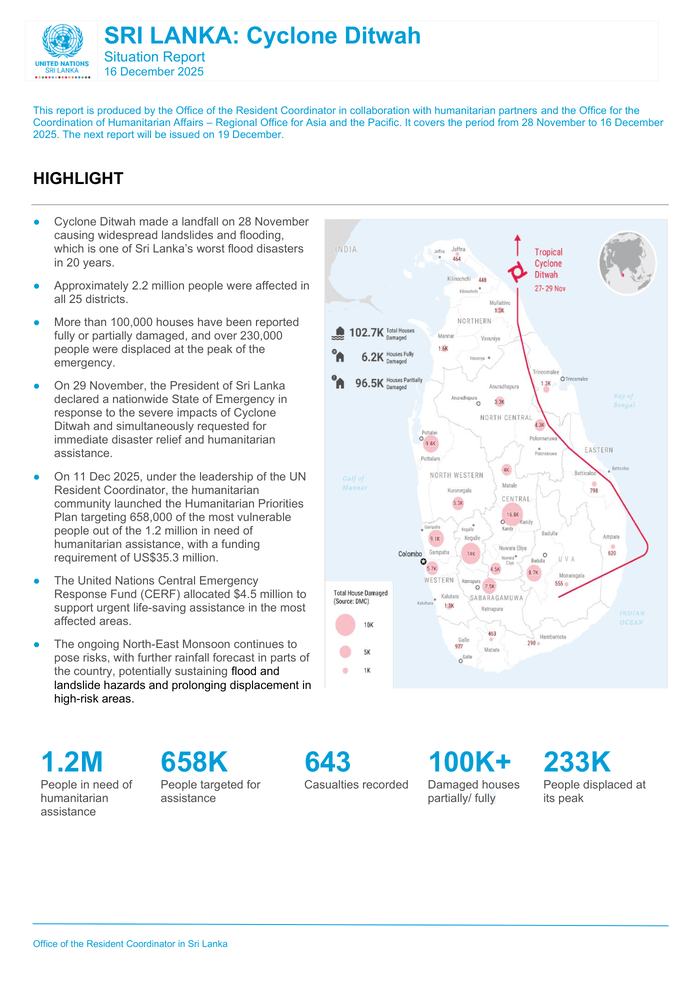
Cyclone Ditwah made a landfall on 28 November causing widespread landslides and flooding, which is one of Sri Lanka’s worst flood disasters in 20 years.
Approximately 2.2 million people were affected in all 25 districts.
More than 100,000 houses have been reported fully or partially damaged, and over 230,000 people were displaced at the peak of the emergency.
On 29 November, the President of Sri Lanka declared a nationwide State of Emergency in response to the severe impacts of Cyclone Ditwah and simultaneously requested for immediate disaster relief and humanitarian assistance.
On 11 Dec 2025, under the leadership of the UN Resident Coordinator, the humanitarian community launched the Humanitarian Priorities Plan targeting 658,000 of the most vulnerable people out of the 1.2 million in need of humanitarian assistance, with a funding requirement of US$35.3 million.
The United Nations Central Emergency Response Fund (CERF) allocated $4.5 million to support urgent life-saving assistance in the most affected areas.
The ongoing North-East Monsoon continues to pose risks, with further rainfall forecast in parts of the country, potentially sustaining flood and landslide hazards and prolonging displacement in high-risk areas.
1.2M People in need of humanitarian assistance
658K People targeted for assistance
643 Casualties recorded
100K+ Damaged houses partially/ fully
233K People displaced at its peak
SITUATION OVERVIEW
Between 27 and 29 November, Cyclone Ditwah caused widespread flooding and landslides across Sri Lanka, affecting communities in all districts. The storm claimed lives, displaced many people from their homes and caused extensive damage to houses, roads, schools, and health facilities, with the most severe impacts recorded in the Central, Western, and North-Western Provinces. As of mid-December, more than 2.2 million people have been affected nationwide, with 643 fatalities reported and 183 people still missing as of 14 December 2025.
While the pace of new evacuations has slowed since the cyclone’s immediate impact, displacement remains significant. As of 15 December, approximately 70,000 people remain displaced, representing around 3.2 per cent of the total affected population. Many displaced families are staying with relatives or other families as a coping mechanism, while others remain in safety centres due to housing damages, limited access to basic services and ongoing safety concerns. Displacement patterns vary across locations; while households have begun returning and initiating repairs, others are expected to remain displaced for extended periods, including in areas where flood and landslide risks continue to make return unsafe. In several locations, schools continue to be used as temporary shelters or for storing relief items, delaying the resumption of classes and increasing protection and psychosocial risks for children. Protection concerns have increased among displaced communities, particularly for women and girls, as overcrowded shelters, disrupted services, and prolonged displacement heighten risks of gender-based violence, exploitation and psychosocial distress.
Damage to houses remain a key driver of humanitarian needs. More than 100,000 houses are reported as fully or partially damaged. Many families returning to their communities are living in partially damaged homes or in makeshift conditions, increasing exposure to weather, health risks, and protection concerns. Damage to water supply and sanitation systems in several affected areas is limiting access to safe drinking water and adequate sanitation and increasing public health risks, particularly in displacement settings.
Livelihoods have been significantly affected, particularly among households dependent on subsistence farming, fisheries, daily wage labour and small businesses. Losses of crops, livestock, fishing equipment and small productive assets have disproportionately affected poorer households with limited coping capacity and access to compensation mechanisms. The floods coincided with the Maha cultivation season, and delays or missed planting risk carrying food and income losses into the next season, with potential knock-on effects on local food availability and prices, particularly affecting small-scale farmers and low-income households.
Access to affected communities remains uneven. In hilly, landslide-affected areas, damage to narrow secondary roads has made some remote villages difficult to reach, and relief items and services in the most affected locations require manual transport. Access constraints are expected to persist for weeks or longer in some areas until repairs are completed. Damage to power and telecommunications infrastructure was reported in the immediate aftermath of the floods; while services have largely been restored, limited disruptions persist in some remote locations, affecting access to information and services.
Most basic health services are reported to be largely operational; however, in affected areas, available information indicates that some facilities are experiencing increased pressure as more people seek care. No major outbreaks of communicable diseases have been reported to date. However, health authorities continue to monitor elevated risks of flood-related diseases, including leptospirosis, dengue and diarrheal illnesses, particularly in areas with standing water, damaged sanitation systems and crowded living conditions.
According to national authorities, landslide risk remains elevated in several districts during the ongoing northeast monsoon, particularly in hilly and previously affected areas, with implications for safety, access and the feasibility of return. National meteorological forecasts also indicate the possibility of further heavy rainfall in the coming weeks, which could sustain flood and landslide risks and prolong displacement in high-risk locations.
A Joint Rapid Needs Assessment was conducted following Cyclone Ditwah, led by the Government with support from humanitarian partners, informed initial response planning. A broader inter-agency assessment is currently underway to refine understanding of evolving needs and priorities, with findings expected to inform future response planning and reporting.
On 11 December, the Humanitarian Priorities Plan was launched under the leadership of the Resident Coordinator, in coordination with the Government and humanitarian partners, to guide and prioritise coordinated assistance for the most vulnerable people affected by Cyclone Ditwah, informed by joint assessments and ongoing analysis.