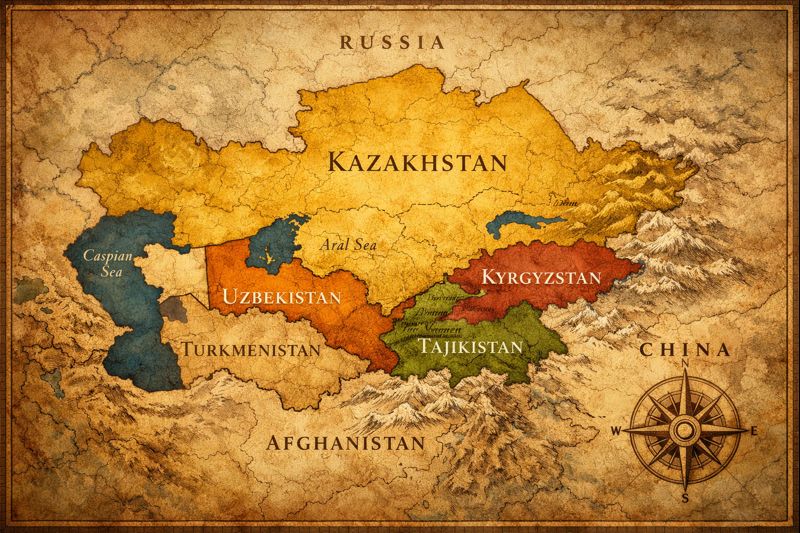
At first glance, President Donald Trump’s November meeting with the leaders of five Central Asian countries under the C5+1 framework appears to signal a revival of America’s expansionist economic diplomacy. In reality, however, it reflects a fundamental shift in the United States’ geopolitical calculus driven by three decisive factors: the stalemate over the war in Ukraine, the deepening Russia-China alignment within the Shanghai Cooperation Organization, and the growing concerns over Beijing’s technological and mineral dominance. After two decades of military focus on the Middle East, Washington is once again turning its attention to a region that could play a critical role in shaping the future of great-power competition: Central Asia.
Washington’s Return to Central Asia
For the past two decades, Central Asia—comprising Uzbekistan, Kazakhstan, Tajikistan, Turkmenistan, and Kyrgyzstan—has largely remained on the margins of U.S. foreign policy. After the withdrawal from Afghanistan, Washington viewed the region not as a battlefield, but as a quiet buffer zone separating Russia, China, and Iran. That perception, however, is changing. The war in Ukraine, the growing convergence between Moscow and Beijing, and the reemergence of ‘bloc politics’ have convinced U.S. strategists that the stability of this region will shape not only Eurasia’s future, but also the architecture of the emerging world order.
This renewed engagement can be seen as a redefinition of the C5+1 initiative that began under the Biden administration but is now being pursued under Trump with a distinctly economic and commercial tone. The difference lies in emphasis: rather than promoting liberal values, Washington’s new approach prioritizes industrial cooperation, transit corridors, and competition over critical mineral resources.
Washington no longer relies on hard containment. Instead, it is adopting what American policy circles call ‘smart containment’: a strategy of weaving economic, technological, and logistical interdependence that constrains Russian and Chinese influence without a military presence. Central Asia can become a strategic lever for Washington by positioning itself against Russia through reducing export routes dependent on Moscow and reshaping energy transport networks. For China, Central Asia can compete in the extraction and processing of vital minerals, which are the backbone of batteries, clean energy, and advanced technologies.
Uzbekistan and Kazakhstan: Washington’s two Strategic Anchors
The United States engages Central Asia through two key partners: Kazakhstan, the region’s largest economy and the world’s main uranium producer, has become increasingly attractive to the Trump administration, and Uzbekistan, with its central location and sizable population. Investments by major U.S. companies like GE, Wabtec, and Microsoft represent more than industrial partnerships. They are part of Washington’s broader efforts to build non-Chinese supply chains, integrating the region into networks that bypass Beijing’s Belt and Road Initiative (BRI).
However, unlike in the 1990s and early 2000s, the Central Asian republics are now seeking to act independently. Kazakhstan, for instance, blocked the deployment of Wagner Group forces near its borders in 2023 and declined to deepen its participation in the Eurasian Economic Union. Uzbekistan, for its part, has introduced new foreign investment reforms designed to limit its dependence on China. The region’s leaders have now learned that diversification, not dependence, is the true safeguard of sovereignty and survival in an increasingly competitive Eurasian landscape.
Trump’s recent summit with Central Asian leaders carried significant political weight. Kazakhstan’s willingness to join the Abraham Accords marks the first formal linkage between the Middle East and the Eurasian security architectures. Further, Kazakhstan recently signed a $4.2 billion deal with U.S. Company Wabtec Corporation to supply 300 locomotives over the next decade. Central Asia holds vast reserves of strategic minerals such as lithium, copper, and uranium that the U.S. can capitalize on.
Washington at a Crossroads: Containment or Partnership
Central Asia’s renewed importance for the United States stems from its position at the intersection of three major global trends: competition for vital resources, the restructuring of supply chains, and the emergence of a multipolar world order. This realization has prompted Washington to return to the heart of Eurasia after two decades of relative disengagement. Still, Washington will have to decide on a long-term strategy for diplomacy in Central Asia.
Today, Washington faces a choice between two approaches in Central Asia. The first is a containment-oriented strategy, viewing Central Asia primarily as a tool to counter China and Russia. The second is a partnership-oriented approach, focusing on infrastructure, technology, and sustainable development, which could help transform Central Asia into a genuine partner in the emerging global order.
Kazakhstan’s multi-alignment strategy, Turkmenistan’s neutrality, and Uzbekistan’s pragmatic approach signal efforts to navigate between competing powers. If these dynamics are guided by a cooperative mindset, Central Asia could transform from a backyard of disparate states to a bridge between major powers. However, if the competition continues under a zero-sum logic, the history of Cold War competition risks repeating itself in a new guise.
By embracing a cooperative strategy that recognizes the region’s strategic autonomy and prioritizes economic diversification and technological cooperation, Washington could move beyond the traditional containment mindset. In doing so, it could play a constructive role in shaping a new Eurasian order grounded in soft power, connectivity, and multilateral cooperation.
Ziaulhaq Tanin is a university lecturer and researcher. Views expressed are the author’s own.