
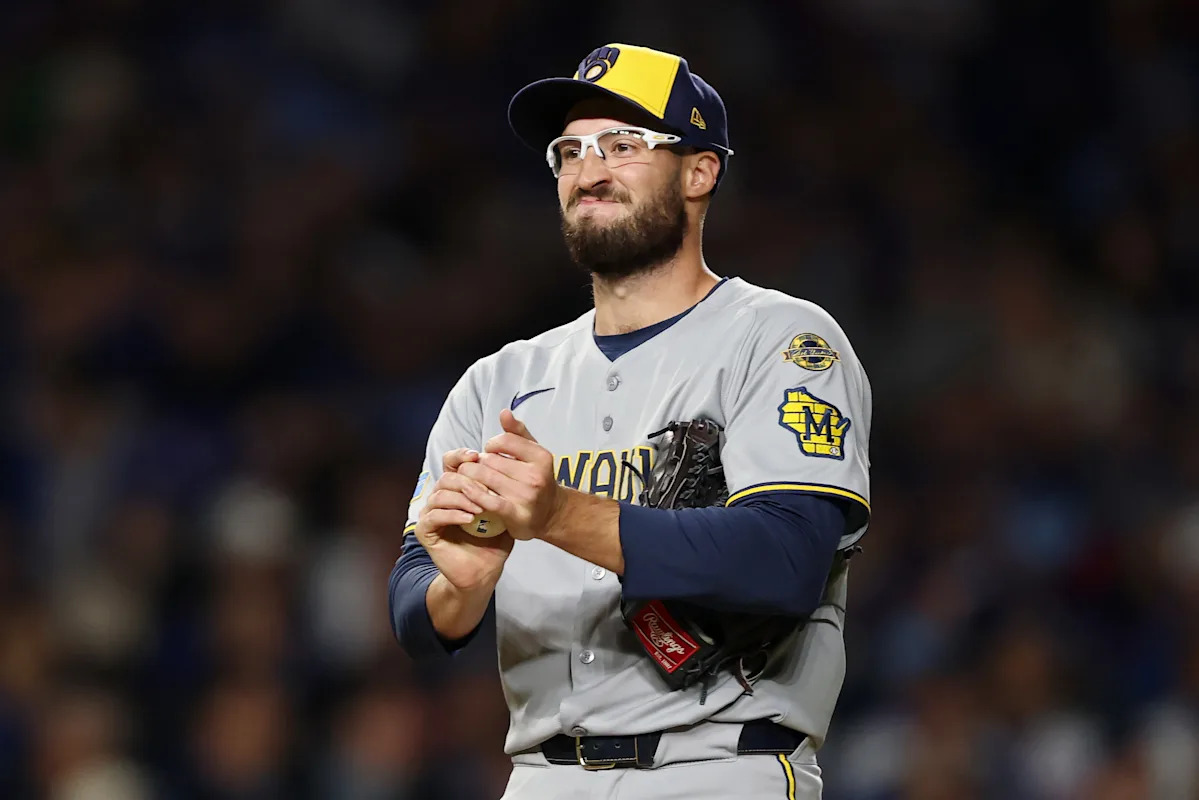
Harrison took an early stab at predicting the Opening Day 26-man roster yesterday, and it got me thinking about something that’s come up in conversations lately, and that’s whether the Brewers will have any left-handed pitchers in their starting rotation. That also led to the question of whether or not it actually matters whether there were any left-handed starters. I was curious about both these questions, so first let’s do a quick recap of the options for the pitching staff and their handedness, then look at league-wide splits.
Pitching staff options
As Harrison cites, the Brewers have 13 players on their current 40-man roster who could reasonably start (and let’s assume we’re talking about real starts, not “opens”) a game for the Brewers next season. I’m going to rank them in a sort of depth chart order, listed along with their R/L handedness:
Advertisement
If the Brewers have taught us anything in the past two years, it’s that we shouldn’t expect that they’ll stick to a five- or six-man rotation for long. Injuries will happen, players will need rest, etc. So, the fact that I don’t list a lefty until we get to number seven—Gasser—doesn’t by any means suggest that I don’t think any lefties will start.
But there are real questions about whether any of these lefties will be in the rotation plans, whether that means at the beginning of the season or at all.
Ashby and Hall
Aaron Ashby and DL Hall have both pitched almost exclusively in relief over the past two seasons, and both have injury histories (especially Hall) that might make the Brewers wary of using them in the rotation. Ashby also presents a confounding question: he has been so valuable in an old-school “fireman” role that the Brewers might just want to keep him there. What’s more valuable: the reliever who has thrown 95 innings in 57 outings with 10.3 K/9 and some of the best stuff in the league over the past two years, or a starting pitcher who has to dial back on that stuff in order to stretch out further?
Advertisement
Hall could be a different story. When the Brewers acquired him along with Joey Ortiz for Corbin Burnes, they were surely thinking of him as a starter. Hall was a top-100 prospect for several years while starting exclusively in the minor leagues, but relieved when he got cups of coffee with the Orioles in 2022 and 2023. Injuries have disrupted his career in Milwaukee, but he started 14 games at Triple-A Nashville in 2014 and made a couple of spot starts last season, even though only 10 of his 33 major league appearances with the big-league Brewers have been starts.
The injuries could force the Brewers to move Hall into a long-term bullpen role, but given that Hall hasn’t been nearly as good as Ashby out of the bullpen, it probably makes it so that the Brewers would prefer to move Hall into the rotation before Ashby. There is a little question of money hanging over Ashby’s head; after signing an early-career extension with the Brewers, Ashby is owed $5.5m this season and $7.5m next season, and the Brewers hold option years in 2028 and 2029 at $9m and $13m. Those are reasonable numbers for a good pitcher—even a reliever—but the Brewers aren’t in the habit of spending that kind of cash on relief pitchers. Is there a chance they’d try to move Ashby into the rotation to try to better justify the money they’re spending?
Maybe… but it doesn’t seem like the smart move to try to pigeon-hole Ashby if it’s not the best move for him. Maybe the Brewers try him out of the rotation this spring and see how things go, with an “abort” button at the ready. But if he’s more valuable to the team as a reliever, they should use him that way. Just expect the trade rumors to start popping up if that’s the route that gets chosen—maybe not this year, but soon.
Other lefties
Gasser seems the most likely lefty option to start games for the Brewers this season. He’s not far down the depth chart, and he made it back into the rotation for a couple of starts at the end of last season (and two relief appearances in the playoffs). Gasser probably wasn’t at full strength at the end of the season as he worked his way back from the Tommy John surgery that he had in June of 2024. A full offseason and a full spring training should have Gasser back to full strength, and while I think the Brewers probably prefer the top five guys on my depth chart above, I could see Gasser leapfrogging Henderson as the sixth guy, partially because he offers something different as a lefty.
Advertisement
Another wrinkle here is that it’s conceivable that the Brewers were so intrigued by the bullpen version of Chad Patrick, who tore through the 2025 postseason, that they might keep him in that role—particularly if, say, Trevor Megill leaves and there’s a high-leverage opportunity for someone new in the pen. If the Brewers think that having a lefty in the rotation is important, they could certainly start the year with Patrick in the bullpen and Gasser in the rotation.
After Gasser, Ashby, and Hall, though, there isn’t much to look at. Matt Arnold said some things about the potential to use new acquisition Ángel Zerpa as a starter… but this feels to me like posturing. I’d be quite surprised if Zerpa was used in the rotation at all this season.
The Bullpen
The bullpen, though, has more options. Ashby and Hall were already discussed, and there’s a real chance that Zerpa moves into a high-leverage role right away. Jared Koenig is also still around, and he’s proven enough over the last couple of seasons that he has, rightfully, become one of Pat Murphy’s favorites. Milwaukee also still has Rob Zastryzny on the roster, and while he seems to be an afterthought in most of these discussions, he’s done nothing but get outs as long as he’s been in a Brewer uniform: it’s a small sample, but in 29 2/3 innings over the last two seasons Zastryzny has allowed only seven earned runs (2.12 ERA). It’s true that Zastryzny’s FIP lags behind (4.09), but he’s certainly an option.
Advertisement
Sammy Peralta is another bullpen option, but given the other choices available, his lack of experience, and his existing minor-league option, it seems likely that he’ll start the season in Triple-A.
Either way: Ashby, Hall, Koenig, and Zerpa will likely all be on the roster to start the season—Hall could potentially face a numbers crunch and he does have an option remaining—giving the team plenty of matchup flexibility in the bullpen.
How much does it matter?
Well, a little. Managers don’t bend over backwards to get the right pinch-hitter or the right left-handed pitcher into the game at the right time for no reason. In 2025, the league had a .725 OPS against right-handers and a .704 OPS against lefties. Situationally, left-handed batters struggled against left-handed pitchers more than any other matchup type. Baseball Reference does some regulating for the league by putting this on an OPS+ scale (on their splits page, it’s referred to as tOPS+); basically, it breaks down like this:
Advertisement
RHP vs. RHB: 96 tOPS+
RHP vs. LHB: 108 tOPS+
LHP vs. RHB: 101 tOPS+
LHP vs. LHB: 85 tOPS+
So it’s pretty clear that left-handed pitchers create favorable matchups (and barely create unfavorable ones even when the platoon isn’t to their advantage).
But… I also feel that these differences aren’t enough that you shouldn’t just use your best starting pitchers. In certain lefty-heavy matchups, particularly in the postseason, having a lefty or two available for longer outings would definitely be an advantage, but pitching rotations get so messed up by the postseason that it doesn’t really matter who’s there in the regular season. My advice to the Brewers would be to just use the five pitchers who, at any given moment, seem to be the best five. Worry about platoon splits later.