
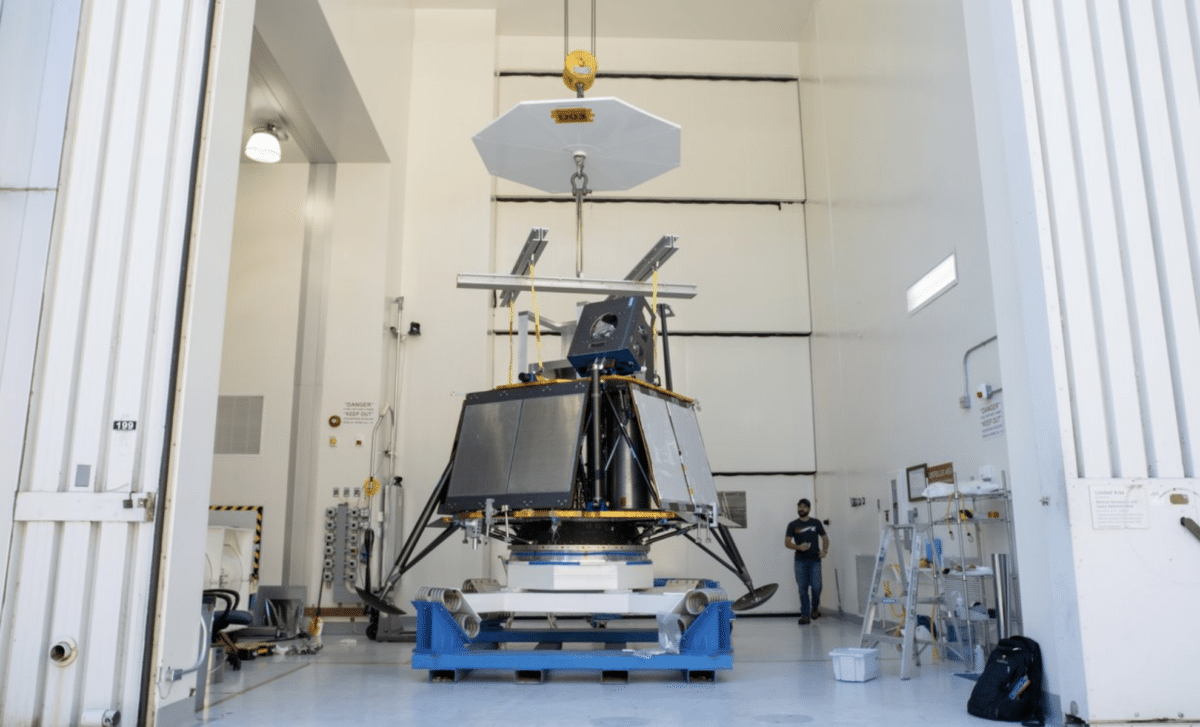
NASA’s Jet Propulsion Laboratory (JPL) is once again playing a pivotal role in preparing spacecraft for the harsh realities of space travel. As Firefly Aerospace readies its Blue Ghost Mission 2 for a trip to the Moon’s far side, JPL engineers are putting the lunar lander through extreme tests. These crucial tests, designed to simulate the violent conditions of a rocket launch, are a part of NASA’s ongoing efforts to support commercial partners in returning to the Moon.
NASA JPL’s Environmental Test Laboratory: A Crucial Testing Ground
NASA’s Environmental Test Laboratory (ETL) at JPL has a storied legacy of testing spacecraft before they face the rigors of space travel. For decades, this facility has ensured that spacecraft, from the Mars rovers to interstellar probes, are capable of surviving launch and space conditions. Recently, the spotlight has turned to Firefly Aerospace’s Blue Ghost Mission 2 lunar lander, which is scheduled to launch as part of NASA’s Commercial Lunar Payload Services (CLPS) initiative.
The recent testing, conducted in October, saw a full-scale model of the Blue Ghost spacecraft placed atop two lunar orbiters. This full stack was subjected to a range of brutal simulations, including vibration tests that replicate the shaking of a rocket launch and acoustic tests that simulate the deafening noise produced during liftoff. These conditions are critical for ensuring that the spacecraft can withstand the violent conditions of space launch without breaking or malfunctioning.
Michel William, a JPL engineer who led the testing, shared his insights into the significance of these trials:
“There’s a lot of knowledge gained over the years, passed from one generation of JPL engineers to another, that we bring to bear to support our own missions as well as commercial efforts. The little details that go into getting these tests right — nobody teaches you that in school, and it’s such a critical piece of space launch.”
This accumulation of expertise has proven essential not just for NASA missions, but for the growing collaboration with private companies like Firefly Aerospace.
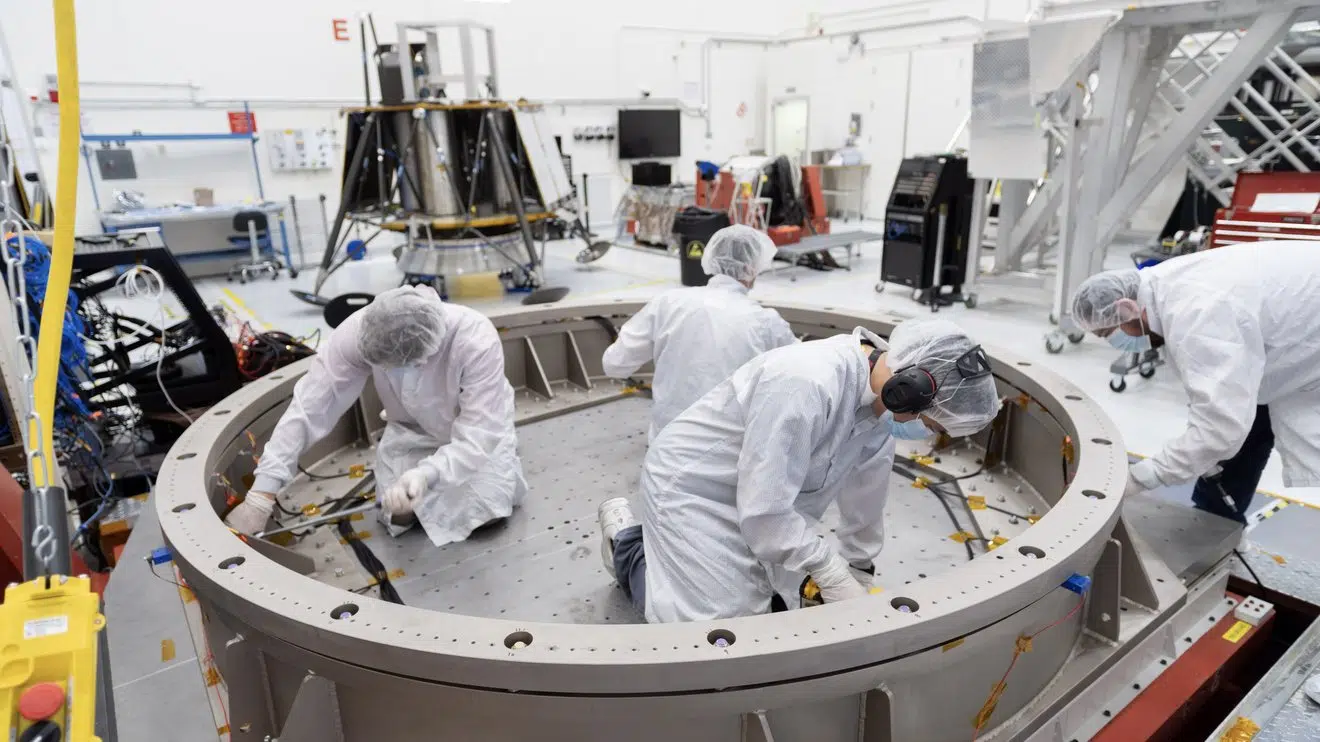 Technicians and engineers at JPL ready a fixture that will attach a full-scale model of Firefly Aerospace’s Blue Ghost Mission 2 lunar lander, visible in the background, to a “shaker table” that tests a spacecraft’s readiness to survive the stresses of launch. Credit: NASA/JPL-Caltech
A Delicate Balance: Testing Without Breaking the Hardware
The process of testing spacecraft is as much about precision as it is about endurance. In the case of Firefly’s Blue Ghost Mission 2, engineers face the challenge of ensuring the lander can survive launch conditions without compromising its integrity. The tests involve subjecting the spacecraft to intense vibration and sound pressures that simulate the worst of what it will experience during a rocket launch. However, the margin for error is razor-thin.
“You can either under-test or over-test, and both are bad,” William explained. “If you over-test, you can break your hardware. If you under-test, it can break on the rocket. It’s a fine line.”
The team at JPL is focused on pushing the spacecraft just enough to test its durability without causing irreversible damage. The careful calibration of these tests is a critical factor in ensuring the spacecraft survives its mission to the Moon.
Commercial Lunar Missions: The New Frontier of Space Exploration
Firefly’s Blue Ghost Mission 2 is more than just a technological test; it represents a crucial step in NASA’s long-term strategy for sustainable lunar exploration. This mission, scheduled for launch in 2026, will help advance technologies that will be used in NASA’s Artemis program, which aims to send astronauts back to the Moon by the mid-2020s. Blue Ghost will carry both NASA and international commercial payloads, including the LuSEE-Night radio telescope and the User Terminal, a compact communication system that could support future lunar missions.
Ray Allensworth, Firefly’s spacecraft program director, emphasized the significance of these efforts:
“Firefly’s Blue Ghost Mission 2 will deliver both NASA and international commercial payloads to further prove out technologies for Artemis and help enable a long-term presence on the Moon. The extensive spacecraft environmental testing we did at JPL for Mission 1 was a critical step in Firefly’s test campaign for our historic lunar mission. Now we’re collaborating again to support a successful repeat on the Moon that will unlock even more insights for future robotic and human missions.”
The mission is a part of NASA’s broader vision of returning to the Moon, not just as a temporary outpost but as a sustainable base for future exploration, with commercial entities like Firefly playing a key role. As these commercial payloads are tested and refined, they help lay the groundwork for a new era of lunar exploration that will see both robots and humans returning to the Moon in the coming years.