
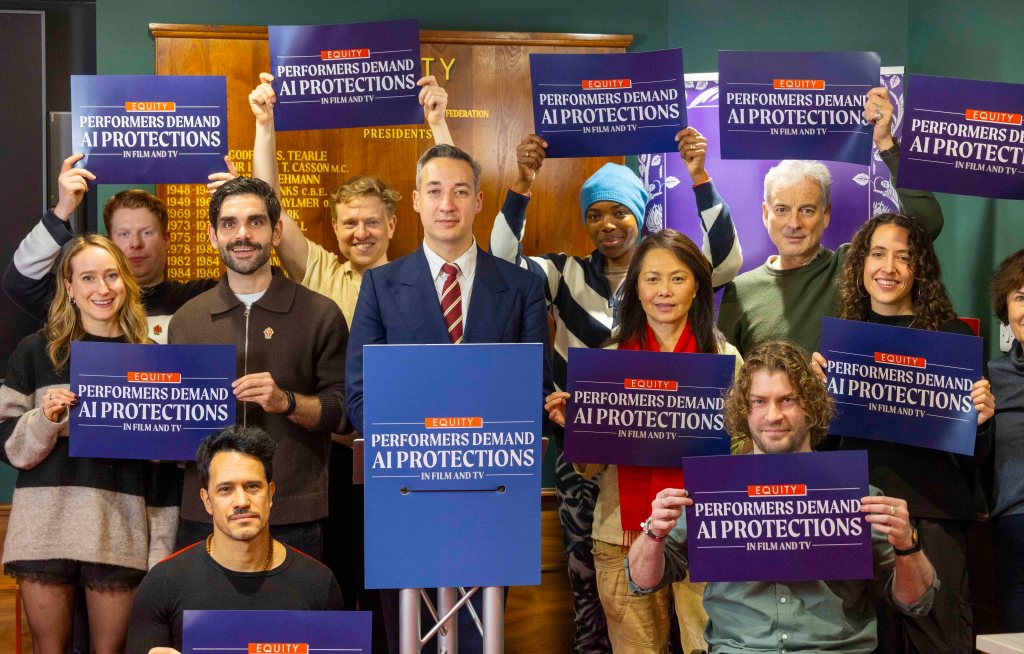
British actors are taking a stand against body scans on film and TV sets amid a growing AI row.
Members of Equity have voted overwhelmingly to refuse the digital scans in a landmark indicative ballot held by the UK performers’ union, which underlines a desire for artificial intelligence protections in contracts.
Equity asked its 7,000 members: “Are you prepared to refuse digital scanning on set to secure adequate AI protections?” Harriet Walter, Hugh Bonneville, and Adrian Lester were among the 99% who voted, “Yes.” The ballot turnout was 75%.
Equity fears that actors are being digitally scanned and their data is being used without consent, potentially to train AI models. There is no suggestion that this is happening at present.
As it is an indicative ballot, it is not binding and does not legally cover Equity members to take industrial action. For that, a statutory ballot is needed.
Instead, Equity will use the vote as leverage in negotiations with Pact, the UK producer trade body, over a new collective agreement for performers. Pact said Equity is pushing for guardrails that “extend beyond the established safeguards already proven to protect actors around the world.”
The current UK Pact-Equity agreement does not contain a single reference to AI. Equity’s recent deal with the BBC, which encompasses shows like Doctor Who, only includes a holding clause saying AI terms will apply once the industry is agreed.
Equity General Secretary Paul W Fleming said: “Artificial intelligence is a generation-defining challenge. And for the first time in a generation, Equity’s film and TV members have shown that they are willing to take industrial action.”
“90% of TV and film is made on these agreements. Over three quarters of artists working on them are union members. This shows that the workforce is willing to significantly disrupt production unless they are respected, and decades of erosion in terms and conditions begins to be reversed.
“The US streamers and PACT need to step away from the brink, and respect this show of strength. We need adequate AI protections which build on, not merely replicate, those agreed after the SAG-AFTRA strike in the USA over two years ago.
“The union believes this can be resolved through negotiation, but 18 months of talks have led us to this stalemate. With fresh AI proposals, significant movement on royalties, and a package of modern terms and conditions, PACT and allied producers can turn this around. The ball is in their court when we return to the table in January.”
A Pact spokesperson said: “The majority of productions don’t scan cast. In some types of production (such as those with SFX), scanning has taken place for many years – long before new technologies like Generative AI. Cast are informed when and why they are being scanned – most commonly for editing purposes. Producers abide by the legal requirements for the treatment and storage of scans.
“During the recent negotiations, Pact offered Equity terms on AI consistent with those that are in place in other countries. Equity is asking for future-facing protections that extend beyond the established safeguards already proven to protect actors around the world. Pact has assured Equity that we will keep the dialogue open as things develop so we can have an informed discussion.”
Equity’s indicative ballot could be followed by a statutory ballot. Strike action is not being ruled out further down the line, Deadline understands.
SAG-AFTRA’s deal with U.S. studios, symbolically endorsed by Equity, included the principle of “informed consent,” meaning clauses around digital replicas should be clearly signposted in contracts (specifically in bold, capital letters) and not buried in terms and conditions.
Digital scans largely affect background actors, who, once scanned, can be replicated by AI. Pierre Bergman, a doyen among UK background artists, said many are bounced into scans out of fear of having a “target painted on their back” by employers.
Adrian Wootton, CEO of the British Film Commission, said it is “working with all parties to reach a fair, reasonable solution to this very complex issue as soon as possible.”
He added: “All are committed to developing fair, effective guardrails and provisions for the use of AI in film and TV, and it is in everyone’s interests to exhaust all of the available options for negotiation. To that end, the British Film Commission will be liaising with Pact and Equity, with the aim of supporting an agreement satisfactory to all parties.”