
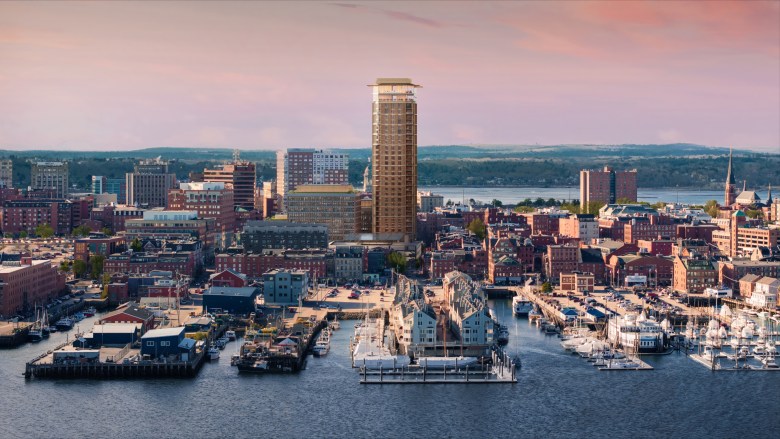
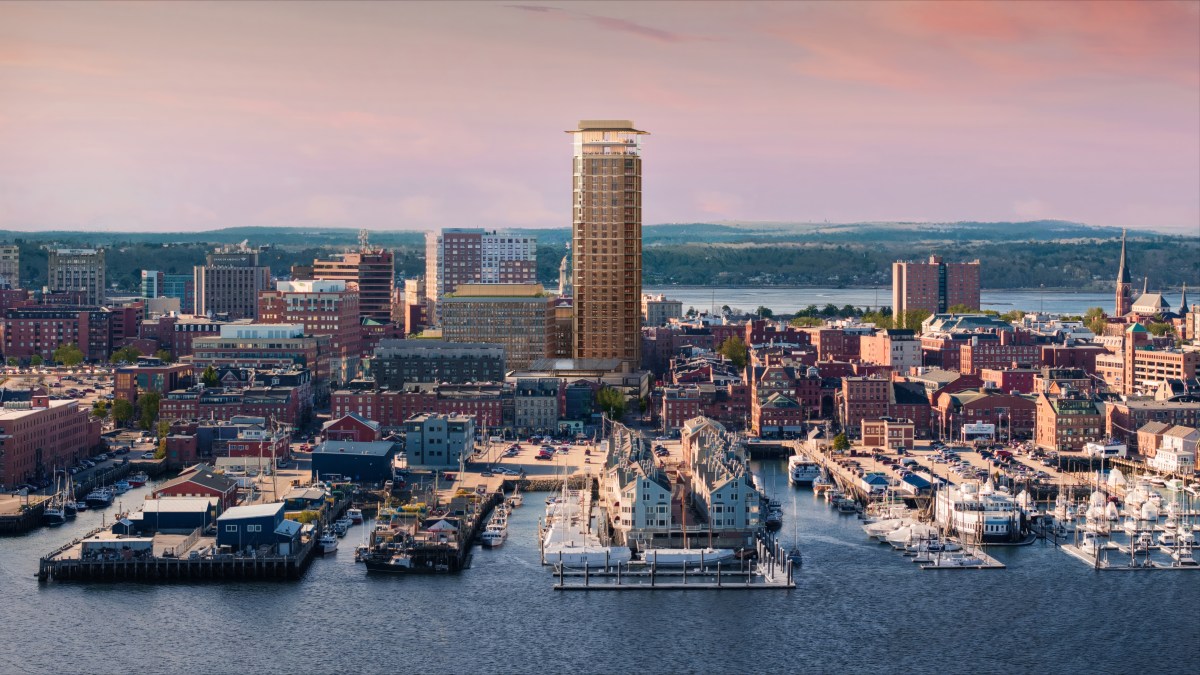
 At 380 feet, the Old Port Square tower on Union Street in Portland would be the tallest building in Maine. It is meant to resemble a lighthouse beacon. (Courtesy of Safdie Architects)
Portland’s skyline is changing.
First, the iconic B&M Baked Beans brick smokestack came down. Then the 190-foot Casco building went up. And soon, the city will add a sweeping new Roux Institute campus and an “architecturally significant” expansion of the Portland Museum of Art.
But perhaps no change will have as much visual impact as the 30-story, nearly 400-foot tower the planning board approved earlier this month.
The proposal has ruffled feathers, with many bemoaning what they say sticks out like a sore thumb (or middle finger) on the city’s idyllic skyline. They fear if more high-rises pop up across the city, Portland might slowly morph into a northern version of Boston.
So will this project usher in an era of skyscrapers for Maine’s largest city?
Experts say that’s unlikely.
“We’re not expecting a windfall of 30-story buildings,” said Kevin Kraft, the city’s director of planning and urban development.
Under new zoning laws, only a small section of downtown along Temple, Federal and Union streets allow buildings as tall as the tower. That means even if there was an appetite for more high-rises, there simply isn’t much undeveloped space.
Furthermore, much of Portland ‘s peninsula is covered in historic districts, and “contributing buildings” can’t be torn down, Kraft noted.
Chapter 14 Land Use Code – Revised 12-3-2025 (PDF)-Pages by julia
GROWING UP
Vertical development, experts say, is a sustainable way to squeeze more housing into a smaller footprint, something cities have been doing for decades. And Portland needs housing in spades.
Last year, city leaders updated its zoning laws with the goal of allowing growth while preserving character. The overhaul included an increased maximum height for buildings in some of the city’s major corridors, permitting buildings up to 380 feet in a section of downtown.
That part of the city has always allowed the tallest buildings, but until last year’s recode, the maximum height was 250 feet. And that height cap was in place for nearly 30 years before it was even remotely tested when Redfern Properties built the 190-foot Casco in 2023, currently the tallest building in Maine.
The new proposal from Portland developer East Brown Cow Management LLC, tentatively called Old Port Square tower, would be twice that tall. It would include more than 70 residential units, commercial space, an 88-room hotel and a restaurant at the top, and is just one piece of a development project that could fill an entire city block.
Whether any other developers follow suit with similar proposals could depend more on market conditions than Portland’s updating zoning.
“People aren’t going to build speculative high-rises,” Kraft said.
If the building ends up being successful, though, it could be an important “proof of concept” for other developers in the area, said Tim Love, assistant director of the Master in Real Estate Program at Harvard University.
Love is generally supportive of the project, which he said is in a great location.
“A lot of these proposals don’t happen because at the end of the day, the financing doesn’t work or the numbers that were plugged in for rents aren’t supported by the underwriting,” he said. “So I think it would be good for Portland if this project is a success,” because it could lead to additional residential development downtown.”
And more people living downtown is exactly what the city needs, he said.
“I hope this is a model for more residential mixed-use development at densities that can extend the kind of not 24/7 but 18/7 life of the city all the way to the museum,” he said.
If Portland is going to get an influx of high-rises, it won’t be for some time, said Jeff Levine, a former planner for the city of Portland who now divides his time consulting and teaching urban studies and planning at the Massachusetts Institute of Technology.
“I don’t think you get instant results in anything,” he said.
Real estate is complicated. Beyond just zoning changes, there are building regulations, financial restrictions and even simply individual personalities that impact whether a building will go up, Levine said.
FEAR OF CHANGE
Nancy Smith, CEO of GrowSmart Maine, a nonprofit that helps communities grow in sustainable ways, says the Old Port Square tower will certainly be symbolic for the city, but it’s not a “game-changer.”
Game-changers, she said, were the Franklin Arterial and the demolition of Union Station — projects that transformed the city (though arguably not for the better) and made a statement about what Portland wanted to be in the future.
But some feel like the tower could do that, too. It just might take time.
“We’re not (just) trying to capture the current moment, we want to anticipate the growth we could see in the next 15, 20, 30 years,” Kraft said. “We want to accommodate that growth (and) be more proactive than reactionary.”
Cities are constantly changing and evolving, he said. At one point, the Time and Temperature building on Congress Street seemed to dwarf those around it, including the Fidelity Trust building, which was once known as Maine’s “first skyscraper.” Now, they blend in.
Additionally, Smith said, the uses intended for the proposed tower area already commonplace downtown: a hotel, restaurant, apartments and shops.
Still, a big element of early opposition to the tall tower is fear of change, and that’s natural, she said.
“The challenge is moving beyond that deeply personal response to actually consider what you’re looking at,” she said. “This building has a lot of symbolic value. Portland is changing, but stopping the building isn’t going to stop that change.”