
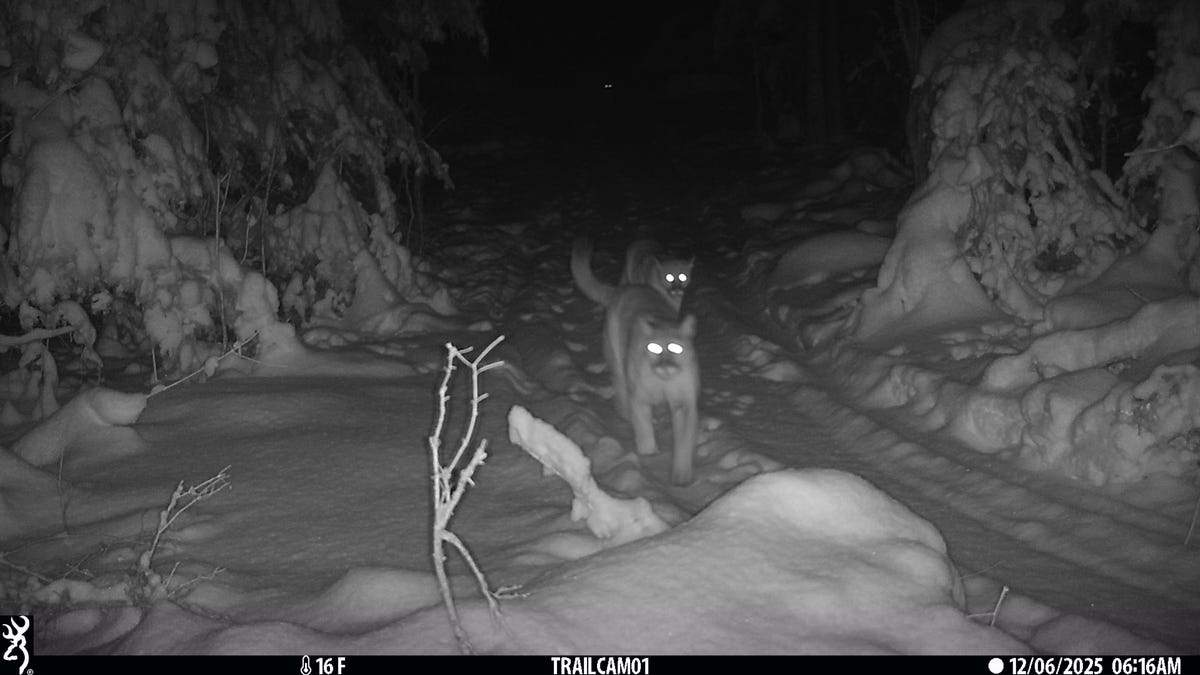
State wildlife experts say a rare pair of cougar cubs not seen in the Upper Peninsula since March appear to be alive and well, based on a recent trail camera photo.
The kittens were first seen March 6 after an anonymous resident found and photographed them on private land in Ontonagon County. They were an estimated 7-9 weeks old at the time and were the first cougar cubs to be seen in the Michigan wild in more than 100 years.
However, officials with the Michigan Department of Natural Resources were not overly optimistic about the kittens’ chance for survival since there was no sign of their mother. Cougar kittens generally stay with their mother for about two years before venturing out on their own, according to DNR.
But a Dec. 6 photo indicates the young cougars are not only still alive, they’re navigating the Michigan wild alongside their mom. Last week, a private landowner sent a photo of what appeared to be an adult cougar with two juveniles about a year old to DNR.
Brian Roell, the DNR’s large carnivore specialist, verified the site of the photo on Monday and DNR’s cougar team has confirmed its contents by enhancing the nighttime image. The young cougar bringing up the rear in the photo is difficult to see with the naked eye.
DNR said people regularly submit faked or unverifiable photos so the agency worked methodically to ensure the photos were legitimate.
Experts now believe the U.P. cubs have a good chance at surviving for a typical lifespan, which for cougars is about 8-12 years.
“The kittens’ chances of survival are actually pretty high because just like bears, cougars invest a lot of their energy into their young,” Roell said in a press release. “So these kittens will stay with their mom through this winter and possibly even into next winter. They already have a leg up, seeing as how they’ve been with her for a year now.”
DNR operates more than 1,300 trail cameras in the U.P. to survey wildlife, so Roell is surprised the cubs hadn’t been spotted either by the state or by private individuals since they were first seen in March.
“The interesting thing is, where were they for nine months?” Roell said. “That’s a mystery.”
Cougars were hunted out of existence in Michigan in the early 1900s. The U.P. kittens may be evidence of the first known cougar reproduction in the western Great Lakes states (Michigan, Wisconsin and Minnesota) in “modern times,” Roell said in March.
Cougars are native to Michigan, and there have been 132 verified sightings of adult cougars in the state since 2008, according to the DNR. Most are believed to be “transient,” having dispersed into Michigan from states further west. The DNR has been able to conduct DNA testing on three or four cougars found in the Michigan wild in recent years and they all were males. Officials do not know the sex of the U.P. cubs.
Cougars need vast territories because they are solitary ambush predators that rely on deer and other large prey, which leads to low population densities, according to DNR. They’re also considered endangered mammals in Michigan, so it’s illegal to hunt or harass them, including trying to locate their den, even on private property.
“Too much human pressure can also trigger the female cougar to abandon her cubs,” Roell said in the press release. “As with all wild animals, we’re asking the public to respect their habitat and allow them to live naturally in their home.”
mreinhart@detroitnews.com