
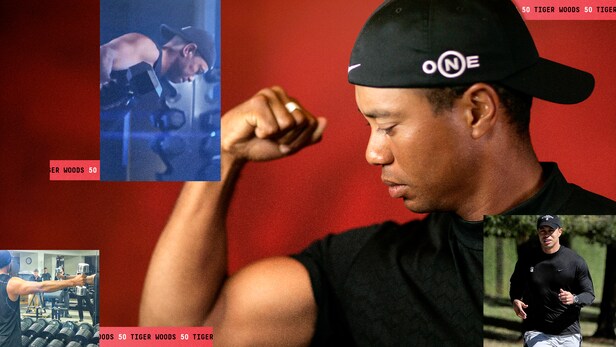
Editor’s Note: In honor of Tiger Woods’ 50th birthday on Dec. 30, 2025, Golf Digest is analyzing different parts of Woods’ game and career to explain what made the 15-time major champion so great. Other parts of this series will examine Woods’ putting, his mental game, equipment, course strategy, golf swing, and more.
Tiger Woods at his peak was not only the best golfer in the world but also the fittest, with one shot in particular underscoring his power.
Advertisement
Woods was already starting to separate himself from the field during the second round of the 2000 U.S. Open at Pebble Beach when an errant tee shot on the par-5 sixth left him in some deep rough down the right side. NBC’s Roger Maltbie thought Tiger might just wedge one back to the fairway, but was stunned when Woods somehow slashed a 7-iron up and over the cliff and onto the front of the green from 202 yards away.
RELATED: Our super-handy guide to Tiger Woods’ 82 PGA Tour titles
“You think strength isn’t an advantage?” Gary Koch said from the NBC booth, to which Maltbie replied with the most famous line of his broadcasting career. “It’s just not a fair fight.”
Tiger’s superior strength was a big reason why he pummeled Pebble and the rest of the field by a record 15 shots that week. Woods’ swing speed had always given him a distance advantage, but his work in the gym helped him hit shots like that.
Advertisement
“You need a lot of upper-body strength to swing through the thick stuff,” says Randy Myers, director of fitness at the Sea Island Golf Resort and trainer to 30-plus PGA Tour winners told Golf Digest. “You not only have to make sure you can get through the grass, but you also need strength to keep the club from twisting open or closed.”
And that’s why Woods would probably take issue with the fair part. After all, the eventual 15-time major champ didn’t get so strong by accident.
In a video discussing his fitness—part of Golf Digest’s “My Game” series—Woods recalls he and Vijay Singh being the only people in the gym during his early days on the PGA Tour.
“Pre-round workouts or lifts, post-round cool-down sessions, training six days a week, that was unheard of,” Woods says in the video. “Most of the guys would recover by going to the bar. That’s no longer the case.”
Advertisement
Fitness is certainly a more integral part of the average tour pro’s life these days, but none would find Tiger’s old workout schedule average. Not even a young, fit golfer like Justin Thomas, who learned on a 2018 flight to the Genesis Open just how hard Woods used to work to improve his strength, mobility and endurance.
“You know, JT was asking me this on the flight, ‘What did you used to do when you were about my age?’” Woods said ahead of that tournament. “Well, I used to get up in the morning, run four miles. Then I’d go to the gym, do my lifts. Then I’d hit balls for two to three hours, I’d go play, come back, work on my short game. I’d go run another four more miles, and then if anyone wanted to play basketball or tennis, I would go play basketball or tennis. That was a daily routine.”
Woods’ former instructor, Hank Haney, has confirmed that exhausting schedule, adding that Woods, who first started working out during his two years at Stanford, would often do a second weightlifting session at night. And Rory McIlroy, a golfer who was inspired in part by Woods to undergo his own physique transformation, has said that Tiger texted him from the gym at 4 a.m. So why did Woods train so hard?
“The more I trained, the better I felt,” said Woods, who only weighed 155 pounds when he turned pro in 1996, but added 25-plus pounds of muscle to his 6-foot-1 frame in his first few years on tour through heavy lifting and changing his diet. “The better I felt, the longer I was able to practice, the more it fed into the training. . . . It just fueled itself.”
Advertisement
Woods also believed that putting himself through such extreme training—including long runs wearing combat boots and even secretly taking part in Navy SEALS drills—would give him a mental edge.
“The more strength and endurance I got from all the training I did, I didn’t feel the tiredness come Sunday,” Woods added.
And it worked. At least, to a point.
McIlroy has speculated that it was Tiger’s “overtraining” that hurt his sleep. And even Woods has lamented some of his training choices during a career that has been curtailed by a host of surgeries on his back, knees and his achilles in 2025. When a then 44-year-old Woods was asked what advice he’d give his younger self in a GolfTV interview in 2020, he said the following:
Advertisement
“Not to run so much,” Woods answered. “Running over 30 miles a week for probably my first five or six years on the PGA Tour pretty much destroyed my body and my knees.”
Those following in his footsteps can learn from those missteps, mainly a lack of rest and recovery time. A generation of bigger, stronger, faster golfers are already on their way.
“The level of player that’s coming through, from high school and college and onto the various tours now because it’s so competitive, there’s gonna be fewer and fewer of them aren’t exhausting all avenues to improvement,” says Mike Carroll, a trainer who has worked with more than a dozen PGA and DP World Tour players. “And the fitness element is one of them for sure.”
It has a lot to do with Woods, who changed the perception of how a golfer should look from arriving at the course in a tank top fresh off a workout to posing shirtless as “Mac Daddy Santa.”
Advertisement
“Tiger looked so much different to the rest of them . . . he was clearly more jacked than the other golfers,” says Carroll, who added that Woods helped change the long-held misconception that bulking up could only limit a golfer’s flexibility and swing speed. ”The physicality that he had and how far he hit the ball and how hard he swung definitely changed the trend in golf and fitness in terms of these guys realizing being athletic and strong and powerful helps.”
It certainly helped at the 2000 U.S. Open. Just ask Roger Maltbie.
“I was gobsmacked by what I’d just seen,” Maltbie recalled 25 years later, “and the only thing that came to mind was to say, ‘it’s just not a fair fight,’ and it wasn’t.”