
Most baseball experts agree Paul Skenes of the Pittsburgh Pirates, the 2024 National League Rookie of the Year and 2025 NL Cy Young Award winner, is one of the best young pitchers in major league baseball today.
He won the Cy Young Award this year as his league’s top pitcher with an incredible 1.97 earned run average and 216 strikeouts, despite a pedestrian .500 record of 10 wins and 10 losses. After two years with the lowly Pirates, Skenes has a career record of 21-13 with 386 strikeouts and a 1.96 earned run average.
He would likely have more wins to date if he pitched for a contending team like the Dodgers, Phillies, Yankees or Blue Jays. But that is not where No. 1 draft picks typically find themselves, at least not until they have sufficient playing time to become free agents or are traded.
While I had hoped Christopher Sanchez of the Phillies would be named the Cy Young Award winner with his 13-5 record, 2.50 ERA, and 212 strikeouts, voters opted for Skenes.
That did not sit well with my neighbor, Michael, who stopped me while I was walking my dogs. He wanted to know how a pitcher with as many losses as wins could be considered the best. I explained that voters value ERA and other statistics higher than victories these days and also that Skenes pitched for a last place team.
“So did Steve Carlton in 1972,” he replied, “and he won 27 games.”
Game, set and match to Michael, who definitely has a legitimate point.
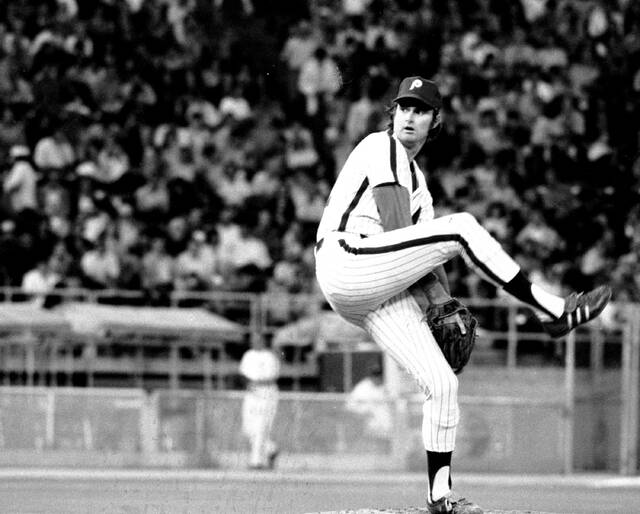
There has likely never been a more deserving Cy Young Award winner in major league baseball than Carlton, the tall left-hander who went 27-10 with a 1.97 ERA and 310 strikeouts that season. The Phillies managed only 59 wins with 97 losses, yet Carlton attained pitching’s triple crown by leading the league in all three major pitching categories while pitching for a cellar-dwelling team.
To say Carlton, who was known simply as Lefty, was dominant in 1972 is like saying Roger Maris showed a little power while hitting 61 homeruns in 1961.
The 1972 Phillies were terrible, they couldn’t hit, their fielding was suspect, and other than Carlton, they couldn’t pitch well either. Somehow, though, none of that mattered
when Lefty took the mound and he accounted for an amazing 45.7 percent of his team’s victories.
Carlton was magnificent, winning 15 consecutive games that season. The Phillies scored two or fewer runs in 11 of his starts and he won nine of them. His 12.5 WAR, a comprehensive and advanced statistic that measures a pitcher’s overall effectiveness, was the highest since Hall of Famer Walter Johnson in 1913.
Incredibly, Carlton pitched 30 complete games in 1972, faced 1,351 batters, and had eight shutouts. He gave up a miniscule 76 earned runs for the entire season and walked only 87 batters, eight of them intentionally.
Carlton pitched against his former St. Louis Cardinals teammate Bob Gibson on April 19, 1972, and not only pitched a shutout but also had two hits off the future Hall of Famer. Lefty beat the Cardinals again on September 7, a 2-1 victory that took only one hour and 49 minutes to complete and marked the 100th victory in his career.
Major League Baseball had little need for a pitch clock back when Carlton was on the mound. He wasted no time between pitches and was known for his incredible focus and tremendous mental and physical conditioning.
As shared on the Steve Carlton official website at stevecarlton.com, “The ten-time All-Star was able to log over 5,000 innings in his career and pitch into his 40s by being in excellent shape. He began his major league career in 1965 with the St. Louis Cardinals and retired in 1988 with the Minnesota Twins. In between, he pitched for the Chicago White Sox, San Francisco Giants, and Cleveland Indians, but was most well-known for his 15-year tenure with the Philadelphia Phillies.”
Rich Westcott, author of the book, “Philadelphia’s Top Fifty Baseball Players,” published by the University of Nebraska Press, quoted Phillies Hall of Fame outfielder and broadcaster Richie Ashburn as saying, “Lefty was a craftsman, an artist. He was a perfectionist. He painted a ballgame. Stroke, stroke, stroke, and when he got through it was a masterpiece. There was nothing accidental about it. His games were perfectly orchestrated.”
Ashburn was on the Phillies TV and radio broadcast team throughout Carlton’s long tenure in Philadelphia and had a tremendous view of Lefty’s pitching expertise.
Carlton mastered a devastating slider that broke late and gave hitters little time to react, as well as a powerful fastball and an effective sweeping curveball. He was the first pitcher to win four Cy Young Awards, and the last to pitch over 300 innings in a single season when he threw 304 for the 1980 World Series Champion Phillies.
A four-time 20-game winner with 27 wins in 1972, 20 in 1976, 23 in 1977, and 24 in 1980, Carlton won games two and six in the 1980 World Series as the Phillies defeated the Kansas City Royals for the team’s first World Series Championship.
To put that in perspective, there have been only five National League pitchers to win 20 games in a season in the last ten years. Jake Arrieta won 22 for the 2015 Chicago Cubs, Max Scherzer, 20 for the 2016 Washington Nationals, Julio Urias, 20 for the 2021 Los Angeles Dodgers, Kyle Wright, 20 for the 2022 Atlanta Braves, and Spencer Strider, 20 for the 2023 Braves.
Elected to the Baseball Hall of Fame in 1994, Carlton’s career marks of 329 wins, 55 shutouts, and 4,136 strikeouts will be difficult for anyone to match.
He turns 81-years-old on Monday. Happy birthday, Lefty.
David Jolley is a writer, author, public relations and marketing communications consultant, sports fan and historian. For more content, visit davidajolley.com.