
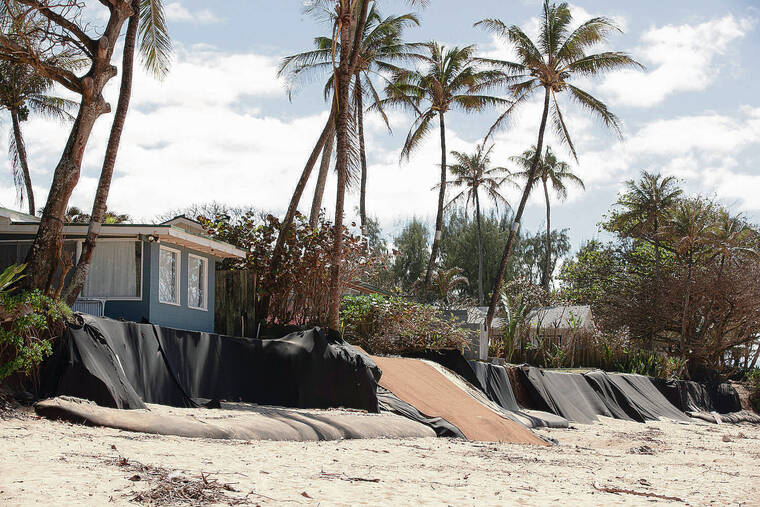
Hawaii is facing a rapidly escalating insurance crisis driven by climate change, aging housing, and a sharp retreat by private insurers, according to a new report released by the Hawaii Appleseed Center for Law &Economic Justice.
The analysis, “Who Pays for Climate Disasters? Case Studies on Regulatory
Responses to Climate Change-Related Disasters,” concluded that Hawaii’s property insurance market — particularly for condominiums — is becoming
increasingly unstable. Nonrenewals across the state jumped 216% between 2018 and 2023, while premiums for homeowners rose an
average of 12% from 2021–2024. Condominium associations saw even sharper increases, averaging 16%, with some buildings reporting fee hikes of more than $2,000 per unit.
Appleseed Executive Director Will White called the situation a “flashing red light.”
“The question is no longer if another major climate disaster will strike Hawaii, but when,” White said.
“Our report shows that
our current financial and regulatory systems are unprepared. If we do not act decisively, the cost of recovery will fall disproportionately on those least able to bear it — working families, kupuna and fixed-
income households.”
Drawing on national and local insurance data, the report warns that Hawaii is being hit from multiple
directions.
Over 60% of Hawaii’s housing was built before 1990 and now requires costly upgrades to meet modern safety standards, roughly 40% of homes statewide are in multifamily buildings, where insurance is a prerequisite for mortgages and sales; and hundreds of condos and single-family homes are
seeing nonrenewals due to age, deferred maintenance, or wildfire and hurricane exposure.
Don’t miss out on what’s happening!
Stay in touch with breaking news, as it happens, conveniently in your email inbox. It’s FREE!
The report notes that these conditions mirror
patterns seen in California, Florida and Louisiana — states where insurers withdrew after major disasters, leaving government “insurers of last resort” to absorb billions in risk.
In Hawaii, similar cracks already have appeared.
Private insurers retreated sharply after the 2023 Lahaina wildfires, and state-backed entities such as the Hawaii Hurricane Relief Fund and Hawaii Property Insurance Association required expanded authority under a 2025 law to protect condominium associations denied coverage by the private market.
Appleseed’s analysis warned that those public backstops would be quickly overwhelmed in a storm on the scale of Hurricane Iniki, which caused $1.6 billion in insured losses in 1992 — equivalent to $3.6 billion
today.
Because mortgages cannot be issued without adequate insurance, instability in the sector threatens to freeze parts of the state’s housing market. The report highlights how older, more affordable condos — already rare in Hawaii — are increasingly at risk of becoming unsellable.
In some buildings, escalating premiums and required reserve contributions have driven homeowners association fees up by 1,000%, according to Appleseed’s review of condominium records. For homeowners on fixed incomes, such spikes can force sales or foreclosure. For renters, costs are often passed down as higher rents.
Federal Reserve Chair
Jerome Powell recently warned that in the next
decade “there are going to be regions of the country where you can’t get a mortgage,” a prediction the report argued could become reality in Hawaii without significant intervention.
A central argument in
Appleseed’s report is that the rising cost of climate
disasters should not fall solely on homeowners
and taxpayers.
Author Arjuna Heim,
Appleseed’s director of research and housing policy, argued the state should be empowered to pursue subrogation — recovering disaster costs directly from major fossil fuel companies whose products have driven global warming.
“The solutions we propose are about fairness
and foresight,” Heim said. ““They are about ensuring that the financial burden of climate change is borne by those who profited from creating the crisis, and that we invest now in protecting our people and our homes. We start by making polluters pay and building a Hawai‘i that is resilient by design.”
Several states, including Vermont and New York, have adopted “Climate
Superfund” laws requiring major oil companies to pay billions into adaptation and disaster-recovery funds.
In 2019, the Honolulu City Council authorized the Department of Corporation Counsel to pursue legal action against major fossil fuel companies in an effort to
recover the costs of climate adaptation and extreme weather impacts. The county argues that the companies profited from selling oil in Hawaii while engaging in a decades-long campaign to downplay and conceal the climate risks associated with fossil fuel emissions.
The report laid out a
multistep strategy to prevent further deterioration of Hawaii’s insurance market, recommending holding major polluters financially accountable through state-enabled subrogation, strengthening land-use
policies by restricting new development in high-risk
areas and expanding natural coastal buffers, and improving building safety codes by more quickly adopting updated national standards.
The authors also called for ramping up efforts to retrofit the state’s aging housing stock with measures such as hurricane clips, roof reinforcements, wildfire-resistant materials and sprinkler upgrades, while expanding resilience incentives and education through grants, low-interest loans and community
outreach.
The report also points
to earlier Hawai‘i examples — including the post-Iniki Project Blue Sky program and resilience credits offered by the Hawai‘i Hurricane Relief Fund — that successfully encouraged homeowners to invest in risk-reduction measures. But Appleseed warns that today’s climate-driven disasters, from hurricanes to wildfires and floods, are unfolding faster than state systems can adapt. Without swift, statewide action, the report warned that Hawaii could face a future in which large numbers of properties become effectively uninsured, unsellable or accessible only to cash buyers.
Such fallout, the report argues, would extend far beyond the insurance market and fuel a broader housing crisis. With already exorbitant housing costs, Hawaii has little room for additional strain, and the loss of accessible insurance could undermine residents’ ability to buy, sell or even stay in their homes.