
AMHERST — The big cat population in Myanmar — Bengal tigers, Indochinese leopards and mainland clouded leopards — are declining at a rapid rate.
A study conducted between 2014 to 2018 reported that no more than 50 tigers are currently present in the country. Other studies reflect similarly low numbers for leopards there. Recent University of Massachusetts research is identifying where conservationists should focus their efforts, before it’s too late.
Recently published in the Journal for Nature Conservation, the UMass study explains that, while a variety of factors are contributing to the decline, such as poaching, deforestation, habitat fragmentation, and climate change, focusing conservation efforts on specific sites, beyond already protected land, might be crucial in preventing extinction.
Using motion-sensing cameras to document the big cats, researchers noticed that all three species can be found within Myanmar’s Chindwin River Basin, an area renowned for its biodiversity. At about 44,016 square miles, the basin is about four times the size of the Connecticut River watershed.
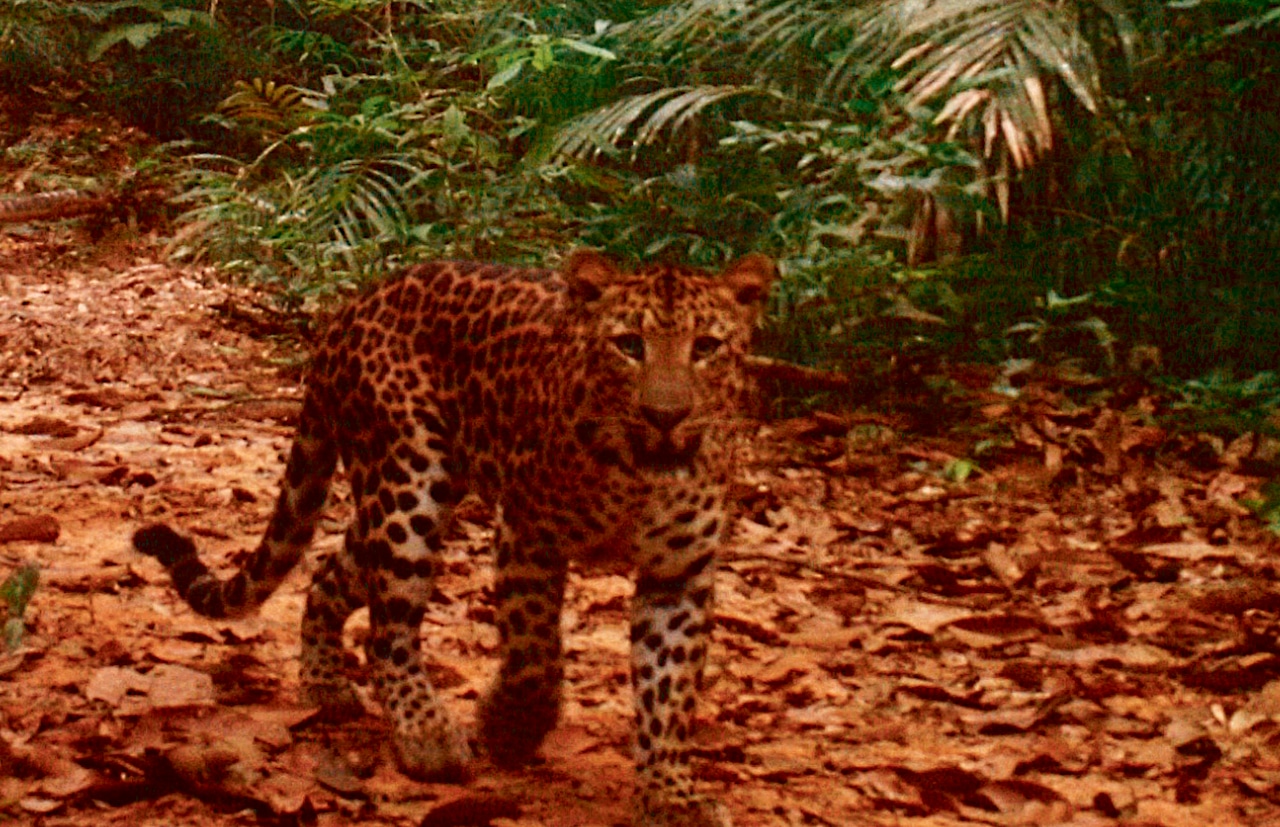 Timothy Randhir’s work is providing the first precise picture of where to target conservation efforts to save the big cats, such as the Indonesian leopard. (Wildlife Conservation Society photo)Wildlife Conservation Society
Timothy Randhir, director of Massachusetts Water Resources Research Center and a professor of environmental conservation at UMass, has spent his career studying watersheds and ecological landscapes. He explains that ecologists depend on current and past observational data of certain species to assess how dependent they are on their environment. He uses the data to predict their possible outcomes.
As a senior author on the study, Randhir looked at how the basin’s ecosystem was changing, being affected by climate change and other variables, and the effects those changes are having on Myanmar’s big cats.
“All of these factors have a synergy,” said Randhir. “It’s not like one dominating another. But right now, I think the biggest dominant (factor is) human disturbances through poaching, then landscape and climate.”
Randhir said that focusing only on protected land isn’t enough to save the big cats from extinction. He said when landscapes get disturbed, it results in habitat fragmentation, land broken up into chunks by human activity. He argued that it’s important for bio- and genetic diversity for wildlife to have “corridors” between these protected areas to freely move between.
“If there is a stress in one area, let’s say it’s a drought or a severe poaching in one area, the animals have to have a chance to move to another one. So corridors are the ways they allow them to actually adapt, or reduce some sort of risk,” said Randhir.
Bringing in data from on-the-ground experiences in Myanmar, former UMass graduate student Theint Thandar Bol wanted to see what the combined effect of human disturbances, ecological changes and climate change was having on the area.
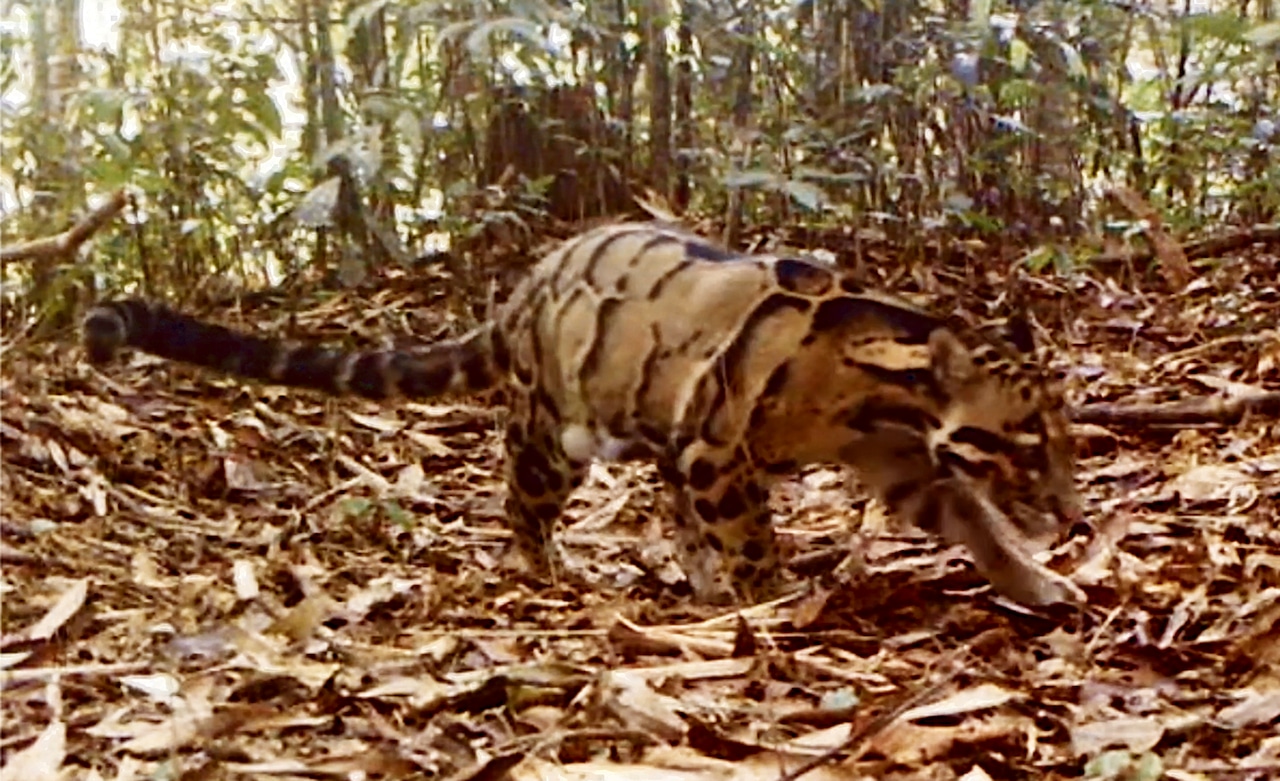 Mainland clouded leopards, like many of Myanmar’s big cats, are in danger of regional extinction. (Wildlife Conservation Society photo)Wildlife Conservation Society
From 2015 to 2018, Bol was a research assistant with the Wildlife Conservation Society in Myanmar. The study’s lead author, she also was concerned about fragmented landscapes and the need to expanding conservation efforts beyond just protected areas. During this time, her fieldwork involved going on foot into mining areas and setting up cameras at different sites within the forest.
Combining Randhir’s modeling and Bol’s fieldwork data, the team was able to pinpoint specific areas for conservationists to focus on. The researchers created detailed maps highlighting these locations and graphs that broke down the effects of each ecological variable.
Randhir and Bol hope that their research can encourage conservationists to not only keep working for protected lands, but also the surrounding habitats that are vital for preservation of local wildlife and Myanmar’s big cats.
“If the landscape keeps fragmenting,” said Bol, “the big cats cannot freely move around in that area, and then gradually this area will be very fragmented, like pieces, and it will be too late to think about it.”