
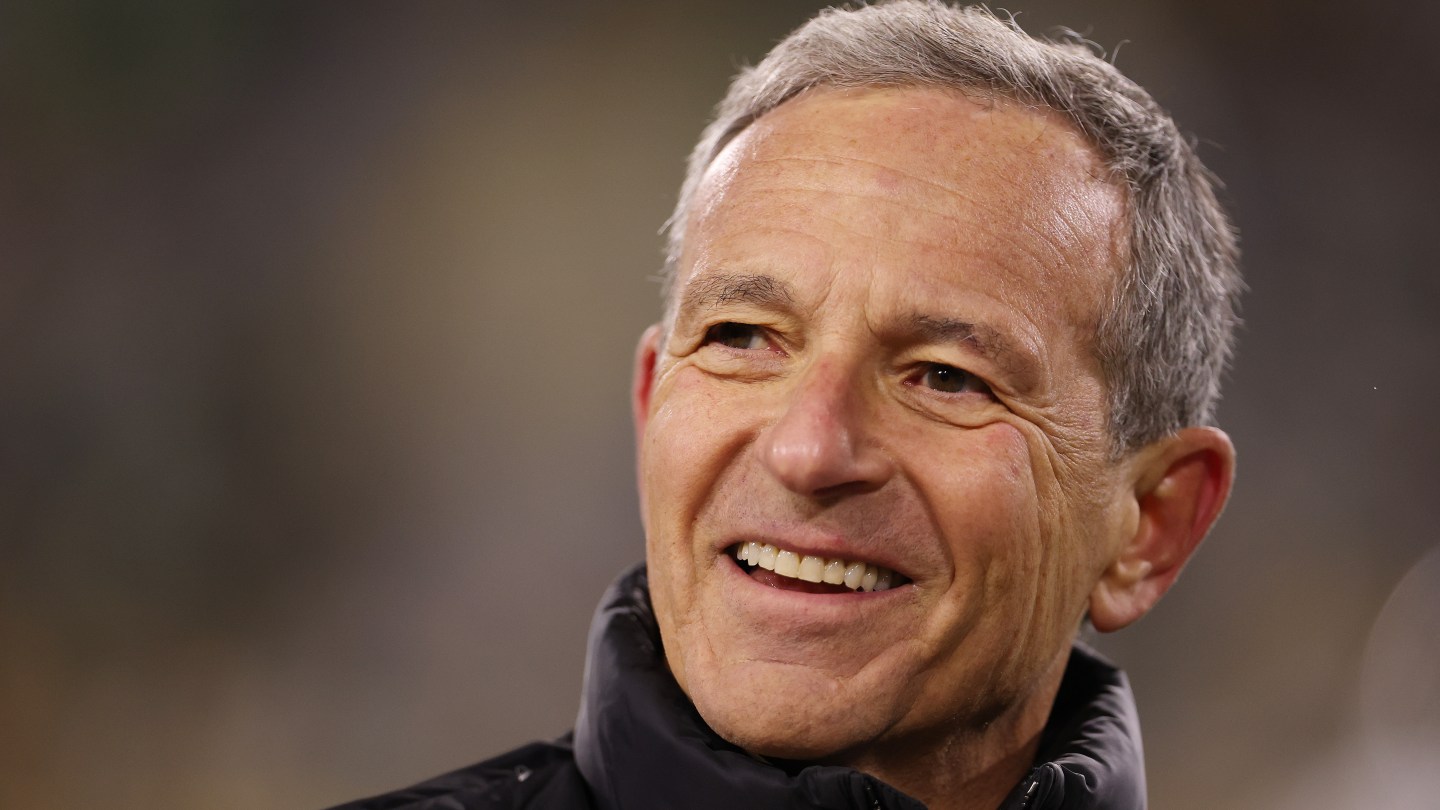
On December 11, Disney and OpenAI announced a landmark partnership: The entertainment giant, according to CEO Bob Iger, would pay $1 billion to the artificial intelligence power player for an equity stake, while also licensing its Sora tech for short-form video on Disney+ (some 200 animated and live faceless characters).
The three-year deal — exclusive in the first year — changes everything. Suddenly Darth Vader isn’t just a character that you watch — it’s one you create with. And with the deal, Disney+ is set to become not just a platform where you can dial up your favorite shows and movies, but one where you can drop yourself into the action or even rearrange it yourself, all with just a few prompts.
So, is this the future of entertainment or its end? Two of The Hollywood Reporter’s tech-minded senior editors, Julian Sancton and Steven Zeitchik, break it down.
Steven Zeitchik: It’s been about 10 days since Disney went all in on AI memes. On one hand, the world hasn’t ended, so that’s good. On the another hand, the apocalypse never happens overnight. How do you see what Iger and Disney have done?
Julian Sancton: Well, let’s look at the OpenAI side first. This is a big win for them. Sam Altman has been poking around Hollywood for a couple years now and he couldn’t get anyone to bite. And now he’s gotten the biggest bite of all. He somehow comes out ahead — again.
SZ: I mean, it is kind of crazy. All these first-look deals that Runway and other startups have gotten and OpenAI is out in the wilderness. And now they just come in and flex with this billion-dollar deal from the biggest beast in the jungle. Just when you counted them out, they remind us yet again how they dominate.
JS: It’s such a huge win for OpenAI. And the crazy part is they got Disney to pay them! Shouldn’t it go the other way? They’re the startup and Disney has all this huge IP. And OpenAI gets to piggyback on Disney to show off Sora.
SZ: I was thinking about that too. I guess it makes sense if you assume that the major place people will consume this stuff is on Disney, not OpenAI. Like, Disney will benefit as the retailer so they’re paying to license the tool.
JS: I guess. It just feels like it’s such good publicity for OpenAI. Now everyone else will want it too. Assuming anyone wants it in the first place, of course.
SZ: Which gets us to to the question of how popular this will be. Or, to put another way, what are Iger’s odds of success here?
JS: Disney should also be prepared for the possibility that after an initial period of excitement and experimentation the public will find this hugely lame, and that this blows up in their face. They’re also betting that OpenAI stays ahead of the AI pack, which even Sam Altman seems to doubt. Look, Iger is taking a risk. Everyone’s talking about AI all the time, but poll after poll shows that many people are anti-AI or at least skeptical of AI. I’m getting texts from people who have no stake in Hollywood saying “what’s going on with this?” It’s definitely a controversial move. But he sees himself as in a fight. And in a fight you throw the first punch. He’s seeing the writing on the wall.
SZ: That’s a good analysis but the AI is mad you mixed a metaphor — that’s normally its job! I guess the question is what that writing is. That many young people prefer short-form user-generated video to long-form professional content, sure. But Iger also is betting that users will want to interact with high-end content too — that the stuff we normally just watch we’ll now want to create in. That’s the part that hasn’t been proven and where he’s really putting a chip on the table, to add yet another metaphor.
JS: He’s basically co-opting two threats — TikTok and AI. It’s “if you can’t beat ’em join ’em” on the TikTok. And then also make money on the AI craze.
SZ: You know I don’t even think he sees AI as a threat. Sure, if he doesn’t control it, it’s a threat, which is why Disney is suing Midjourney. But generally it’s a solution.
JS: To?
SZ: To the problem that producing content takes a whole lot of time and money.
JS: So, to Hollywood.
SZ (laughs): Yes, to the problem of Hollywood. But I mean isn’t that what the Wall Street era of entertainment has been working toward — just getting all the risk out? Like that old joke about the embattled book-publishing company that hires a consultant who tells them the answer to their woes is just to stop publishing duds and only put out bestsellers. Hollywood has been trying to mathematically eliminate the possibility of misses for years, which is what all those reboots and sequels have been about.
JS: One look at the box office tells you how well that’s working.
SZ: Yeah I think that’s what Iger is seeing — it’s not. See, the problem with all that stuff, whether it original or reboots — and I mean what I’m about to say sarcastically — is that it takes so much investment, so much time. You pay a lot of people, and they may or may not produce anything you can use, and even if they do it takes you years before you can make money off it. With short-form AI content you don’t need to pay anyone — in fact they’re paying you! Through an add-on to your Disney+ subscription or however they’ll do it. And you get money every day instead of waiting years to put a movie out. That’s their thinking. What’s really happening here is the deprofessionalization of content.
JS: Which sounds frankly insane to anyone who has any appreciation for what Hollywood has done over the past 100 years. But I don’t doubt that is how at least some executives think. By the way, it’s funny to me that the prospect of AI slop now is making reboots and sequels actually seem like a good thing. When for years we’ve believed they were the devil.
SZ: Totally. Because as cynical as that reboot game is someone had to write a script, someone had to have a directorial vision, someone had to think about and perform the character, someone had to design a set. There is creativity even in the most jaded Hollywood rehash.
JS: But the fact that all of that was happening for just, like, a Beauty and the Beast live-action remake or whatever it might be is worth keeping in mind here. Disney was ALWAYS a big commercial enterprise. It’s not like they were these big risk-takers even before the AI revolution. They didn’t have some big bold independent vision that’s now being lost.
SZ: That’s a really good point. It’s not that Disney is moving from risk-taking to conservatism here. It’s that conservatism has been redefined, away from human-led reboots to automated content. Like sequels vs originals was a very 2010’s distinction. The 2020’s battle will be about human vs machine. Are you actually relying on people to come up with what you’re selling? Or are the machines crowding them out?
JS: And I think what’s scary is who it’s being sold to. Disney has got the ultimate hold on young viewers. So they’re really conditioning the next generation to think of this as what Hollywood does — just rehashes of existing IP. Like, “it was this institution that decades ago did cool stuff but now I mainly know it as the place that gives you access to that stuff.” It will become like the crazy old uncle who lets you play with his cool collection.
SZ: I think Iger’s argument would be that this generation is already thinking that way, judging by how much time they spend on TikTok and social platforms. “‘Entertainment’ is something I mainly click on or throw onto a digital platform.” They already want slop. He’s just making it easier for them to create it.
JS: But that’s the drug-dealer argument isn’t it? “I didn’t create the demand — they already want this stuff and if they didn’t get it from me they’d get it from someone else.” Same thing here. Iger is saying “I’m not contributing to the decline of professional content. Consumers already did that, and I just want to take advantage of it.”
SZ: And you think they have a responsibility to push back.
JS: I mean, “responsibility” is a strong word. But drug-dealer logic is not really what you want on your side of the argument.
SZ: I guess he could say he did spend decades getting them hooked on original content. Now he’s just moving where the new demand goes.
JS: Yes. And yet I still think he’ll walk and chew gum at the same time. He’ll do all this automated stuff while still running a traditional studio.
SZ: But why? So Guillermo del Toro doesn’t denounce him at awards shows? OK, maybe that’s an exaggeration. But from a business-case standpoint, what’s the upside now to a traditional studio?
JS: Why do people go for Oscars? Bob Iger is like so many other people in Hollywood. He wants the glamor, he wants to go to parties in the Hollywood Hills.
SZ: But Big Hollywood is so much less about that than it used to be — about celebrating the hot director or actor. it’s become about being an IP caretaker. And that was before AI. AI just accelerates the trend. Look, if Iger wanted to show he was serious about storytelling all he had to do was make a concurrent announcement here. He could have created a fund to go with his billion dollars to Sam Altman. “Here’s a $100 million pool of money for the most creative, tech-forward storytellers in the Disney universe — James Cameron, Pete Docter, whoever — to play with.” Those guys don’t even have to do anything. Just an announcement of “we believe in AI for this new user-generated world but we also believe in it for our original storytelling world.” But Iger didn’t do that. Original storytelling is nowhere near this.
JS: I don’t know, I still believe these are smart people who want to make a creative contribution. Maybe not in so noble a way. But they want to be taken seriously by the right people, hobnob with the right fashionable tasteful crowd, with rock stars.
SZ: But maybe how we define that is changing. Maybe we don’t have that crowd in the way we used too, the people we celebrate via Vanity Fair cover shoots. Maybe Hollywood executives just see that’s much less of a thing now and are going with it. Aren’t tech people the new rock stars?
JS: But rock stars are loved. Tech people are loathed.
SZ: So who are the new rock stars in Hollywood? Timothée Chalamet and … who else? I just don’t know that it lands that way anymore, this idea of “Brad Pitt vs Angelina Jolie and what is US Weekly saying.” AI and all this automated slop may be finishing off that world but it’s been dying for a while now. Sam Altman is the new rock star.
JS: He’s loathed.
SZ: Mark Zuckerberg. Jeff Bezos.
JS: Loathed. Also loathed.
SZ (laughs): Yet billions of people use their products. Maybe that’s where we’re headed, to hate-worship. And Hollywood needs us to worship worship.
JS: I’m optimistic we’ll always find a way to tell stories. People want stories — that’s a cliche for a reason. We’ll just find new ways to tell them.
SZ: I agree with that. But at a mega-corporate level? The new way may be people repurposing old stories.
JS: I guess I should have said new ways to tell stories that are not slop.’
SZ: Slopstories? Could that be a thing?
JS: Only if you want me to take a lot of antidepressants.
SZ: Speaking of depressing, we’re seeing a whole lot of big companies buy up libraries for AI training. That’s clearly Netflix’s game with Warner Bros.
JS: The idea that they’ll be able to control so many decades of Hollywood history — these high-quality archival images especially — is truly scary.
SZ: And we just had Sony pay almost half a billion dollars for a controlling stake in the Peanuts archive.
JS: Too bad they have no platform to put it on.
SZ: PlayStation?
JS: The go-to place for all Peanuts content.
SZ: Haha, I agree there. Entertainment companies don’t even know where they’ll retail the slop; they just believe they have to.
JS: I should say there is a part of me that thinks OK, we’ve had merchandise and Happy Meals for years. Disney has spent a lot more than a billion on those. And that can co-exist with Hollywood so why can’t this.
SZ: That’s true but that really only flowed in one direction — you made the original thing and it powered the derivative thing. Now it’s all commingled. I was talking to a studio executive the other day — a pretty powerful but also upstanding person — and he said ‘you know, I’m OK with people playing with what we do. But they should be playing around the cultural thing. Not with the thing itself.’ That feels like the big subversion — Silicon Valley would say innovation — with AI. Now the cultural product itself becomes malleable.
JS: It’s definitely a shift in that sense. Just another way the business isn’t top-down anymore.
SZ: Studios will I do think need some new stuff occasionally of course to keep the train running. Disney can’t just spend the next 20 years being like “We’re here to help you put Darth Vader at your Thanksgiving dinner.”
JS: “Have a lewd sex act with Goofy.”
SZ: I guess there will be guardrails.
JS: Until there is money.
SZ: Or desperation.
JS: I’m feeling a rush of emotions.
SZ: Like Pixar’s Inside Out!
JS: Maybe I can AI-insert myself in that movie.