
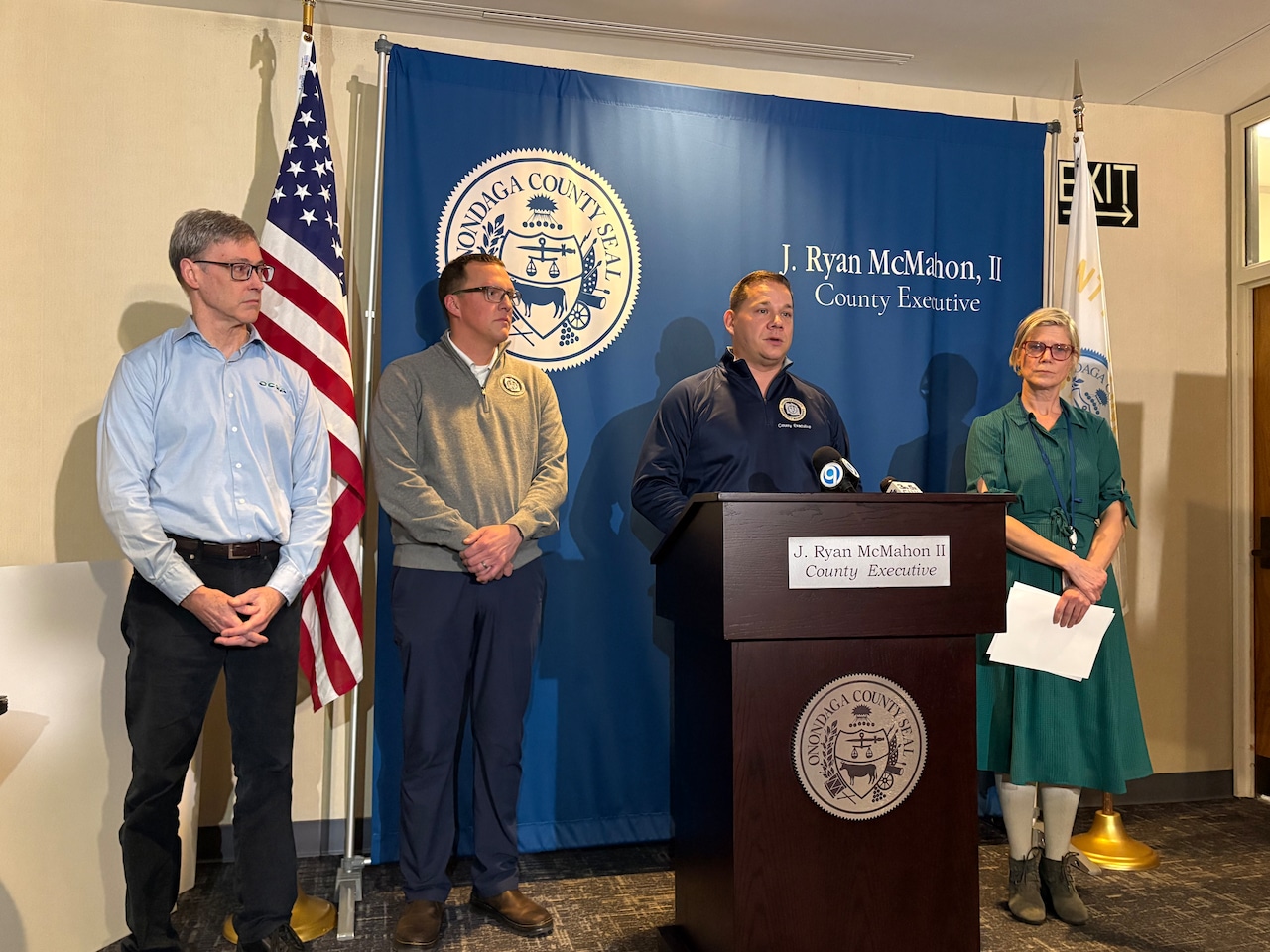
Syracuse, N.Y. — If residents and businesses in six Central New York towns affected by a water pipe rupture keep using water as normal, some could run out of drinking water in less than a week and some businesses could be temporarily shut down, Onondaga County Executive Ryan McMahon said today.
McMahon said the Onondaga County Water Authority can provide about five to six days of water at current usage in the six towns, but it could take two weeks to repair the pipe.
That means both businesses and people in the towns, including DeWitt, Manlius and Pompey, need to conserve now, he said.
“We have to do better or else we have serious challenges ahead,” McMahon said at a news conference late this afternoon. “To be crystal clear, if the amount of gallons per day do not change out of this service area, there will be days where there will likely not be water.”
Residents in the area have started receiving public safety alerts on their phones that read: “OCWA has announced a major water break that requires a mandatory water conservation order.”
OCWA Executive Director Jeff Brown said the water authority is monitoring usage after issuing an alert Saturday that a 42-inch diameter pipe burst and water reserves for the six towns quickly fell.
He said the next steps in conservation guidance and orders will be dictated by how people and businesses react in the coming days.
“The next several days will be very, very telling,” Brown said. “Are we getting the level of water conservation that we need to keep everybody in water, or are people continuing to operate as normal? That will be really the tipping point.”
OCWA has already told car washes to shut down for now. McMahon said the county could use its emergency powers to temporarily close water-using businesses such as restaurants and coffee shops.
McMahon said the county is preparing for the possibility that water could run out. The county has secured sufficient drinking water for the affected area, he said.
OCWA announced over the weekend that the transmission main ruptured in Cicero and would need to be replaced. That pipe carried about 5 million gallons a day of Lake Ontario water to the six towns.
Those towns are DeWitt, Manlius, Pompey, Sullivan, Lenox and Lincoln.
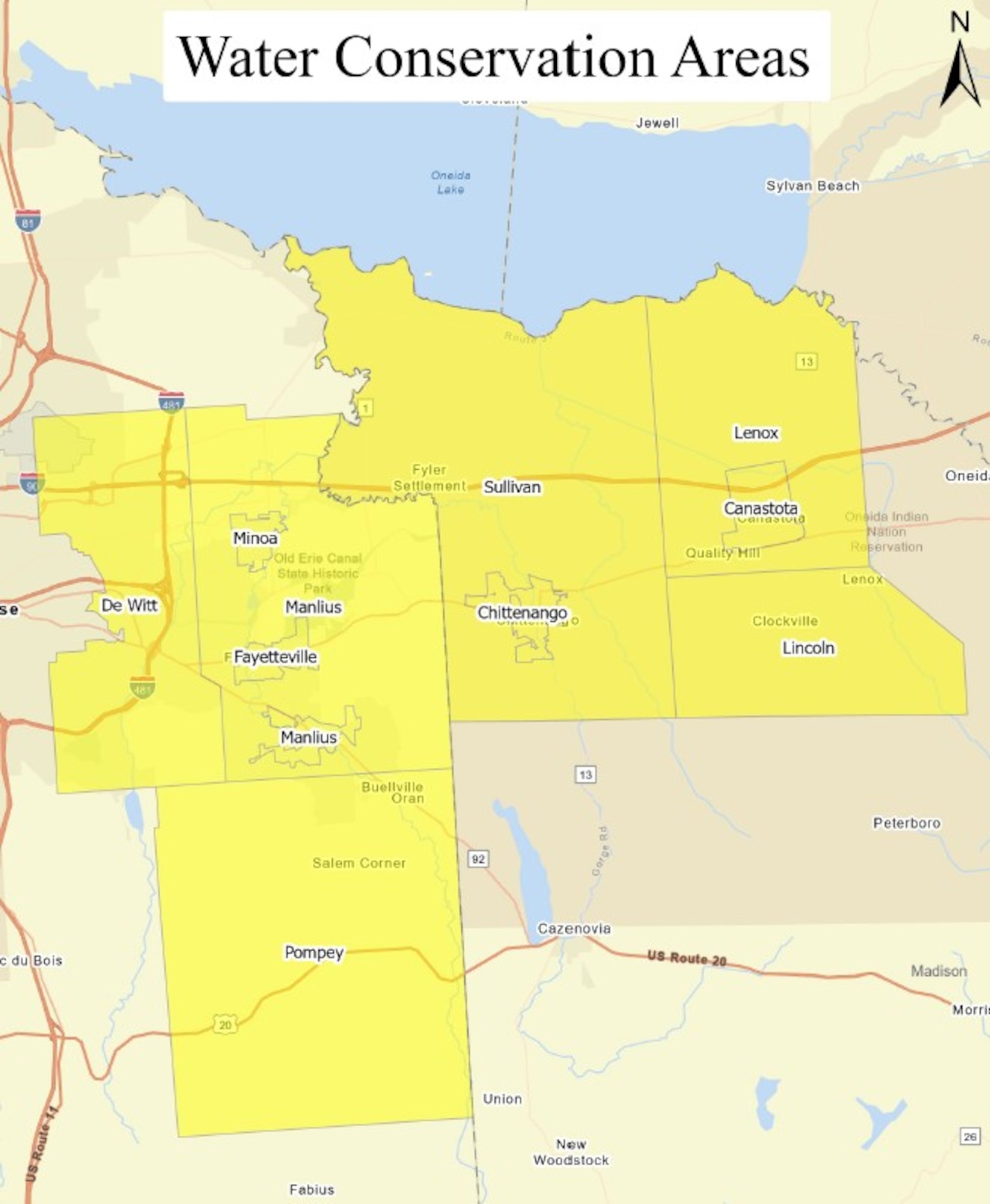 The Onondaga County Water Authority has issued mandatory conservatoin measures in six towns in Onondaga and Madison County communities to conserve water after a major break in a transmission main on Saturday.Central New York’s Water Authority
The agency is scrambling to repair the ruptured concrete pipe that delivers water to 27,000 customer accounts in those towns. The complicated repair could take two weeks, Brown said. It’s the first major problem for that section of pipe since it was built in the 1960s.
Right now, water is being supplied to those areas from a storage facility in Cicero that has about 10 million gallons of water, or about 20% of its normal capacity. OCWA is pumping extra water into those tanks from other sources, but not fast enough to keep up with the usual demand.
To keep refilling the tanks, OCWA is getting water from the cities of Oneida and Syracuse, and Otisco Lake. DeWitt is getting its water right now from Syracuse. Oneida is supplying Canastota.
All of those measures are delivering a combined 3.5 million to 4 million gallons a day to a pair of enclosed tanks in Cicero, Brown said.
That leaves a 1 million to 1.5 million gallon gap — and there’s where the conservation effort and water users come in.
All the water has been treated and is safe to drink, McMahon said, although some users may see some discoloration in their tap water.
Brown said OCWA has contacted the largest users in the area and they are taking steps to ease the burden on the agency.
“They’ve been very willing to work with us, going to other facilities outside of the impacted area, whether it’s getting water from the city of Syracuse, changing their operations or other options,” Brown said. “We are cautiously optimistic that those are going to allow us to continue on the path to keeping everybody in water.”
The biggest water user in the six towns is pharmaceutical firm Lotte Biologics, near East Syracuse. Lotte uses an average of 210,000 gallons per day, according to OCWA’s 2024 annual report.
In an emailed statement, Lotte said it has “implemented actions to reduce water consumption,” but gave no details.
A typical household uses 370 gallons on average per day, according to OCWA’s data.
Replacing the section of pipe that ruptured could take two weeks largely because the soil is soaked and unstable from recent rain and snow melt, Brown said. Contractors first have to erect a wall of steel sheeting to make it safe for workers.
But the big job, he said, is pumping out all of that groundwater and stabilizing the site before connecting the new section of pipe, which will be about 120 feet long.
“Believe it or not, the repair itself is relatively straightforward compared to the other things that we have to do to get the site ready,” Brown said.
New York state is sending several tankers that can carry potable water, according to a spokesperson for Gov. Kathy Hochul. One 6,700-gallon water tanker is being deployed to Onondaga County, and three 500-gallon tankers are being sent to Madison County.
How is this water shortage affecting you? Have you been notified to close your business or send workers home? How is your water pressure? Please share your experiences with us at citynews@syracuse.com.
OCWA has issued the following restrictions for the six towns:
Using laundry facilities in unaffected parts of the OCWA system (western and northern Onondaga County).Adjusting all water-using appliances to use the minimum amount of water.Running the dishwasher and washing machine at full load. If you wash dishes by hand, use a bucket or container with soapy water and only use the faucet for quick rinsing of scrubbed dishes.Taking 5-minute showers and shallower baths. Turn off the shower while soaping; turn off the faucet while brushing teeth, etc.Reducing the number of toilet flushes per day. Each flush uses about 5 to 7 gallons.Using sink and tub stoppers to avoid wasting water.Keeping a bottle of chilled drinking water in the refrigerator instead of running the water till it gets cold.Eliminating use of water for ornamental purposes, including but not limited to fountains, artificial waterfalls and reflecting pools.Reusing water when possible.Commercial Customers: Limiting non-essential work practices that involve water usage and utilizing additional water conservation measures such as having employees work from home.Car Washes: Pausing all wash services until mandatory conservation is lifted and full water service is restored.
Staff writer Mark Weiner contributed to this story.