
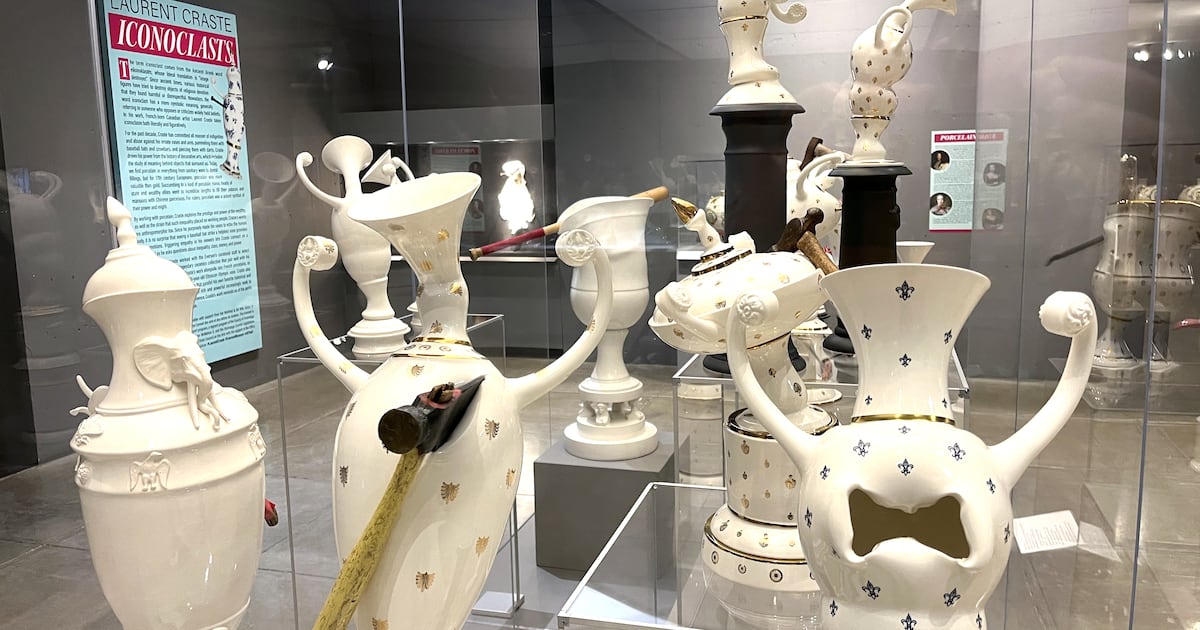
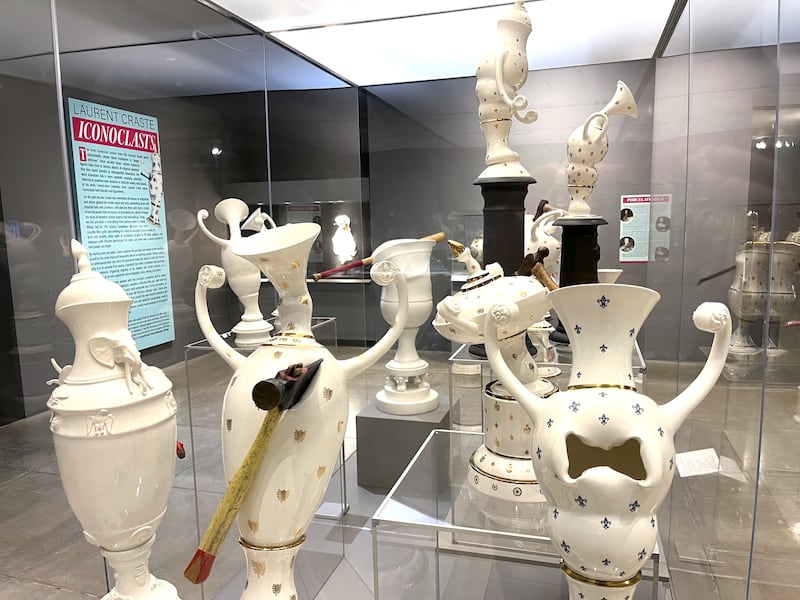
 Everson Museum of Art Sculptures by Montreal artist Laurent Craste. (Willson Cummer/Willson Cummer)
Laurent Craste’s “Iconoclasts” sculpture show at the Everson Museum of Art features porcelain vessels apparently attacked with axes, crowbars and bats.
The violence is faked, Craste told Syracuse.com. For example, he created his sculpture of a porcelain vessel pierced by an axe in several stages.
First he made the vessel on the wheel, in the traditional manner, and then — while still wet — he pressed the axe into the vessel. He removed the axe before firing the porcelain — as the wooden handle would have burned in the kiln.
Once the vessel was fired and cooled, Craste carefully re-inserted the axe.
The violence against the lovely porcelain vessels is shocking to some people, said Craste. He wants to stir people up, he’s also trying to use humor to make a serious point about luxury objects and their collectors. He said kids are particularly eager to touch the sculptures.
Craste trained as a potter, and used to make conventional, valuable porcelain vessels, but lost interest in it.
“I wasn’t very comfortable with the idea of producing a very beautiful and expensive object to be collected by very rich people who just wanted to show their wealth,” he said.
Porcelain has a long history as a luxury material: originally produced only in China, it was traded throughout the world, and was at times more valuable than gold, according to the museum. The European method of production was not discovered until the mid-19th-century, in Germany.
The unusual name for Craste’s show has two meanings: “Iconoclast” comes from a Greek word that translates as “image destroyer,” according to the Merriam-Webster dictionary. Icons — the religious images — have been controversial in history, and at times have been hunted down and destroyed.
Today, an iconoclast is someone who criticizes or opposes beliefs and practices that are widely accepted, according to Merriam-Webster.
For Craste the bats and crowbars are clearly tools used by “image destroyers” — or art destroyers.
But Craste might also be considered an iconoclast, as he upends the conventional presentation and use of porcelain. Fine china remains widely in use as dinnerware, but Craste has created a different use, one that is challenging and somewhat humorous: he talks about the violence of the images, but they also seem lighthearted: who has not thought about smashing valuable and fragile items just for fun or stress relief?
“When I hit a beautiful porcelain vase with a baseball bat, I provoke a visual shock,” says Craste. “There is a contrast between the beauty and luxury of the objects and the violence that is submitted to. I want to make people conscious of the fragility of our world.”
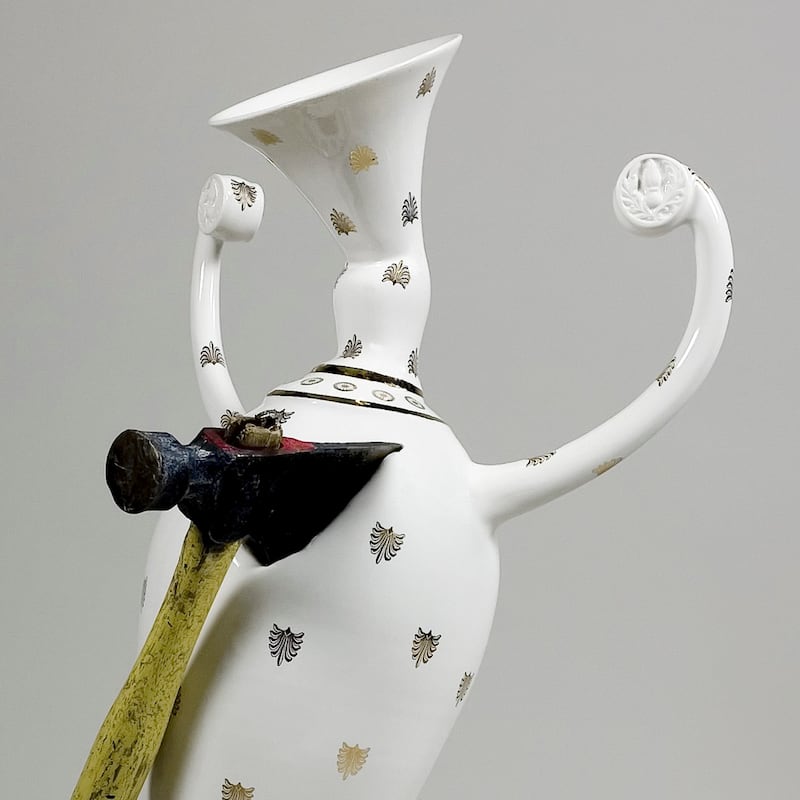 Sculpture Laurent Craste, Révolution VI (detail), 2021. Porcelain, glaze, bright gold and axe. (Courtesy of the Everson Museum of Art) (Willson Cummer/Willson Cummer)
Craste said he would prefer to be called subversive, rather than an iconoclast, because he does not actually destroy anything.
Craste said he’s aware there is some irony in his critique of luxury objects and his production — as a contemporary artist — of work that is fairly expensive. (His Montreal gallery, Chiguer Art Contemporain, lists Craste sculptures for sale at prices between $1,170 and $14,600 in U.S. dollars).
Craste said he prefers not to think about the financial side of his work, and leaves the selling to gallerists. He said his work has conceptual and subversive aspects which he believes are embraced by his collectors.
That was not the case when he made traditional porcelain objects, he said.
“What I am doing now is not decoration,” he said.
By destroying the porcelain vessels with everyday tools he has — surprisingly — created artwork that is more valuable and collectible than the porcelain vases. But it shouldn’t be about the money, he said.
“If someone collects me they know that they are not collecting a neutral artwork,” said Craste. “When you collect an artwork there has to be an emotional action, and not only a monetary action.”
Craste’s work is exhibited at the museum alongside other ceramics. He worked with Garth Johnson, the museum’s curator of ceramics, to pair his works with selections from the museum’s vast ceramics collection. Visitors will encounter Craste’s satirical creations alongside rare French porcelains and a 2,500-year-old Greek Olympic vase.
Many of Craste’s sculptures are crowded tightly together in glass cases — like wounded people packed into a jail. They appear like humans — with arms, faces and a body. Craste said he was pleased with the way the museum organized the cases.
Craste will visit the museum on Feb. 5 to talk about his work.
Where: Everson Museum of Art, 401 Harrison St., Syracuse
Hours: Wednesday 11 a.m. – 5 p.m. Thursday 11 a.m. – 8 p.m. Fri. 11 a.m. – 5 p.m. Saturday 10 a.m. – 5 p.m. Sunday 10 a.m. – 5 p.m. Closed Monday/Tuesday.
When: Through May 24, 2026
More info: everson.org or call (315) 474-6064
Willson Cummer is a landscape photographer who lives in Fayetteville. Contact him at willson@willsoncummer.com