
Despite the winter chill, when many turn a blind eye to such matters, Jessie Schott Haynes and her husband, Beau Haynes, called in an exterior design professional to make the many outdoor spaces in their new Uptown home photo-worthy with the installation of an abundance of flourishing tropical plants.
Celebrated architect Nathaniel “Buster” C. Curtis Jr. designed the University area house in 1963 for himself, his wife, Frances, and their seven children, creating an architectural masterpiece featuring steel-framed pavilions, glass walls, and private courtyards under a canopy of ancient oaks.

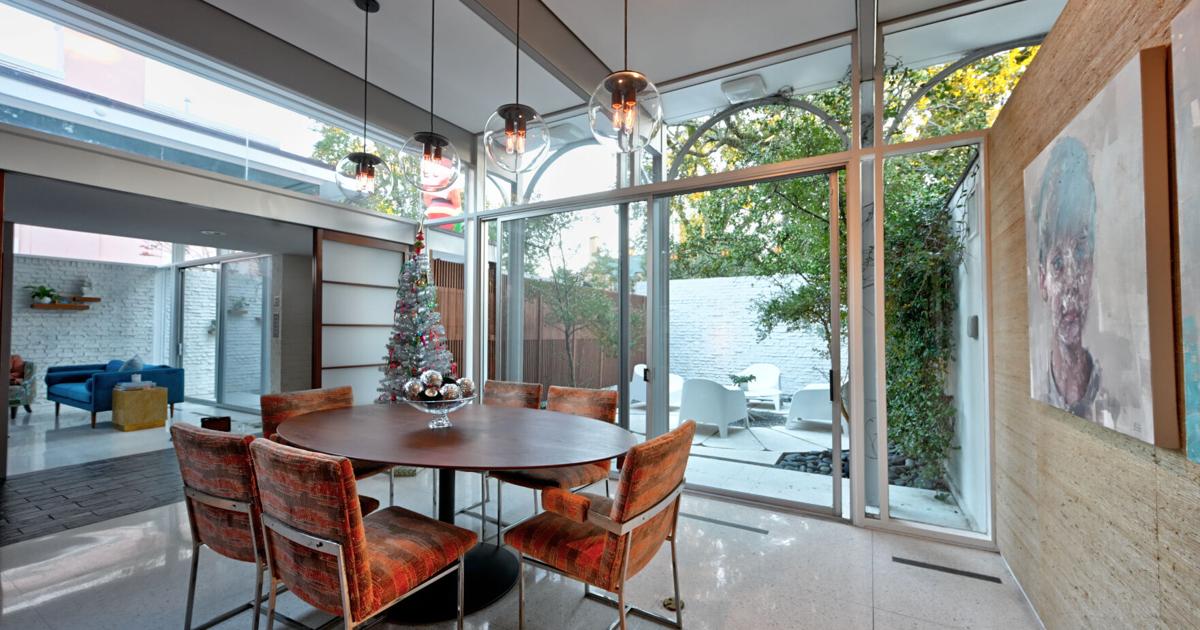
Addy Petyon came to regard this space as The Petal Garden due to the flower-shaped stone centerpiece embedded in the foundation. It is located off the dining room. Peyton left the space mostly untouched except for trimming the existing Holly trees, enhancing the lighting, and installing/repairing irrigation. The petal courtyard is where the Hayneses enjoy their morning coffee before their busy days.
PHOTO BY Jeff Strout
Its four interior courtyards open to the sky within the structure’s living spaces and are fully visible through glass walls, heavily blurring the lines between inside and out while serving as crucial extensions of the under-roof living, dining, and family rooms the Curtises would have needed for their large family.
“The home was Curtis’s modernist look at traditional New Orleans vernacular architecture, including French Quarter courtyards,” said Jessie Haynes.
She and her husband bought the house in May.
Homeowner Jessie Haynes in the living room of her Mid Mod home.
PHOTO BY Jeff Strout
Through changes in ownership, the home’s original structure, the abundance of built-in walnut cabinetry and storage features, terrazzo floors, and the home’s definitive courtyards have remained intact, all of which the Haynes family continues to honor.
Jessie Haynes worked with interior designer Betsey Hazard of House of Hazard Interiors to personalize the interior spaces of the 3,800-square-foot home she and her husband share with their two sons, ages 9 and 14.
As enthusiasts of midcentury modern architecture, the Hayneses’ prior home was designed and built in the same era as their new one, so many of their existing furnishings could be repurposed into the new spaces.
“Our last house was a little midcentury number,” Jessie Hayes said. “This is the Mack Daddy of the genre.”
Jessie Hayes, an attorney, serves as managing director of The Hellis Foundation. The Louisiana-based private foundation fosters and provides access to the arts in the city.
Beau Haynes is a health care attorney with the local firm Phelps Dunbar.
This is the courtyard Addy Peyton dubbed the Zen Garden “because it feels very pensive and museum-like.”
PHOTO BY Jeff Strout
Expansive blank-sheet walls accommodate the family’s enviable collection of works by Southern artists including Ida Kohlmeyer, Maude Schuyler Clay, Lin Emery (a former neighbor), Kaori Maeyama, Kimberly Ha, Casey Joyner, Ashleigh Coleman, Sophie Lvoff, Carmen Garza, L. Kasimu Harris, and Keith Sonnier.
To tackle the courtyards, the rear yard, and the pool area, Jessie Haynes called on Addy Peyton of Addy Peyton Plant Styling. Peyton and Morgan Williams, Peyton’s holiday décor specialist, worked together to design and install holiday decorations in anticipation of a holiday party.
The family’s dining table is by Room and Board and the chairs are by Milo Baughman. The pendant lighting globes above the table are original to the home, as is the built-in glass and walnut china cabinet. The portraits of Jessie and Beau Haynes’ young sons are by Aron Belka.
PHOTO BY Jeff Strout
“We wanted to keep it very simple and elegant,” Williams said. “She (Haynes) had recently taken a trip to Germany and had seen a wreath adorned with little bows, which inspired her.
“We came up with the idea of hanging these wreaths from the (home’s) beautiful arches with fishing line, giving them the appearance of being suspended in midair. They match the ones outside.”
“We wanted the gardens to feel like a New Orleans take on midcentury modern, avoiding anything feeling ‘too California’ or ‘too Miami,’” said Peyton, a container gardening specialist. “We ultimately decided to use structural, tropical plantings that pay homage to the home’s style while adding a New Orleans flavor.”
Under Peyton’s direction, irrigation systems were installed, specialty exterior lighting was introduced or updated, and the fountains were flushed.
Jessie Haynes and Addy Peyton’s collaboration led them to call the home’s central courtyard The Groovy Garden. “Groovy because of the fabulous, colorful, mid-century furnishings Jessie found for this courtyard, which her bedroom overlooks. We clustered structural plantings in similar pots, balanced with a singular, bold bird of paradise.
PHOTO BY Jeff Strout
“The house came with a myriad of extraordinary vessels that fit the space,” Peyton said. “Most excitingly, the ginormous, square built-in planters near the pool were extremely intriguing to me. “
Peyton filled the planters with mature Chinese fan palms.
“My favorite element of a courtyard we started calling ‘The Zen Garden’ is the Mexican grass tree I planted in the raised bed that is within a fountain, a fascinating design feature,” Peyton said. “I collaborated with my lighting specialist to illuminate the tree at night in a way that creates the most incredible shadows on the entirety of the wall behind it. “
Among the home’s many defining features is a masonry wall that begins in one exterior courtyard, passes into the house to form an exterior wall of the home’s lengthy living/music room, then continues through another courtyard. Both inside and out, built-in shelves of varying sizes and elevations emerge from the wall.
“To emphasize this feature, I styled the indoor and outdoor shelves with a selection of cohesive white pots with similar plantings inside and outside,” Peyton said.
Jessie Haynes worked with interior designer Betsey Hazard of House of Hazard Interiors to personalize the interior spaces of the 3,800-square-foot home. The walnut cabinetry is original to the house. The sofas are from West Elm. The cocktail table was designed and installed by Lee Ledbetter.
PHOTO BY Jeff Strout
“Addy worked so hard to rehab and enliven our outdoor living spaces,” Jessie Haynes said. “She did an incredible job of ensuring that his (Curtis’) vision remained intact with the tropical, lush containers. She nailed it!”
Peyton and Jessie Haynes’ collaboration led them to moniker the home’s central courtyard “The Groovy Garden.”
“Groovy because of the fabulous, colorful, midcentury furnishings Jessie found for this courtyard, which her bedroom overlooks. We did a cluster of structural plantings in similar pots, balanced with a singular, bold bird of paradise. I decided on Rhaphis palms in the matching vessels closest to the house, enhancing the indoor-outdoor feel.”
“It’s just really, really groovy,” said Jessie Haynes. “Especially at night. I couldn’t love it more.”
An architecturally important history
The home of Jessie Schott Haynes and her husband, Beau Haynes, has an impressive architectural pedigree.
Architect Nathaniel “Buster” C. Curtis Jr. designed the house in 1963 for his own family, with steel-framed pavilions, glass walls, and private courtyards.
The four interior courtyards are fully visible through glass walls, creating a visual link between the indoors and the outdoors
(Buster Curtis’s architectural firm, Curtis and Davis Architects and Engineers, most famously also designed the Superdome.)
In 2010, the home was designated a New Orleans landmark. In 2014, it became the city’s first modern house to be listed on the National Register of Historic Places. The home was featured in the March 12, 1965, issue of Life magazine.
Lee Ledbetter, another distinguished New Orleans architect, and Doug Meffert purchased the house from the Curtis family and restored it in 2013.
Under their ownership, the seven bedrooms were combined to create four more spacious ones and a thick glass-topped cocktail table was installed. Designed by Ledbetter on a minimalist iron base, it is now a permanent structure due to its immense weight.
Under Ledbetter’s ownership, the home was featured in the March 8, 2016, issue of Architectural Digest magazine.