
I’ve been trying to figure out something lately: Why is college football the only sport where people spend the entire postseason complaining about the postseason?
And then my colleague Joe Rexrode wrote a brilliant column and hit the nail on the head: “We used to argue, now we complain.” We finally got what we wanted during all those years of arguing over split national champions and undefeated teams getting left out, so apparently we needed something else to be angry about.
And by “something,” I mean “everything.”
Why has there been such resistance to the same playoff system used in every other college sport where all conference champions earn a bid and the committee chooses at-large teams and seeds the field? What would be so terrible about a 24-team field with the top eight receiving byes? This would avoid litigation by giving every school, no matter conference affiliation, an objective path to the Playoff and after the first week we would have a strong field of teams who had earned their spot. — D.D.
Congratulations on being the one reader who, in the wake of the Tulane and JMU blowouts, proposes we add MORE G5 teams.
We can agree that’s never going to happen, but your question gets at the fundamental tension that’s truly unique to major college football. It’s our fixation with making sure only the best teams compete for the national championship.
In nearly every NCAA-operated postseason, it’s implicitly understood that the goal is to put on a truly national tournament where every school starts the season with a defined path to the championship. March Madness is a prime example, and so is every lower level of football. Yet, the College Football Playoff is effectively run by the power conferences, not the NCAA, and they have no incentive to be magnanimous.
On top of that, even those conferences aren’t aligned on what access should look like. Going back to the negotiation of the four-team CFP format in the early 2010s, the group was split between those (mainly Big Ten commissioner Jim Delany) who felt that the field should be exclusively reserved for conference champions and others (mainly SEC commissioner Mike Slive) who insisted it be simply the four “best” teams. The compromise was a selection committee that could pick whoever it wanted, but give an advantage to conference champions. (Which rarely happened.)
Flash forward a decade, when we assumed the next step would be eight teams. The majority of the public assumed the field would consist of the Power 5 champions, the top G5 champion and two at-large bids. However, the SEC was never going to agree to a format with fewer open spots than the previous one. Twelve was the compromise to reward conference champs while also increasing the number of at-large berths.
However, all of that was agreed to right before realignment mania wiped one power conference off the map and supersized the others.
The fundamental takeaway from 2025 should not be, “Why are we still including G5 teams?” but rather, “Why are we still prioritizing conference championships when the standings are almost completely arbitrary?” I’m not just referring to the ACC, whose champion, Duke, was arguably its fifth- or sixth-best team. It’s possible Texas A&M was only the fifth- or sixth-best team in the SEC, but it finished tied for first, and No. 7 in the country, because it drew a comically light conference schedule.
I’ve seen many comments to the effect of: “They should just pick the top 12 teams.” I would love that. So would SEC commissioner Greg Sankey. Meanwhile, Big Ten commissioner Tony Petitti is proposing the exact opposite: a 24-team field where more than two-thirds of the entrants are auto qualifiers. The ACC and Big 12 are understandably open to that because they’d be guaranteed four berths even if those teams aren’t ranked anywhere near the Top 25.
What’s more important to you? Making sure only the “best” teams, as decided subjectively, compete for the national championship? Or, ensuring there are at least some objective entry points and all conferences are represented?
The G5 will never measure up. Why doesn’t the P4 separate from the FBS now and be done with it? — G M M.
There should be a Group of 6 Natty and a P4 Natty. More even matchups and more football. Seems like a win/win. — Jason H.
This whole episode has practically redefined the term “prisoner of the moment.” Did everyone have the “Severance” procedure done, and now their 2025 innie has no recollection of their outie’s life before it?
This was undeniably not an ideal year for two G5 teams, as no team in those conferences truly distinguished itself. Just last year, however, Boise State was a legit top-10 team. Two years before that, the same Tulane program that got shellacked at Ole Miss last weekend beat Caleb Williams-led USC in a New Year’s Six bowl. And the year before that, Cincinnati made the four-team Playoff. Except apparently, no G5/G6 team is ever going to do any of that again.
So, let’s play out these suggestions. The P4 conferences say: Let’s end the charade. We’re playing a different sport than those guys. So they either deem half the teams ineligible for the CFP, as Jason suggests, or, as G M M. suggests, they finally lift football out from under the NCAA umbrella and form an entirely new entity.
Well, the “P4” is really just the Big Ten and SEC now when it comes to CFP decision-making. What makes you think they would stop there? Ten Big Ten or SEC teams finished higher than ACC champion Clemson in 2024, and 2025 ACC champion Duke was unranked. If the goal is to get the 12 best teams, why do they need to keep the ACC around? And the Big 12 schools drag down their TV ratings. Might as well get rid of them, too. Replace Oregon-Texas Tech with Oregon-Texas and cash those checks.
It seems we have a choice. We can sit through a couple of bummer blowouts in December, or we can turn the sport into a gated community to protect the top 2 percent.
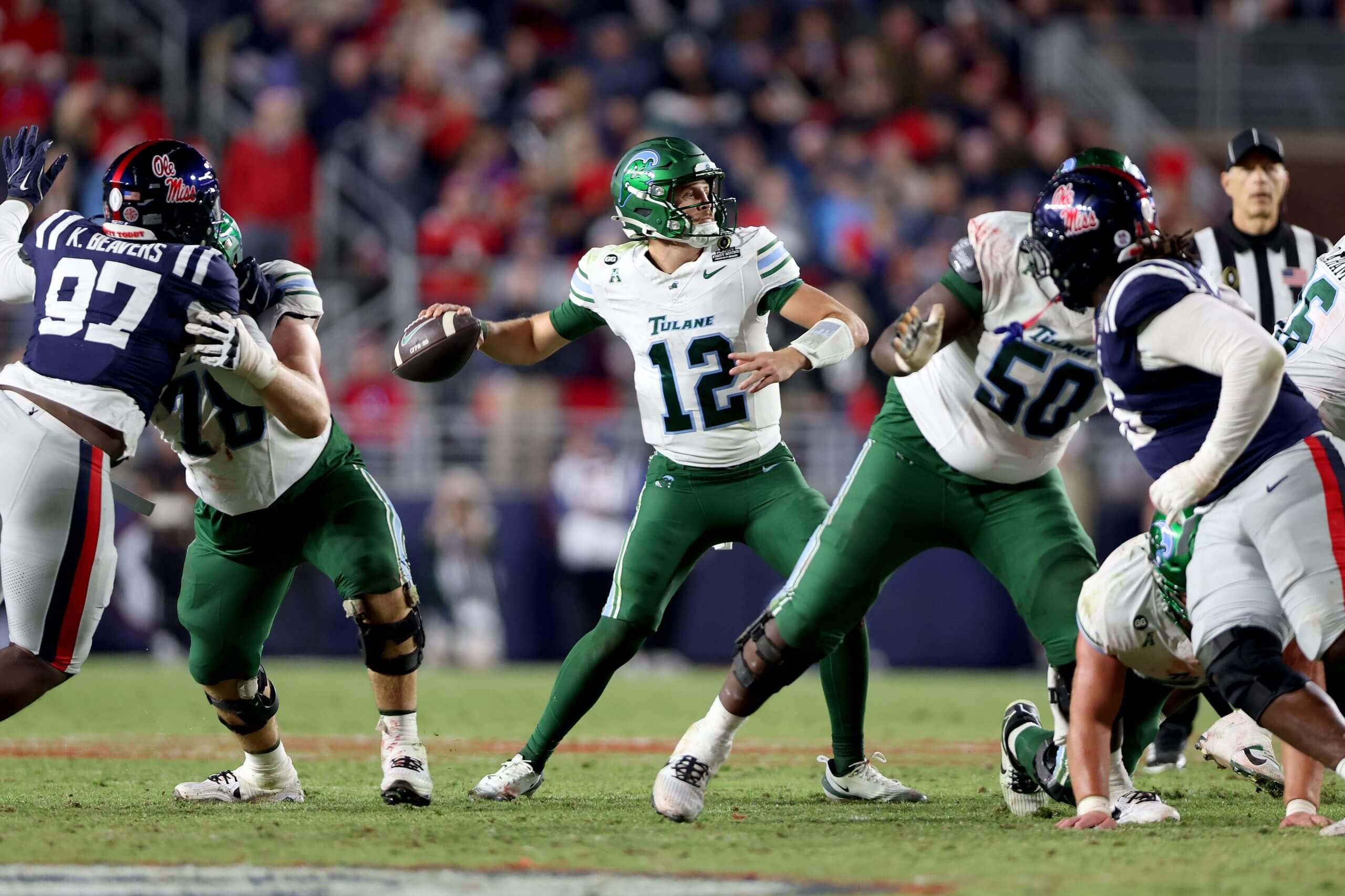
Tulane was dominated by Ole Miss in this year’s Playoff, but three years ago, it beat USC in the Cotton Bowl. (Wes Hale / Getty Images)
Hi, Stew. At what point does Jim Harbaugh start taking some heat for the mess at Michigan? Sherrone Moore is the third coach or staffer in a short period that was behaving in an inappropriate manner and fired. Harbaugh hired all these guys. The Moore years feel like an extension of him, but he doesn’t seem to be getting any of the blame for the mess he left. — Steph
Before answering, let’s acknowledge that as much as we all love to dunk on Connor Stalions, he, unlike Matt Weiss and Moore, was never accused of a real-life crime. Just an NCAA crime that now looks trite compared to being accused of stealing women’s college athletes’ private videos and photos (Weiss) or stalking and breaking and entering (Moore). Still, I get that it fits a larger pattern.
Harbaugh’s Michigan legacy already felt pretty icky to anyone who doesn’t wear maize and blue. Yet, on Monday, interim coach Biff Poggi — who was previously on Harbaugh’s staff for the 2021 and ’22 Big Ten title seasons — became the first in his inner circle to say it out loud. “It has been five years of, let’s just call it what it is, a malfunctioning organization where there’s something every year,” Poggi said.
That five-year timeframe — as opposed to just Moore’s two seasons in charge — was quite the reality check. No more glossing over “hamburger gate” and sign-stealing and deleted texts — not to mention a co-offensive coordinator getting indicted by the feds — just because Harbaugh delivered a national championship. The more you peel back the curtain, the more it appears Michigan football was a cesspool that won despite itself.
It would be unreasonable to suggest Harbaugh should have known when he hired Weiss from the Baltimore Ravens in 2021 that he allegedly was already hacking into women’s accounts, or that Moore, whom Harbaugh hired as tight ends coach in 2018, would engage in an illicit relationship five years later. I’ll even give him the benefit of the doubt that few coaches would have taken much time to vet a low-level staffer like Stalions.
However, the fact that Harbaugh himself brazenly flouted rules and enjoyed such blanket enabling from his bosses probably did not encourage a model culture. “If I am named the (permanent) coach … there will be massive self-examination of what happens in the building, and you can expect a lot of changes,” said Poggi.
I’ll give Harbaugh credit for this: For all the alleged dysfunction among his staff, you rarely hear a peep about anything untoward by his players. If anything, those Big Ten title teams were peppered with acclaimed leaders such as Blake Corum, Aidan Hutchinson and Mike Sainristil. Those guys deserve even more credit today than they did then for thriving at Michigan.
Will the NCAA ever put any rules on the transfer portal so we do not see a player going to a different school every year? Or are they scared to get sued for it all? — Jeff H.
C’mon man, try to keep up. They already got sued. They already lost (a preliminary injunction ruling). That’s how we got here.
The good news is that schools have come up with a solution: Placing punitive buyout clauses in players’ NIL contracts if they transfer before they’re up. These are absolutely ironclad and can never be challenged.
A&M and OU fans should be happy about their seasons, which exceeded most expectations going into the year. But the two teams want to win national championships, and their Playoff games showed they aren’t quite at that level yet. If you’re the one in charge for each, do you stick with Marcel Reed and John Mateer, respectively, or bring a real competition into the room for next year? — Aaron H.
That’s a more complicated question than one might assume, because of money.
Among the questions:
Were those guys on single-year deals or multi-year deals? If it’s the latter, then it would need to be a mutual decision to part ways.
If they’re free agents, then what number is their agent seeking for next season? Is it more than they were already making, and if so, does it match their expected value based on seasons where they were stars at times (Reed more so than Mateer) but floundered in their biggest games down the stretch?
And if you do choose to move on, is there someone else out there who’s an obvious upgrade at a gettable price? If not, is there someone with better value who is not as proven but has a higher upside?
That’s for them to decide.
Though if I were Texas A&M, I’d be comfortable with Reed as my guy. Yes, his 12 interceptions (including four in the losses to Texas and Miami) were concerning. However, he’s come through in big spots several times, from his breakout game against LSU last season to throwing for 360 yards and winning at Notre Dame to the wild comeback against South Carolina. And this was only his third season in college, so still ample room for growth.
I’m more ambivalent about Mateer. For one thing, I know he was one of the highest-paid QBs in the country this season, making a reported $3 million. His performance did not come close to matching that. In his defense, he was off to a great start before his thumb injury, and could well get back there now that he has time to heal. Also, he was carrying the burden of serving as OU’s almost entire run game.
Remember, though, Mateer followed OC Ben Arbuckle from Washington State, so Arbuckle will probably remain loyal to Mateer. Maybe if GM Jim Nagy can upgrade that backfield, it will take some pressure off his QB. Still, it wouldn’t hurt OU to bring in a younger, cheaper guy who could step in if the marriage proves irreparable.
Hi, Stew: Why is Joey McGuire getting zero credit for this season? Every time Texas Tech is brought up, it’s followed with, “and their $25 million roster.” But last year, Ohio State was reported to be spending pretty close to the same amount ($20 million) and Ryan Day got nothing but praise for winning a national title with little mention of spending. — Anonymous
Oh, I recall that $20 million number following Ohio State all the way through the Playoff. McGuire also has not yet won the national title. He has not even coached a CFP game yet.
Nonetheless, I’d agree it’s an unusual situation. Billionaire booster Cody Campbell’s name is arguably more recognizable than McGuire’s. GM James Blanchard gets a lot of praise, too. It’s less a slight against McGuire and more the product of Campbell and Blanchard being so public about advertising how much they’re spending and on whom. While clearly an intentional strategy to send a message that Tech, a member of the often-overlooked Big 12, is playing in the same sandbox as the SEC and Big Ten, there’s no question it has at times overshadowed the on-field product.
Texas Tech’s fourth-year coach has his share of admirers within his profession. In Bruce Feldman’s Playoff Confidential survey, McGuire was one of just four coaches who got votes for “best coach in the Playoff.” Granted, it was only 4 percent of the panel, but that’s still 4 percent more than Day got. Yet, I’m not sure most fans outside of the Big 12 would recognize McGuire if he walked into their living room. That’s nothing against him; he coaches in a conference that’s much less watched and less respected than the Big Ten or SEC.
Still, many people will be watching the Texas Tech-Oregon quarterfinal. Note that the fifth-seeded Ducks, not the fourth-seeded Red Raiders, are the slight favorites in this game. That mirrors the hesitation several folks have about a Big 12 program with no track record before this season. This is McGuire and his program’s chance to beat a nationally respected foe and prove they’re more than just their payroll.
After all, Oregon’s is likely as high, if not higher. The school just doesn’t advertise it.
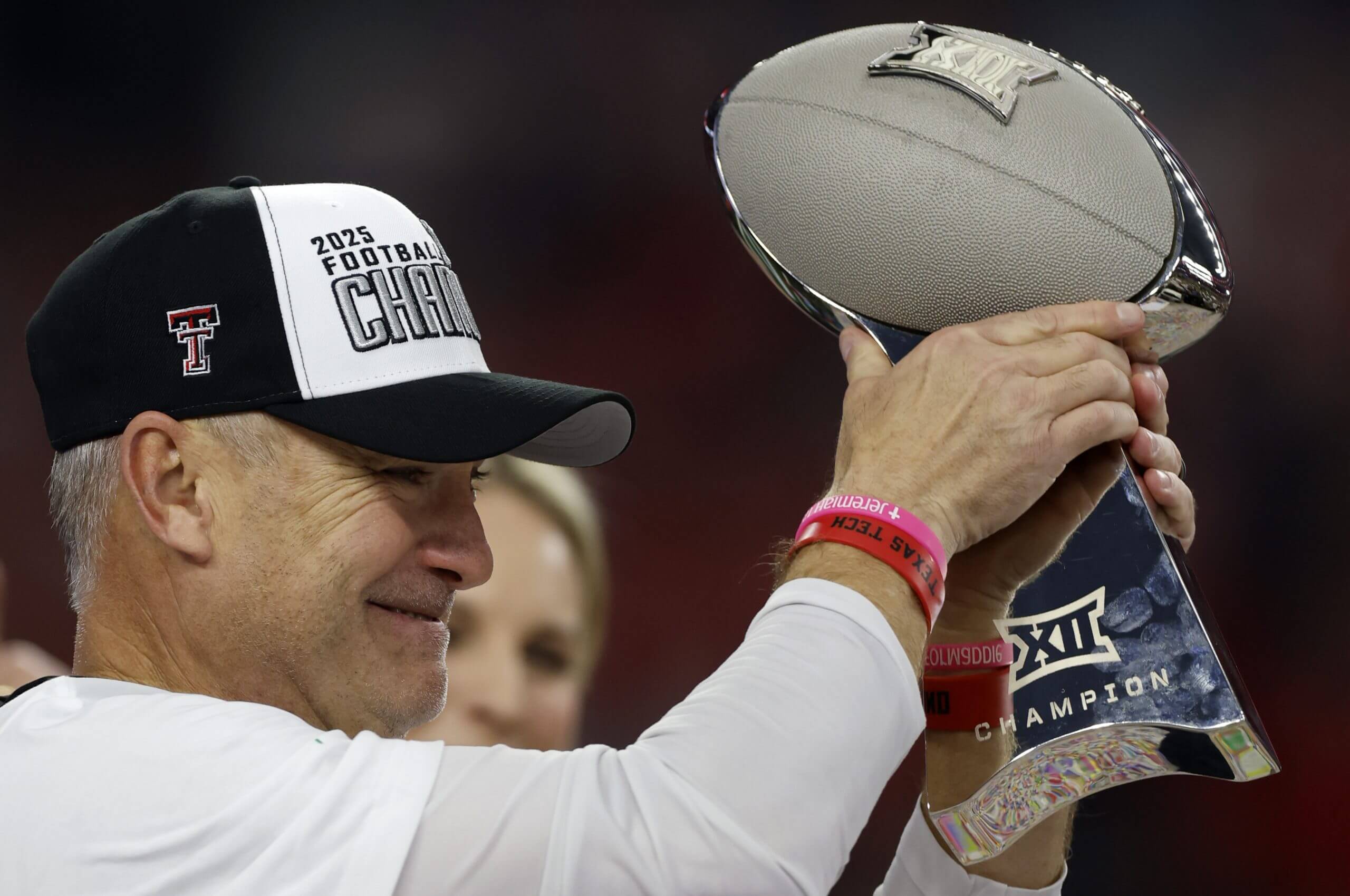
Joey McGuire has Texas Tech on the verge of the first top-10 finish in school history. (Ron Jenkins/ Getty Images)
The impact of Indiana’s loss of defensive end Stephen Daley after the Big Ten championship game is flying under the radar. This would seem to create a massive risk to the Hoosiers’ defense after losing original starter Kellen Wyatt. What are IU’s options to mitigate this loss, and what kind of defensive downgrade can we expect? — Jamie
It’s definitely a concern.
You may recall early in the season, I initially said Indiana could never win a national championship because it couldn’t stockpile depth like the usual top programs. After much backlash, and then after the Hoosiers trucked Oregon, I backtracked. Yet, now we may find out if my initial instinct was correct. All because Daley injured himself while jumping to high-five someone in the stands after the Big Ten title game.
Indiana’s D-line was tremendous all season, even after losing Maryland transfer Wyatt, a career 35-game starter, in Week 8. The Hoosiers had 39 sacks, tied for No. 6 nationally, and 112 (!) tackles for loss, second only to Oklahoma. Though Daley, a Kent State transfer, didn’t officially enter the starting lineup until Wyatt went down, he led the team with 19 of those TFLs.
Indiana still has 2024 sack leader Mikail Kamara on the other edge, and first-team All-Big Ten interior Tyrique Tucker. Curt Cignetti is playing coy on how they’ll replace Daley, but the most obvious candidate is sophomore Daniel Ndukwe, who hasn’t played much but got some reps when Kamara was banged up. Or they could rotate in other young players.
I’m not particularly worried about Indiana’s defense against Alabama, because the Tide’s offense is one-dimensional. Even if the Hoosiers don’t get heavy pressure on Ty Simpson, IU has first-team All-Big Ten DBs D’Angelo Ponds and Louis Moore defending Alabama’s receivers. Daley’s loss, however, could catch up to the Hoosiers in the later rounds, especially against Oregon’s multi-dimensional offense or in a rematch with Ohio State.
Are you gonna do journalism and look into the CFP committee corruption? Or are you a hack? — Moby
How do you know I’m not?
I already demanded Ivan Maisel hand over his tax returns. I spent part of my weekend combing through Wesley Walls’ social media. And I dispatched an intern to poke through Mark Dantonio’s garbage.
With that: Happy holidays, everyone! Enjoy the bowls.