
“Tis the season for predictions of what will happen in 2026 -Fa-la-la-la-la, la-la-la-la”—and many published predictions have a distinctly optimistic flavor. Some forecasts for 2026: Real world quantum computing allows breakthroughs in materials science; Biotech and human digital twins provide breakthroughs on diseases like ALS and Alzheimer’s; Physical AI: Humanoid robots start taking on work that is dull, dirty, and/or dangerous; and so on.
It is worth noting that so far, we can see the impact of AI everywhere – except in the productivity statistics. Many corporations, however, hope this year will be the breakthrough year – when AI has a measurable positive impact on productivity. Overall, major banks are bullish, predicting strong earnings and valuation growth in 2026. In an IBM Institute for Business Survey about trends for 2026, over 80% of executives have a positive outlook for their organizations.
What could possibly go wrong?
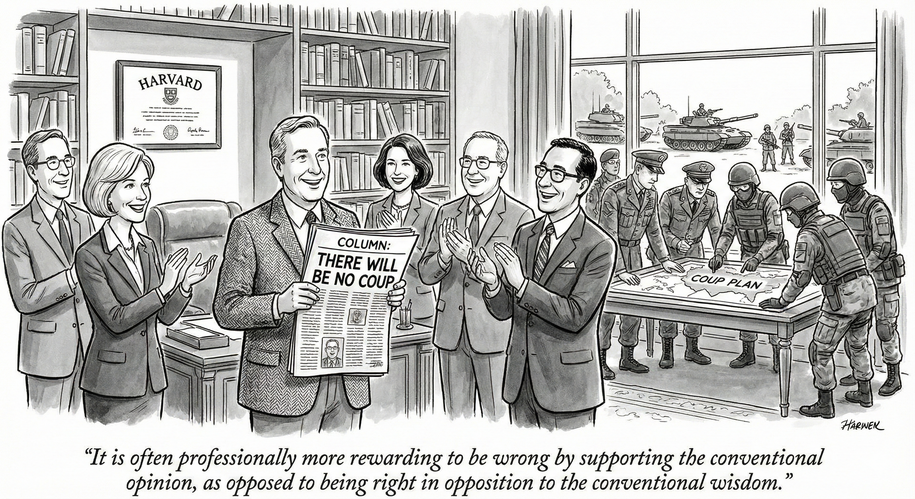
As the old saying goes, predictions are difficult – particularly about the future. The 21st century has already provided plenty of Black Swans (catastrophes that came as a surprise, but in retrospect were entirely plausible): 9/11, the 2008 financial crisis, the Covid pandemic, October 7th terror attack on Israel, and Trump’s attempted coup on January 6, 2021. In hindsight these were all plausible, but pundits and governments underestimated their probability. On a personal note, I did predict that Trump would not leave office easily or willingly, while the New York Times’ Ross Douthat (as late as October 2020) went with the conventional wisdom and predicted There Will Be No Trump Coup. But, as Keynes pointed out, it’s usually professionally better to be wrong (as part of the conventional wisdom), rather than being right (in opposition to that conventional wisdom).
So at the risk of being considered a paranoid pessimist, below are some Black Swan scenarios for 2026 which would likely trigger: large-scale socio-political changes, stock market crashes, and/or recessions. These aren’t specific predictions – but rather plausible disasters – the probability of which we seem to be underestimating.
USA as Rogue State: American actions (such as: a land war with Venezuela, annexation of Greenland, escalating sanctions against European officials, or other similar conduct by the US) trigger a hard pivot in Europe, resulting in sanctions against the US. Europe and Asia dump US treasuries in response to Trump administration threats to default. Europe sanctions American tech giants (e.g., bans Facebook (owned by Meta), which gets an estimated 20% of its revenues in Europe) and so on. America exits NATO, which repositions as a defensive alliance against the US and Russia. Europe pivots toward China, seeking an entente.
AI Bubble Bursts with Spillovers into the Real Economy: The US stock market is trading at historic high levels, mainly due to the AI boom. The bubble bursts (triggered by, for example, a failed OpenAI funding round). Much of the growth in the US economy over the last several years has been driven by AI-related capital expenditures (CapEx). So as tech giants cut capital spending, the result is a recession on the same magnitude as 2008 or worse, with US unemployment surging to 10%, etc. In response to the 2008 financial crisis, the US Government took major stakes in many of America’s leading companies and banks (e.g., Citigroup, GM and many others), but the transactions were structured so the Government had limited voting rights and with the understanding the shares would be disposed of relatively quickly. This time, the Government also takes shares in many leading companies, but the Trump administration insists on the voting rights, pushes the companies to praise the Trump administration, and CapEx cutbacks are targeted to impact blue states.
Autonomous AI Cyber Swarm (rumored to be initiated by a state actor such as Iran, North Korea, Russia, etc.) causes damage at a scale of 5–10 times the NotPetya cyber incident (which caused damages estimated at $10 billion). The goal of such an attack is not completely clear: a prototype that accidentally escaped a cyber war lab; testing out cyber war capabilities; retaliation; etc. Some cities and regions are reduced to a digital dark age for days and/or weeks as hospitals and key functions are significantly degraded.
US November 2026 Elections are a Dysfunctional Disaster – Leading to a Governmental Legitimacy Crisis and Significant Democratic Backsliding: The US emerges as an authoritarian one-party (GOP) country at the federal level. The election suffers from large-scale disinformation campaigns from countries such as China, North Korea, Iran, and Russia—the goal of these campaigns is not direct election interference (e.g., changing vote tabulation), but rather humiliating the US and spreading domestic chaos to weaken America. The US has limited response capability (the current administration has already shrunk US cyber defenses). Also, to the extent disinformation favors the GOP, the administration chooses to be supportive of these disinformation campaigns. The US Immigration and Customs Enforcement service does large-scale sweeps at election polling places in primarily left-wing neighborhoods, nominally to prevent non-Americans from voting; in practice, its aim is clearly voter suppression and intimidation. Courts attempt to stabilize the situation, but are ineffective and ignored. Increased uncertainty results in a stock market crash, capital flight out of the US, and a significant recession.
Ukraine-Russia War moves into an even more disruptive phase: As one example, Russia escalates the conflict by using non-conventional weapons against Ukraine, resulting in a Russian victory – but also millions of Ukrainians fleeing to the West. Or Russia expands the war by attacking Baltic countries, etc. The result is chaos in Europe.
Again, these are meant as scenarios of plausible disruption. On one level, I don’t think any of them will happen exactly as described, but I think there is a high probability that we’ll see a Black Swan event in 2026. Please let me know your thoughts below. Am I being too pessimistic, or too optimistic? And if you think we’ll have a Black Swan in 2026 that’s not shown on the list, please post it in the comments section below.
All the best in 2026!
If you would like to get regular updates when I publish new work, please subscribe to my blog.