
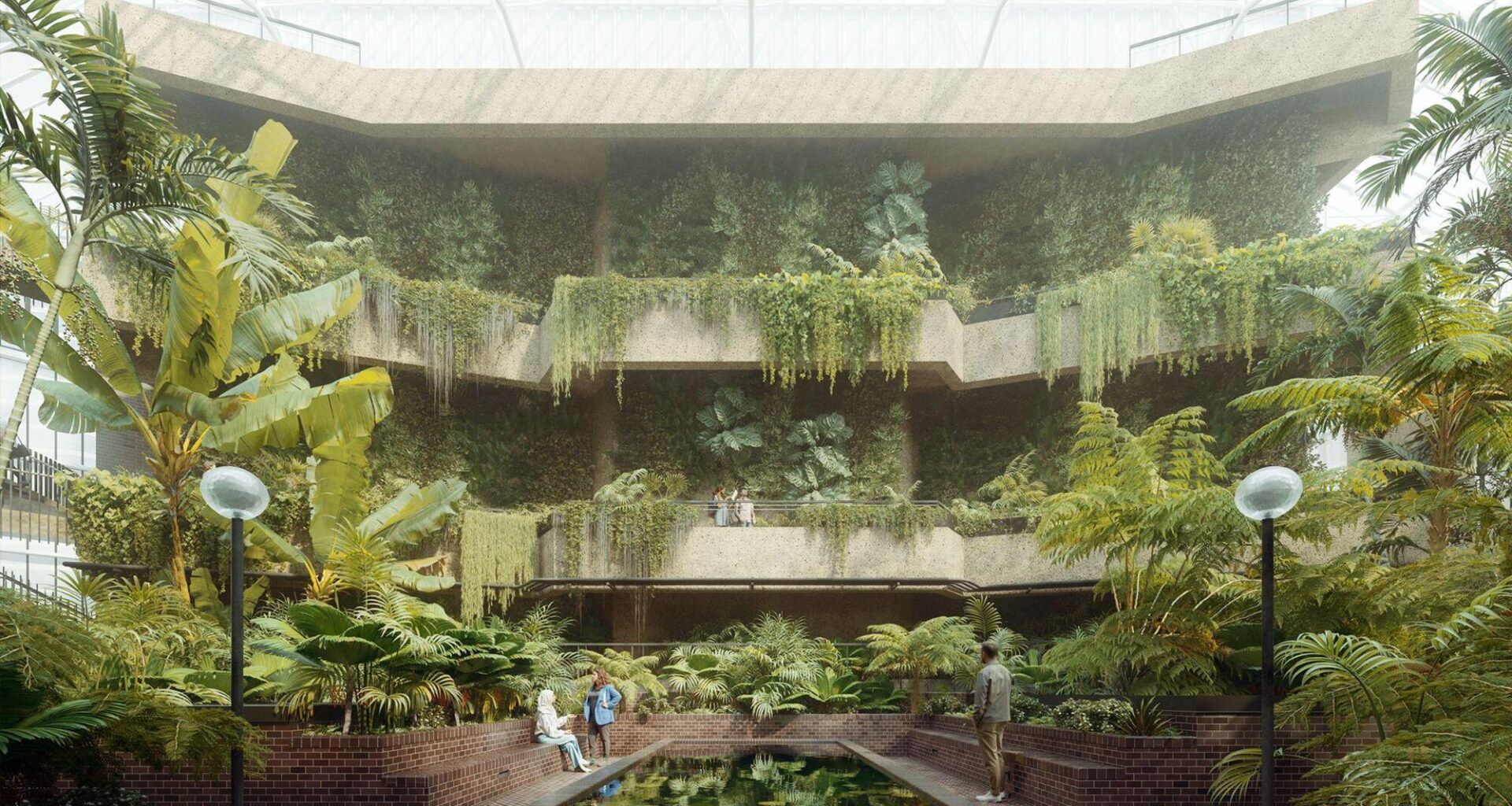
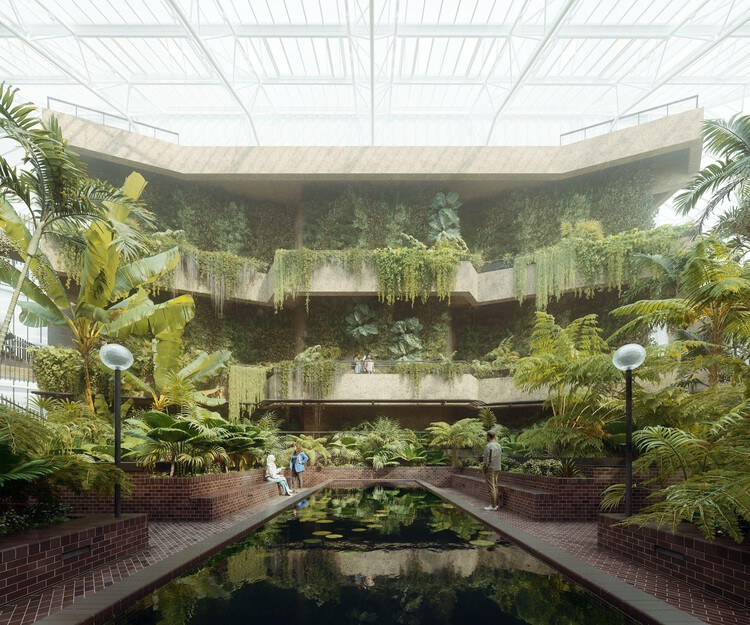
 Barbican Center Conservatory Rendering. Image © Kin Creatives for Allies and Morrison and Asif Khan Studio
Share
Or
https://www.archdaily.com/1037394/barbican-center-renewal-program-moves-forward-to-secure-the-future-of-londons-brutalist-legacy
The City of London Corporation has formally approved the delivery plan for the renewal of the Barbican Centre, confirming a £191 million investment to support the first five-year phase of a long-term transformation programme. Approved in December 2025, the decision secures funding for major repairs, infrastructure upgrades, and public space improvements across the Grade II-listed complex. Subject to planning permission, major construction is scheduled to begin in 2027, with completion of this phase targeted for 2030, ahead of the Barbican‘s 50th anniversary. To facilitate the works, most programmes within the Centre will pause for approximately one year between June 2028 and June 2029, while preparatory upgrades, including essential works to the Barbican Theatre, are set to begin in early 2026.
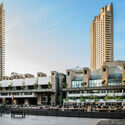
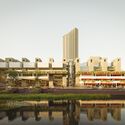
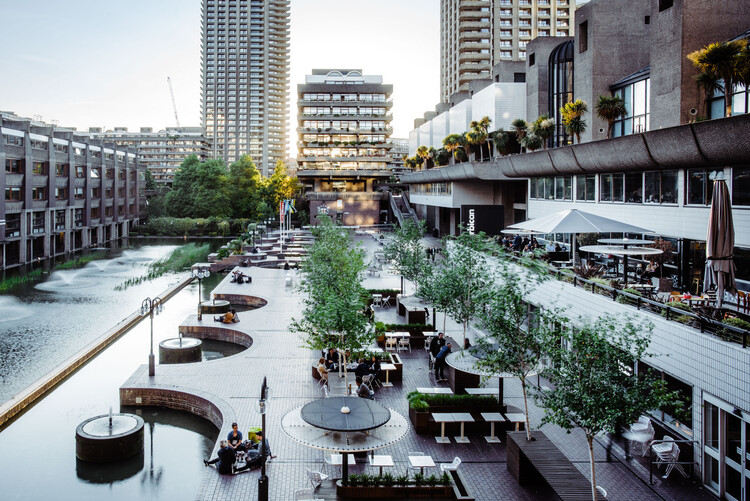 Barbican Center. Image © Max Colson Courtesy of Barbican Centre
Designed by Chamberlin, Powell & Bon and constructed between 1965 and 1982, the Barbican is widely regarded as one of the most comprehensive Brutalist ensembles in Europe. Conceived as a mixed-use development integrating residential, cultural, and recreational functions, the complex houses concert halls, theatres, cinemas, galleries, exhibition spaces, a library, and the Conservatory. After more than four decades of near-continuous use since opening in 1982, the estate’s buildings and systems have experienced significant wear, prompting the need for a coordinated, long-term renewal strategy.
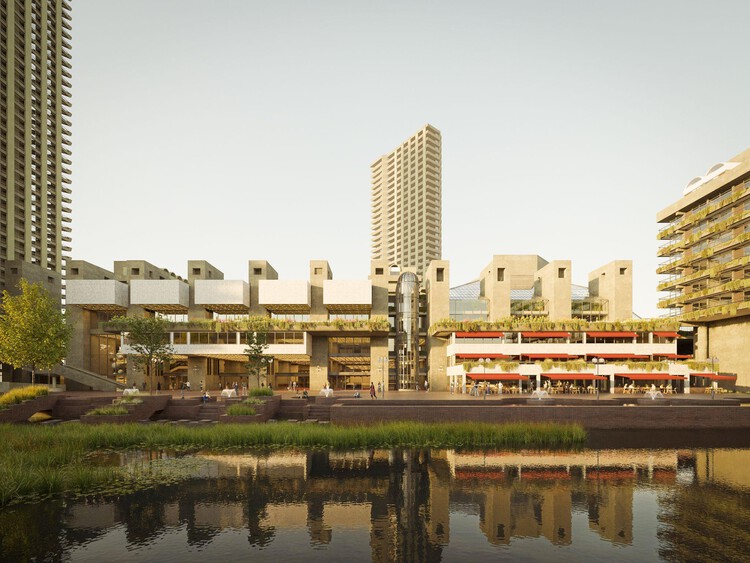 Barbican Center Lakeside Terrace Rendering. Image © Kin Creatives for Allies and Morrison and Asif Khan Studio
The Barbican Renewal Programme was initiated following an international competition in 2021, which resulted in the appointment of a multidisciplinary design team led by Allies and Morrison, working in collaboration with Asif Khan Studio and Buro Happold, alongside specialists in heritage, sustainability, landscape, lighting, acoustics, and access design. The approved delivery plan reflects several years of design development and public consultation, with over 90 per cent of respondents expressing support for the proposed approach.
Related Article AD Classics: The Barbican Estate / Chamberlin, Powell and Bon Architects
The first phase of renewal focuses on some of the Barbican‘s most prominent public spaces, including the multi-level foyers, the Lakeside Terrace, and the Conservatory. These areas will be sensitively restored and enhanced to support a wider range of uses, improve environmental performance, and strengthen connections between indoor and outdoor spaces. The Conservatory is planned to become a free daily public garden while continuing to operate as an event space, supported by climate-responsive design measures intended to stabilise internal conditions.
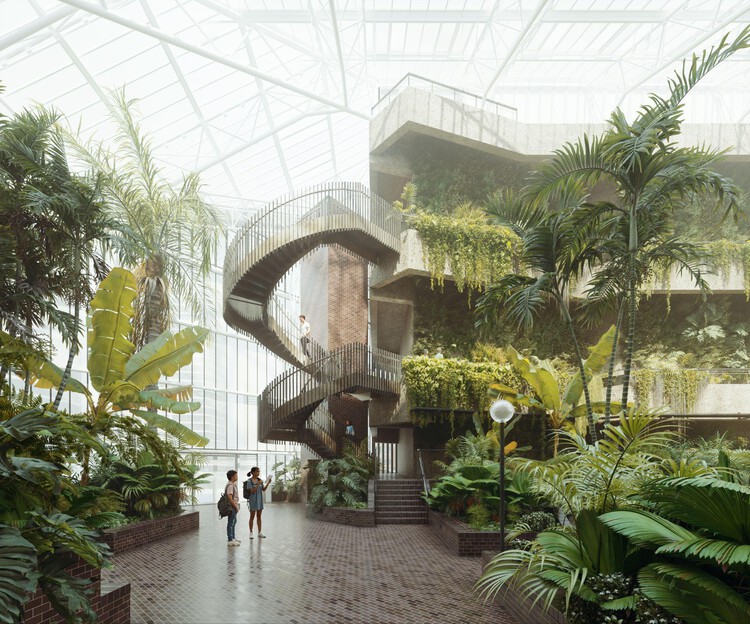 Barbican Center Conservatory Rendering. Image © Kin Creatives for Allies and Morrison and Asif Khan Studio
A retrofit-first strategy underpins the architectural approach, prioritising repair and conservation over demolition to protect the integrity of the listed estate while reducing carbon impact. Original materials, such as Conservatory glazing and paving elements, will be reused or transformed into new finishes. Sustainability measures include upgrades to mechanical, electrical, and plumbing systems, energy-efficient lighting, improved glazing and doors, and rainwater harvesting for toilet flushing and irrigation, alongside essential safety and security works.
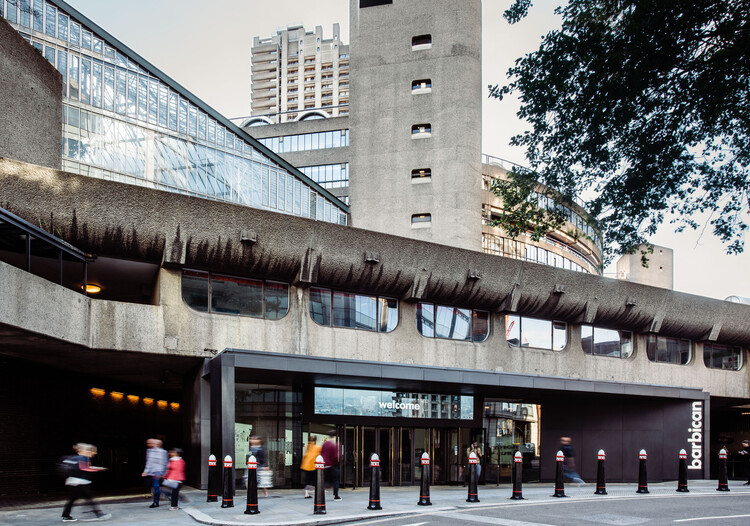 Barbican Center. Image © Max Colson Courtesy of Barbican Centre
Accessibility and inclusivity form a central component of the programme. Planned interventions include improved wayfinding, a substantial increase in toilet provision, new multi-faith and quiet rooms, regraded ramps, wider automatic doors, and step-free access throughout public routes. Full accessibility will be introduced within the Conservatory and the Curve gallery, establishing a new benchmark for access within a large-scale heritage complex.
To allow the works to be delivered safely and efficiently, most Barbican programmes within the Centre will pause from late June 2028 until June 2029. During this period, the cinemas on Beech Street will remain open, and the surrounding residential estate will continue to be accessible. The Barbican will continue to operate through alternative programming models and partnerships, including with resident organisations such as the London Symphony Orchestra and the Royal Shakespeare Company, with LSO St Luke’s remaining open as a hub for concerts, recordings, broadcasts, and learning activities.
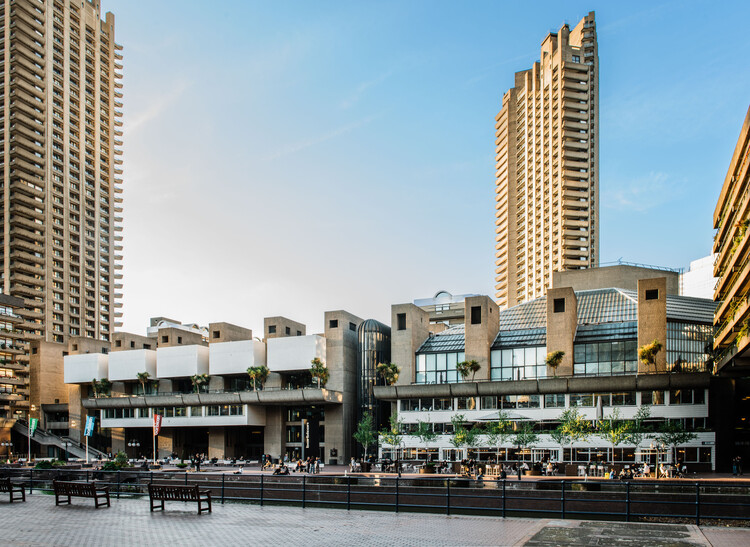 Barbican Center. Image © Max Colson Courtesy of Barbican Centre
In other recent developments related to modern architectural heritage, Paris’s Centre Pompidou, designed in the early 1970s by Renzo Piano and Richard Rogers, is undergoing a five-year closure for a comprehensive renovation led by Moreau Kusunoki, in collaboration with Frida Escobedo Studio and AIA Life Designers. In the United States, Dallas is evaluating repair and demolition options for its Modernist City Hall, designed by I. M. Pei, while the Mississippi Museum of Art has acquired Fountainhead, a house designed by Frank Lloyd Wright, with plans to open the property to the public through reservation-based visits.