
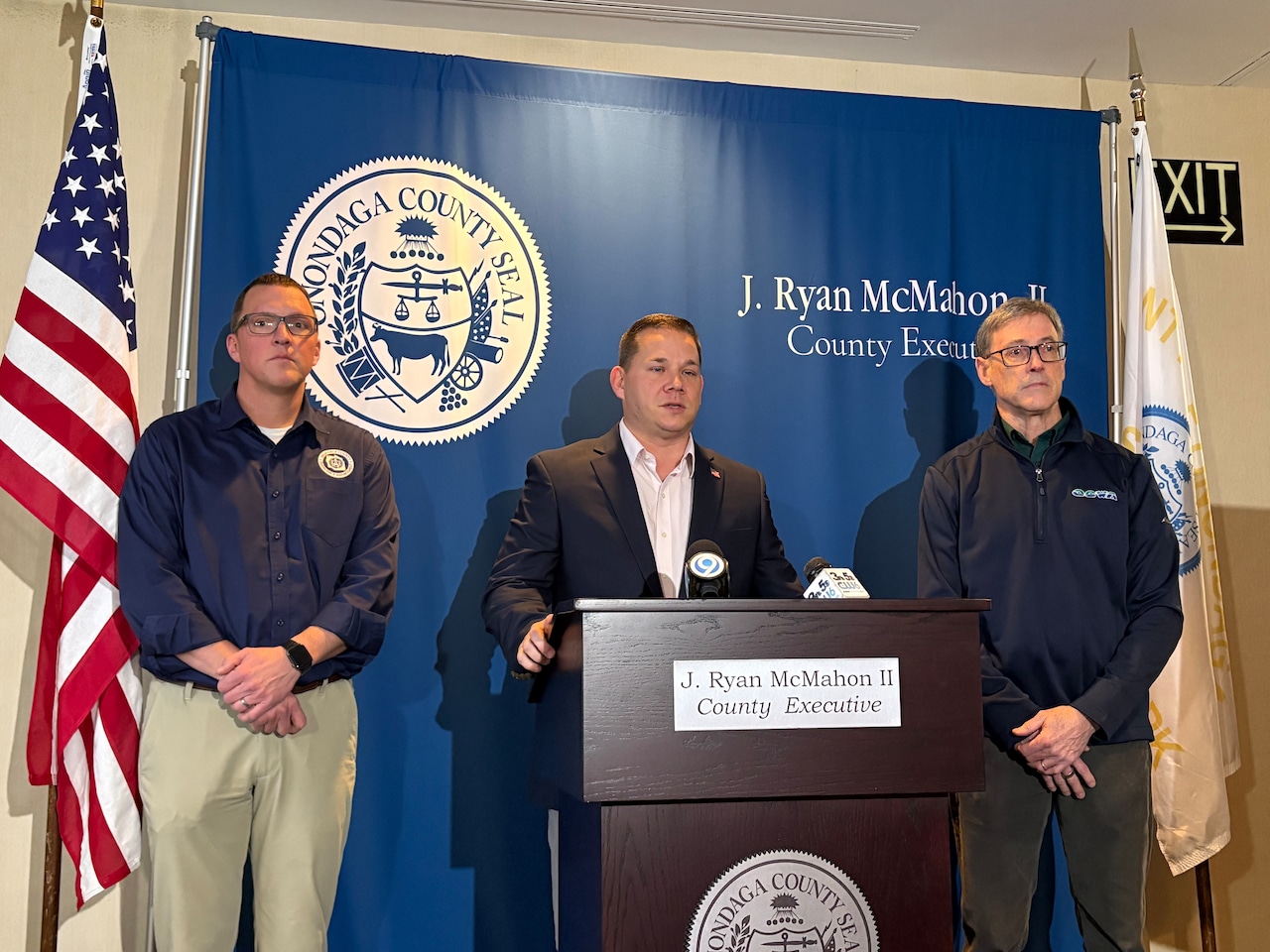
Update at 12 p.m. Dec. 24: County Executive Ryan McMahon said on Christmas Eve the county will bring water supplies to affected areas. The county is storing 30,000 cases of bottled water at the Oncenter, but that will not be the distribution center. This story has been updated to reflect that.
Syracuse, N.Y. — Onondaga County is preparing to distribute large amounts of bottled water to residents if the local water system runs dry, which could happen as soon as this weekend.
County Executive Ryan McMahon said the county stands ready to distribute thousands of gallons of bottled water that residents could use to drink or for sanitary purposes.
“If there are impacted areas, we will be able to get you water,” he said at a news conference Tuesday. “There’s no reason to think you won’t have water. It won’t be the ideal way.”
A rupture to a major water transmission line operated by the Onondaga County Water Authority has caused a water shortage in six towns in eastern Onondaga County and western Madison County. Officials have issued a mandatory conservation notice, telling customers to limit their non-essential water usage.
Water consumption appears to be trending down, officials said. But more cutbacks are needed or certain areas could be out of water as soon as Sunday.
The areas most vulnerable to losing water are the southern part of the village of Manlius, the northern portion of the town of Pompey and parts of the village of Fayetteville.
McMahon said the county is paying close attention to water usage data. He said bottled water distribution would begin if the numbers show a “likely stoppage” of water service.
McMahon is likely to discuss more details about the plan at a news conference scheduled for noon Wednesday.
McMahon said the county has begun ordering large amounts of bottled water from Kinney Drugs and Tops Friendly Markets. He has not said where residents would be able to get the water.
Tops spokesperson Kathy Sautter told syracuse.com | The Post-Standard that the company will start delivering bottled water Wednesday to the county. Thousands of cases of water is being trucked in from the company’s Buffalo-area warehouse.
John Marraffa Jr., the president of Kinney Drugs, said the county executive’s office had reached out Tuesday morning about supplying water.
Marraffa said the company has agreed, “until the county tells us to stop,” to provide about 4,000 one-gallon jugs and 2,500 24-picks of bottled water a day. The first shipment is set to arrive Monday.
“We’re communicating daily with the emergency management team, multiple times a day,” he told syracuse.com | The Post-Standard. “This is easy for us. We’re excited to be called on to help our communities.”
Madison County is planning to distribute bottled water, and jugs of drinkable and non-drinkable water, on Wednesday morning at Chittenango Middle School.
New York state is sending equipment to help local officials.
One 6,700-gallon water tanker is being deployed to Onondaga County, and three 500-gallon tankers are being sent to Madison County.
Dan Wears, the emergency management commissioner in Onondaga County, said residents would be able to bring containers and fill them with water from the tankers.
The water issues were caused by a rupture last weekend in Cicero in a massive concrete pipe. That pipe typically moves millions of gallons of water each day to 27,000 customer accounts in the towns of DeWitt, Manlius, Pompey, Sullivan, Lenox and Lincoln.
Crews have started to repair the pipe, officials said. The work could take until early January to complete.
How is this water shortage affecting you? Have you been notified to close your business or send workers home? How is your water pressure? Please share your experiences with us at citynews@syracuse.com.
OCWA has issued the following restrictions for the six towns:
As an alternative, use laundry facilities in unaffected parts of the OCWA system (western and northern Onondaga County).Adjusting all water-using appliances to use the minimum amount of water.Running the dishwasher and washing machine at full load. If you wash dishes by hand, use a bucket or container with soapy water and only use the faucet for quick rinsing of scrubbed dishes.Taking 5-minute showers and shallower baths. Turn off the shower while soaping; turn off the faucet while brushing teeth, etc.Reducing the number of toilet flushes per day. Each flush uses about 5 to 7 gallons.Using sink and tub stoppers to avoid wasting water.Keeping a bottle of chilled drinking water in the refrigerator instead of running the water till it gets cold.Eliminating use of water for ornamental purposes, including but not limited to fountains, artificial waterfalls and reflecting pools.Reusing water when possible.Commercial customers: Limiting non-essential work practices that involve water usage and utilizing additional water conservation measures such as having employees work from home.Car washes: Pausing all wash services until mandatory conservation is lifted and full water service is restored.