
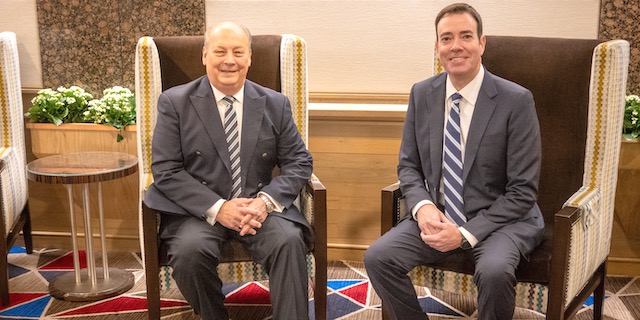
Demand for wheat worldwide has outpaced production several times in the last 10 years, the new president and CEO of U.S. Wheat Associates says.
Mike Spier took over the position July 1 from Vince Peterson, who retired. Spier was most recently vice president of overseas operations for U.S. Wheat, the overseas marketing arm for the industry.
Spier expects that growing wheat consumption to continue.
“Right now (the U.S.) is competitive, and our goal is to continue to grow that and expand our market share,” Spier told Capital Press during a phone interview July 24. “Every bushel of wheat that is exported helps the farmer’s profitability.”
But there’s also been an increase in global competition, particularly from Black Sea and Australian exporters in the last five years.
“We’re in a good position in terms of the wheat our farmers are growing,” Spier said. “We’re seeing an increase in demand for high-quality products. That’s a great fit for the United States. That’s where our competitive advantage is.”
In June, Peterson said market volatility has increased over the last 25 years, calling it a sign of the times. Spier agrees.
“I look at global wheat market volatility as being here to stay,” Spier said. “The world is not significantly building exportable supplies. This leaves the wheat markets open to volatility when there’s a geopolitical event, a supply disruption, a quality issue or changes in economic conditions.
“U.S. Wheat, and our work with our overseas buyers, we can help mitigate some of their exposures to that volatility by providing the wheat marketing information, the quality information that we provide in a very timely and comprehensive way,” Spier said.
Tough price scenario
Lower wheat prices help keep the crop competitive on the world market, but “it’s clear the current price environment is a significant challenge” for growers, Spier said.
He points to increases in input costs, including fuel, fertilizer and equipment.
“Lower prices also present a tough scenario for our farmers,” he said.
U.S. Wheat will continue to show flour millers around the world the quality advantage that comes from using American wheat, he said.
The increase in demand is coming on the consumer level, seeking higher quality products, Spier said.
“Flour mills are asking for more than just ‘wheat,’ they’re getting a lot more specific with their demands, specific end-use performance, consistent quality,” he said.
Social media reflects increased interest for U.S. bakery product trends in markets overseas.
“In terms of improving quality products, you need a higher quality wheat,” Spier said. “We’re really leaning into that.”
Trading commitments
U.S. Wheat recently announced several memorandums of understanding, with wheat customers in Indonesia and Bangladesh committing to purchasing 1 million tons and 700,000 tons each year, respectively, over the next five years.
Milling associations in those countries reached out to U.S. Wheat, Spier said. The agency keeps in contact with the USDA’s Foreign Agricultural Service offices.
It’s a new approach under the Trump administration, Spier said.
“I think the countries are looking at ways to narrow those trade balances with the United States,” he said. “This is one way we’ve seen at least two countries reach out trying to do that.”
“These are the two (more MOUs) that we’ve heard about, at least at U.S. Wheat Associates,” Spier said. “Maybe seeing these other ones out there will encourage other countries to consider them as well.”
‘A challenge I eagerly embrace’
Spier has been in the wheat industry for more than 30 years.
“The opportunity to lead such a remarkable organization is an honor, and also a challenge I eagerly embrace,” Spier said.
He’s excited to work with, and on behalf of farmers, helping to maintain and develop markets for U.S. wheat long-term.
For example, Spier cites commercial sales reports of 100,000 tons of U.S. wheat into the price-competitive region as a direct result of U.S. Wheat’s first Sub-Saharan Africa buyers conference in April.
“I think our buyers understand we’re there to work with them to support them,” he said. “We want them to be profitable and we’re there to help them do that.”