
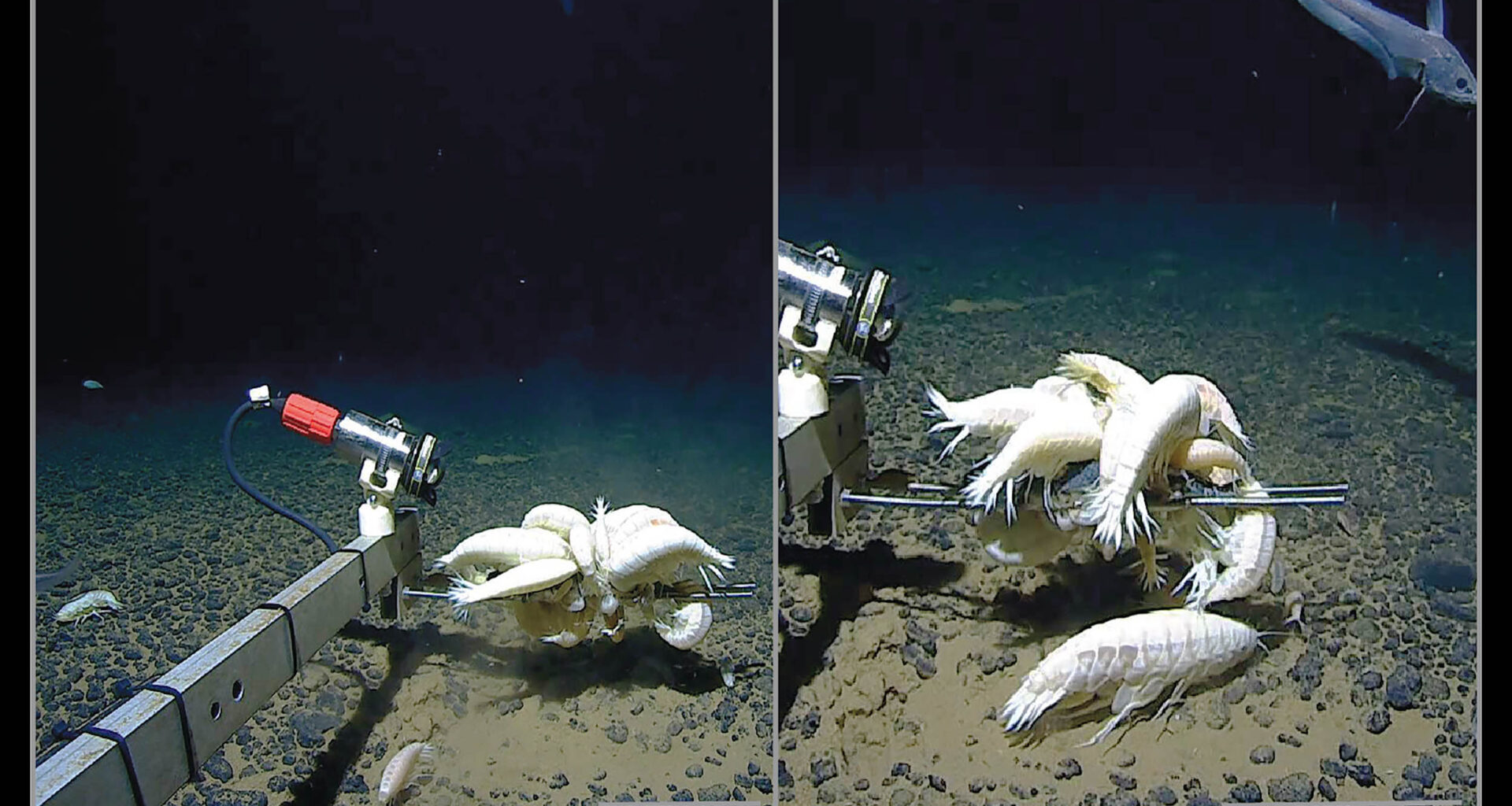
Sometimes, scientists will label a creature as being “rare” simply because it’s hard to find. One such example is the supergiant amphipod Alicella gigantea, which can reach about 13.4 inches in length.
After years of scattered sightings, A. gigantea is now confirmed to appear far more often than suspected.

According to new findings presented by Dr. Paige J. Maroni from the University of Western Australia, this hefty crustacean, which looks like a giant white shrimp, seems to have been hiding in plain sight.
“Historically, it has been sampled or observed infrequently relative to other deep-sea amphipods, which suggested low population densities,” Dr Maroni said.
“And, because it was not often found, little was known about the demography, genetic variation and population dynamics with only seven studies published on DNA sequence data.”
Amphipods in extreme environments
Researchers have known for decades that amphipods are found in nearly every aquatic environment on Earth, including lakes, coral reefs, and ocean trenches.
Many species occupy extreme depths, with the hadal zones extending well below 19,700 ft into waters under crushing pressure.
Amphipods are a diverse group of crustaceans that share some traits with shrimp, yet many adapt in unexpected ways.
A few can flourish in low temperatures and pitch-black conditions, which explains how they manage life in the deepest parts of our planet.
Alicella gigantea is elusive
The earliest camera evidence of A. gigantea emerged in the North Pacific at around 17,400 ft. For more than 20 years, this species remained elusive, and scientists suspected it was truly uncommon.
Only a handful of physical samples turned up, making it look like these giant scavengers existed in scattered pockets. As field expeditions continued, a larger picture began to form, and that picture changed everything.
Scientists compiled 195 records from multiple expeditions worldwide to piece together a sweeping view of Alicella gigantea.
Genetic data from two mitochondrial genes and one nuclear gene showed minimal differences across populations, reinforcing the idea that this amphipod likely moves around the depths with few barriers.
It appears that this species has a presence in a vast network of trenches and plains, spanning the Pacific, Atlantic, and Indian Oceans.
“As exploration of the deep-sea increases to depths beyond most conventional sampling, there is an ever-growing body of evidence to show that the world’s largest deep-sea crustacean is far from rare,” Dr Maroni said.
This discovery challenges old assumptions and expands our view of what we thought possible for an invertebrate in such an extreme environment.
Single global species
Despite appearing in distant waters, Alicella gigantea shows very little genetic change.
Some marine specialists propose that lower temperatures and stable conditions in the deep sea slow down evolutionary divergence, keeping populations similar across large areas.
Others suggest that shifting ocean currents and tectonic changes over millions of years opened pathways for these animals to spread.
In either scenario, the evidence supports one widely distributed type, rather than many closely related variants.
 Spilhaus world projection showing the sample sites of all sequenced Alicella gigantea specimens used in this study. Each site is denoted by a circle and color-coded by deep-sea feature. Bottom left: Three TCS haplotype networks depicting the sequenced material. Credit: Royal Society Open Science. Click image to enlarge.Surviving in cold, dark areas
Deep-sea organisms often cope with near-freezing temperatures, scarce food, and high hydrostatic pressure.
Hadal zones can reach more than 29,300 ft. Alicella gigantea inhabits a wide depth range, an indication of incredible resilience.
Stomach content studies of many large amphipods reveal that they feed on carrion or sinking organic matter. This lifestyle may grant them the flexibility to survive in far-flung regions where consistent meals aren’t guaranteed.
Importance of Alicella gigantea
Marine conservation efforts often focus on well-known animals, but the little-studied denizens of abyssal trenches are equally important.
By learning how creatures like Alicella gigantea spread and maintain populations, scientists hope to grasp how deep-sea ecosystems respond to environmental changes.
Gauging distribution patterns in underexplored ocean zones helps direct future research. It also encourages deeper conversations about how human activities on the surface might affect habitats thousands of feet down.
Many experts believe that we’ve only scratched the surface of the deep ocean’s biodiversity.
Growing interest in sub-seafloor mining and other commercial ventures makes it even more critical to understand how these regions function.
Insights from larger genomic studies may reveal specific genetic adaptations that enable survival in such harsh conditions. That knowledge could have broader applications, from biotechnology to climate resilience research.
 Aggregations of giant crustaceans Alicella gigantea to bait traps at roughly 22,000 feet (6700 meters) deep from the Murray Fracture Zone, North Pacific. Credit: Royal Society Open Science. Click image to enlarge.Importance of amphipods
Our planet’s deep marine habitats are often out of sight and out of mind. Yet, they are central to carbon storage, nutrient cycles, and other processes that keep the global ecosystem stable.
The genetic blueprint of species like A. gigantea may hold clues to how life persisted through Earth’s past climate swings.
Large-scale expeditions push our understanding further, often prompting questions about how many other “rare” organisms might be more widespread than we realize.
Technology improvements in submersibles and sampling equipment make it possible to investigate remote sites with greater frequency.
Modern traps, cameras, and monitoring tools can gather data at extreme depths, improving our ability to find elusive marine animals.
“The advancements in next-generation sequencing technologies and an increase in deep-sea exploration will allow research into the evolution of hadal amphipods to grow rapidly in the coming decades,” Dr Maroni said.
“These developments will help reveal further insights into hadal biodiversity, pressure adaptations and the evolutionary history of life in this zone.”
There’s much to discover, but this supergiant amphipod shows that sometimes the ocean’s hidden giants are just waiting to be found in far more places than expected.
The study is published in Royal Society Open Science.
Image Credit: Maroni et al. / Royal Society Open Science
—–
Like what you read? Subscribe to our newsletter for engaging articles, exclusive content, and the latest updates.
Check us out on EarthSnap, a free app brought to you by Eric Ralls and Earth.com.
—–