
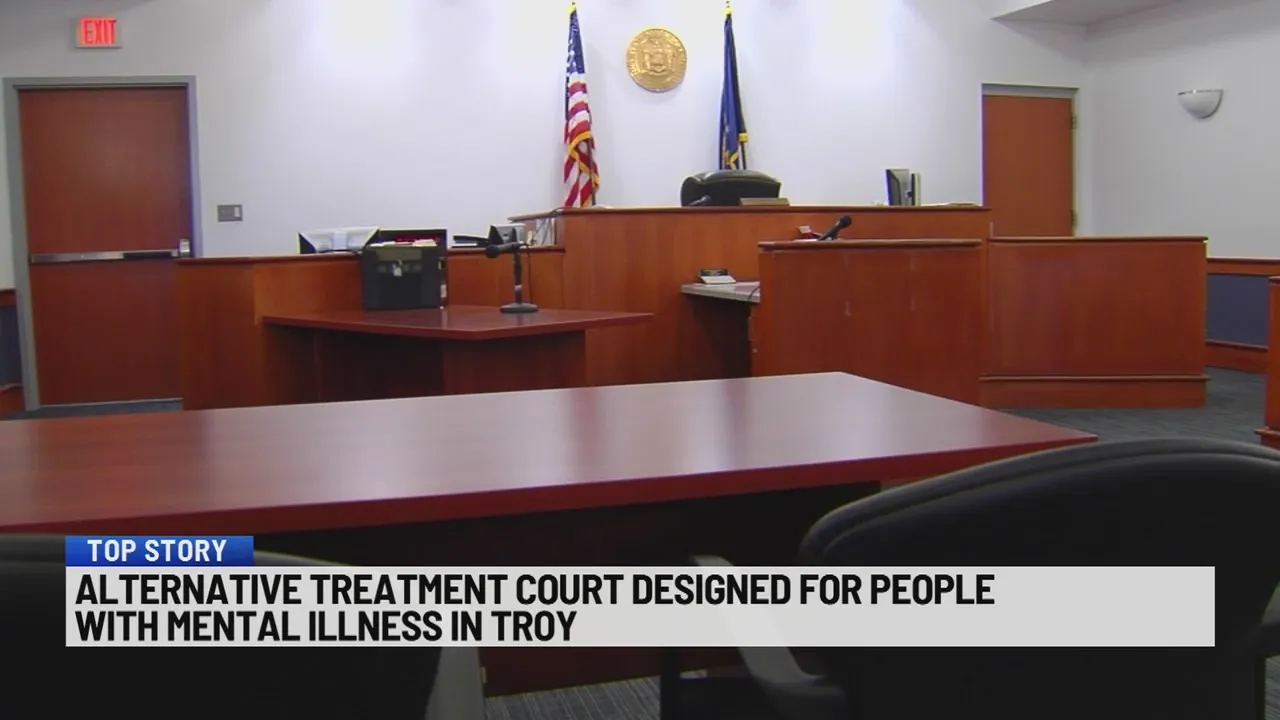
TROY, N.Y. (NEWS10) — Instead of asking, “What did you do?” This court asks, “What do you need?” Troy City Court has recently launched an Alternative Treatment Court, designed for people with mental illness and focusing on support and care rather than incarceration.
Get the latest news, weather, sports and entertainment delivered right to your inbox!
New York State has several specialty courts, including drug, veterans, and mental health courts. They are designed to address underlying issues rather than rely solely on punishment. Launched in August, Troy’s alternative treatment court — or ATC — connects people with mental illness to a resource coordinator who helps guide them through the program.
Laura Stoddard is a Resource Coordinator with Troy City Court. She spoke about why having a bond with the participants is important, saying, “Building trust is the most important. I feel for any participant to be willing to engage in the court, having somebody that they can rely on– that they can call when they’re struggling– is my most important step for them.”
Participants undergo a mental health evaluation and are then matched with services tailored to their individual needs. This can include therapy, medication management, and support from community partners.
New York Democrats push to limit ICE operations
“A lot of participants will also have co-occurring substance use issues, so being able to offer resources for substance use as well is going to be a big step. Enhancing the lives and creating a safer community,” continued Stoddard.
Some participants receive addiction support as well. Each plan is built around the individual.
Right now, the Alternative Treatment Court in Troy is working with misdemeanors and lower-level cases. Troy City Court Judge Christopher Maier said that the decision is based on whether the court can actually help the individual. “There isn’t really anything that we wouldn’t consider at this point in terms of dealing with folks. It really depends on whether we have something to offer them in the sense of a treatment plan,”
New York’s new laws for January and February
Judge Maier continued, “The goal is not to incarcerate people, if we can prevent that, and to get them the proper treatment.”
Many cases involve low-level offenses linked to untreated mental health conditions. Without intervention, those issues can turn into a cycle through the court system. Hudson and the City of Albany also have Alternative Treatment Courts.
“I think so many people who come through the criminal justice system suffer from some sort of mental health issue. And if it goes unaddressed, it can mean that it could get worse. It might mean that that individual is seen again and again. It becomes a revolving door within the community, within the criminal justice system. And we want to stop that.” Judge Maier explained.
For Valerie Eagle, a graduate of the Albany City ATC, the program arrived at a moment when her life was falling apart. She explained that at the time she was addicted to drugs, and said, “When I was first introduced to ATC, I was in a very dark place in my life. I mean, very dark. I was being evicted, and I was arrested,”
Through the program, Valerie was connected to therapy, medication, and eventually rehab for her addiction. She said that for the first time, she felt like people were rooting for her to succeed. She continued, “When I came out, the welcoming that I got when I came into ATC was so warm. And so I was amazed. They said, ‘You did it, you did it! Keep going, keep going!’”
She says the alternative treatment court didn’t just see her case — it saw her as a person. “I have to say, ATC is transformative. It transformed my life. I am grateful that they have a program like that because a lot of us don’t deserve to go to jail,”
Read the latest from NEWS10:
NEWS10 is the Capital Region’s local news leader!