
High above storm clouds where commercial jets don’t fly and conventional satellites cannot observe in detail, scientists have begun collecting data on elusive electrical discharges known as transient luminous events (TLEs). These phenomena include red sprites, blue jets, and ELVES—brief, high-altitude bursts of light triggered by lightning that occur far above thunderclouds.
From the International Space Station (ISS), astronauts are now documenting these discharges with unprecedented precision. Instruments installed outside the station are capturing high-speed images and radiation measurements, giving scientists fresh insight into how these flashes may affect Earth’s atmosphere, long-distance radio communications, and even climate processes.
The renewed focus on storm-generated upper-atmospheric electricity is reshaping how researchers understand severe weather systems. By viewing lightning activity from orbit, space agencies are opening a new frontier in atmospheric research, offering evidence that storm energy often travels far beyond the visible storm cloud.
Space-based lightning detectors reveal storm activity at high altitudes
The ESA’s Atmosphere–Space Interactions Monitor (ASIM), installed on the ISS in 2018, plays a central role in observing upper-atmospheric lightning. Built by Danish aerospace firm Terma and operated from a control centre in Belgium, ASIM is designed to detect light, ultraviolet radiation, and X-rays from rare electrical phenomena occurring between 20 and 100 kilometres above Earth’s surface.
Its position outside the station allows it to record events above large thunderstorm systems, particularly in equatorial regions. ASIM’s instruments include high-speed photometers and X-ray sensors that identify and record brief discharges like ELVES, which appear as large, expanding rings of light, and red sprites, which look like vertical bursts resembling jellyfish.
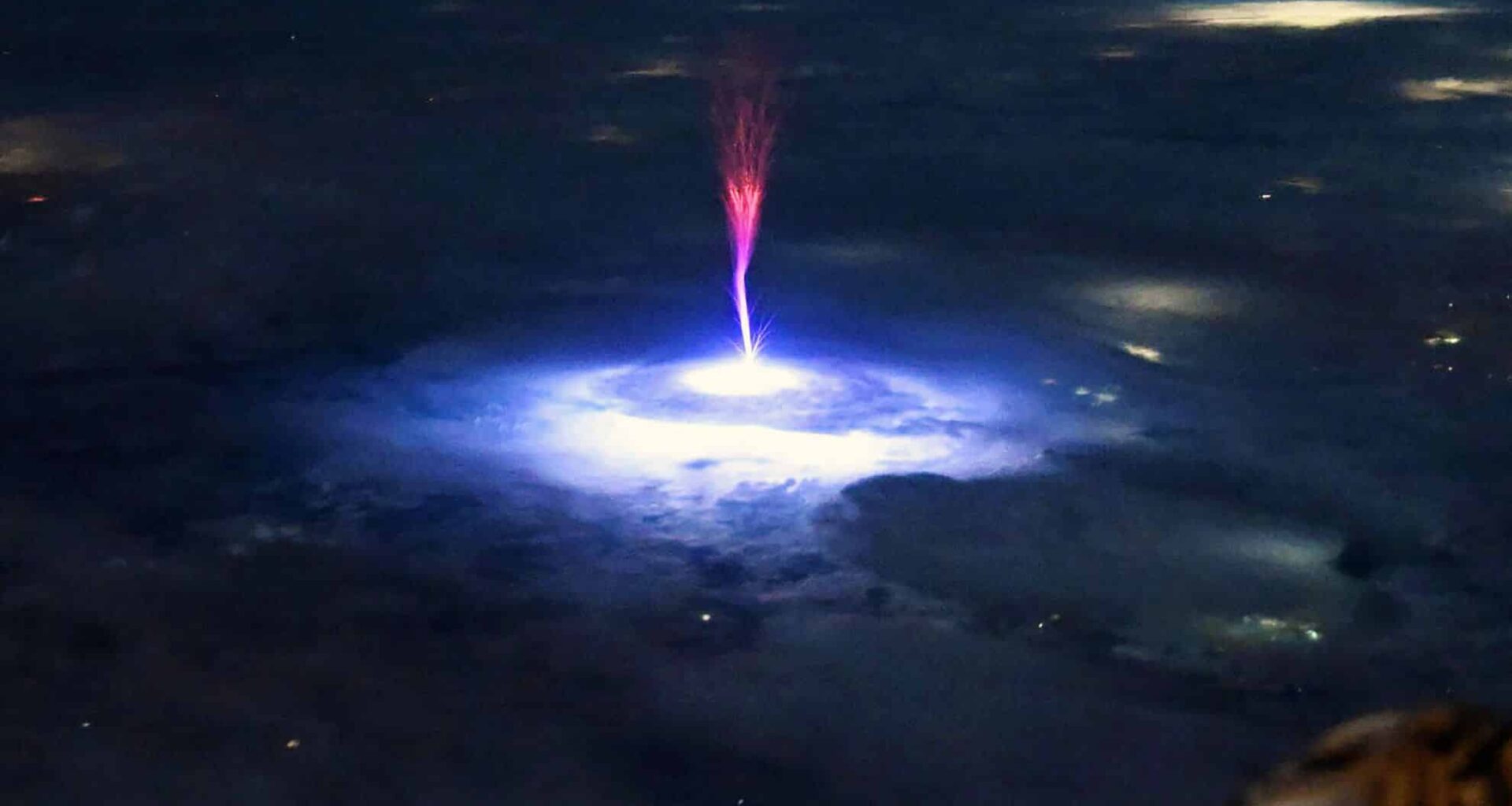
 Red sprites like this one are called TLEs or Transient Luminous Events. They happen above the clouds and are triggered by intense electrical activity in the thunderstorms below. Astronauts have a great view above the clouds, so scientists can use these types of pictures to better understand the formation, characteristics, and relationship of TLEs to thunderstorms. Credit: NASA/Nichole Ayers
Reporting by Earth.com noted that ASIM confirmed lightning-like discharges can emit enough electromagnetic energy to reach the ionosphere, the charged layer of the atmosphere that supports long-range radio communication. These vertical pulses, triggered by storm activity, may influence how radio signals travel across continents, creating potential disruptions to aviation, naval, and military communications systems.
One notable observation involved a blue jet—a bright electrical discharge rising from a thundercloud into the stratosphere. Captured at an estimated altitude of 40 kilometres, it was documented with supporting ground-based instruments and visual confirmation from the ISS.
Detecting terrestrial gamma-ray flashes from orbit
In addition to optical phenomena, storm systems sometimes generate intense pulses of ionising radiation called terrestrial gamma-ray flashes (TGFs). These gamma-ray bursts last just milliseconds but can expose aircraft passengers and sensitive equipment to radiation doses comparable to a chest X-ray.
To improve detection of these bursts, the UAE and Bahrain jointly developed the Light-1 CubeSat. The nanosatellite was launched to the ISS in December 2021 via a SpaceX Falcon 9 rocket and deployed into orbit from JAXA’s Kibo module in February 2022.
Light-1 uses scintillating crystals to detect gamma rays. These crystals emit flashes of light when struck by high-energy photons, which are then amplified by photomultiplier tubes and processed by onboard electronics. Data is transmitted to three ground stations across Lithuania, Denmark, and the UAE via X-band and UHF frequencies.
 In this photo, the “gigantic jet” TLE storm with red sprites appears to be hovering near the Texas–Mexico border. You can spot the glow of Dallas, Austin, San Antonio, and Houston to the northeast, and Torreón, Mexico, to the southwest. Credit: NASA/Nichole Ayers
During its initial hours of operation, Light-1 recorded nearly 50 gamma-ray flashes above storm regions. Its data are now contributing to global mapping of TGF activity and helping researchers better understand the spatial distribution of storm-driven radiation events. Insights from this project are particularly relevant to flight safety and space weather modelling.
Mission updates published on the official Light-1 project page highlight its role in advancing regional and international atmospheric science capabilities.
Ultra-high-speed cameras track lightning development
In addition to satellite-based detection, astronauts are using ultra-sensitive imaging devices as part of the THOR-DAVIS experiment. This project tests a neuromorphic camera—a sensor that captures data only when light levels change at individual pixels. The design allows extremely high frame rates, up to 100,000 frames per second, without producing excessive data volumes.
The camera system consists of a Davis 346 neuromorphic unit mounted on a Nikon D5 DSLR and is operated using an AstroPi controller based on the Raspberry Pi platform. It was tested by Danish ESA astronaut Andreas Mogensen during a mission aboard the ISS.
Technical details from a European Geosciences Union abstract explain how the instrument records lightning activity at the top of clouds and into the stratosphere. Its high dynamic range—around 120 decibels—allows it to capture both faint corona discharges and intense electric pulses without saturation.
The collected footage helps researchers evaluate real-world atmospheric discharges against lab-based plasma models. This may eventually lead to more accurate simulations of lightning formation and improved forecasting tools for power grid protection and satellite operations.