
For environmentalists and climate scientists, 2025 was a nightmare.
In January, on the first day of his second term in office, U.S. President Donald Trump signed an executive order to withdraw the U.S. from the 2015 Paris Agreement, an international climate agreement that aims to limit warming to 1.5 degrees Celsius from pre-industrial temperatures.
But that was merely a harbinger of what was to follow: Trump has gutted funding for climate research, removed “climate change” references and data from U.S. federal websites, and called climate change a “hoax” in a speech at the United Nations General Assembly.
In August, it emerged that the U.S. administration had sent a memo urging countries to oppose capping the volume of plastic production at the start of U.N. plastic treaty talks. Ultimately, negotiators failed to reach an agreement on a treaty.
And in December, the U.S. refused to send an official delegation to COP30, leading the annual climate conference to end without a consensus on transitioning away from fossil fuels, the biggest source of greenhouse gas emissions, for the second year in a row.
“There was no landmark element of this year’s COP,” said Kenichiro Yamaguchi, a fellow at Mitsubishi Research Institute and a carbon credit expert who attended the conference in Belem, Brazil.
“Future COPs will probably be like this for a while. … Without a new framework that replaces the Paris Agreement, COP will be a place to confirm the common understanding among the countries, and to make incremental steps forward.”
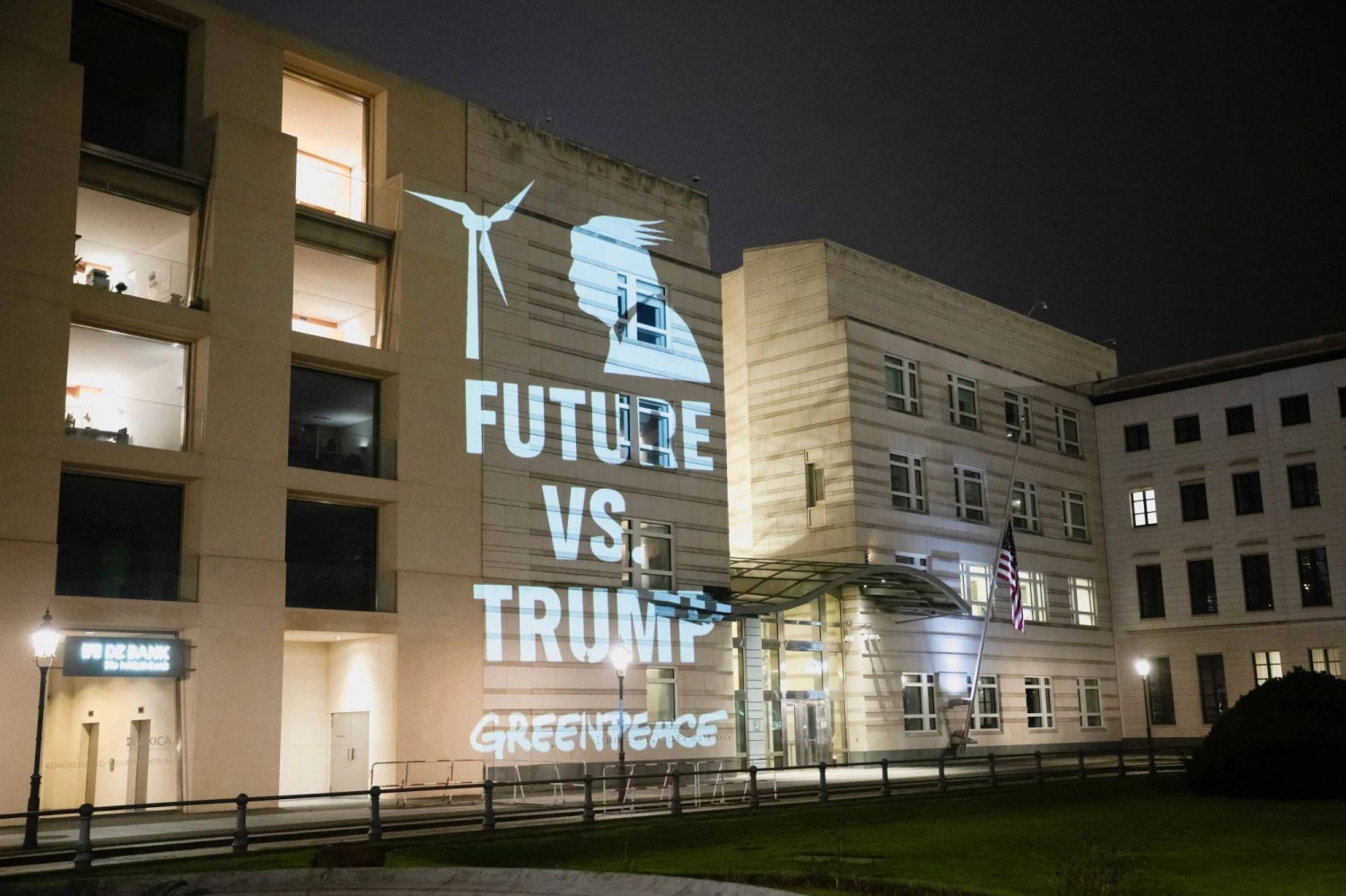
A projection set up by Greenpeace activists on the wall of the U.S. Embassy in Berlin after U.S. President Donald Trump’s withdrawal from the Paris agreement, on Jan. 21.
| REUTERS
All of this came as the climate crisis marched on.
Extreme weather linked to warming claimed lives, damaged people’s health and hurt the economy.
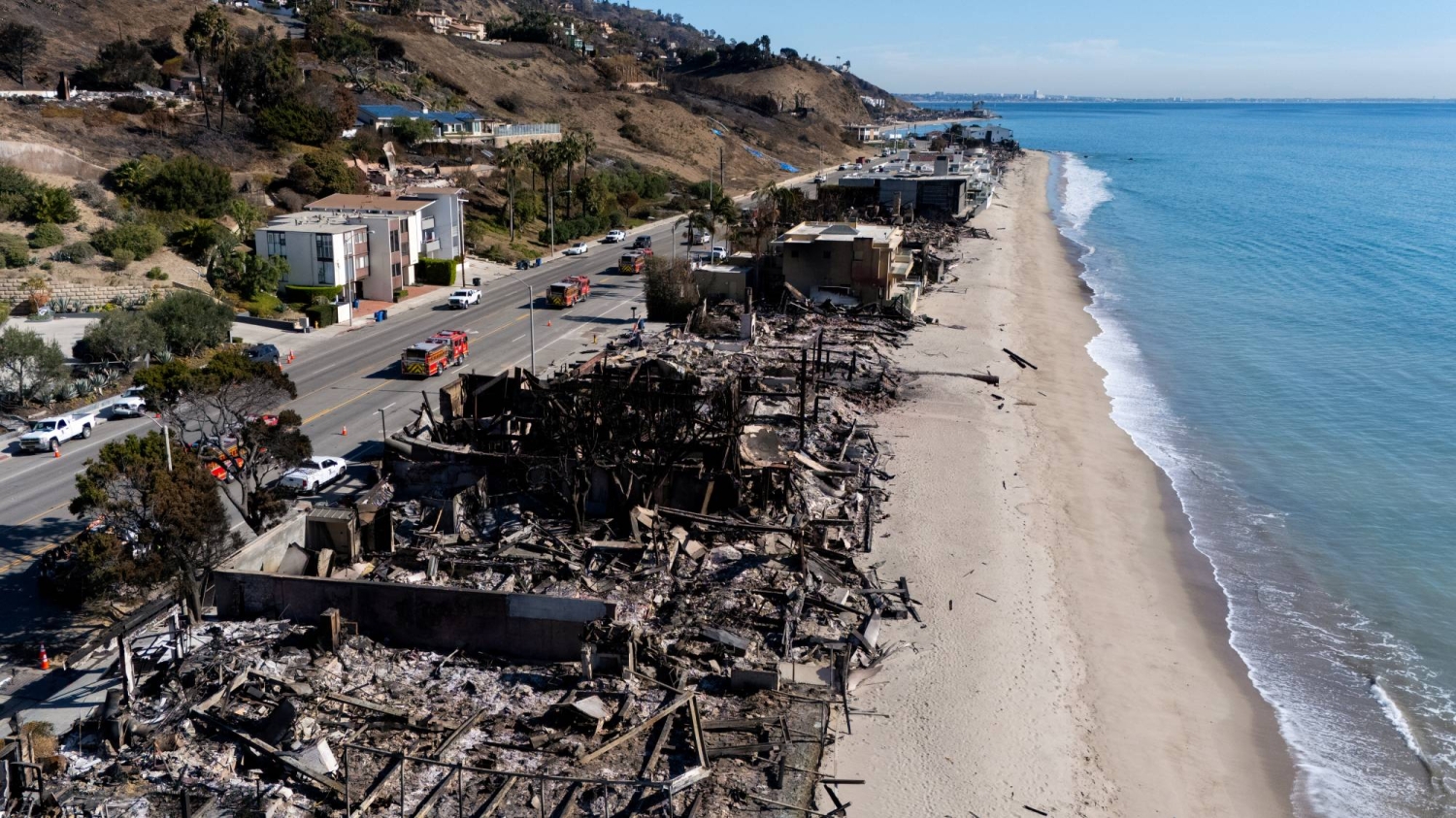
Wildfires in the Los Angeles area in January were the most expensive climate-linked disaster this year, with economic losses exceeding $60 billion, according to a report released Saturday by British charity Christian Aid.
In a section titled “Japan’s extreme year,” the report also mentions snowstorms in February and March after an unusually warm January. The cold snap caused massive train and flight cancellations in large parts of the country, including Tokyo.
“Climate change played a role in both the snowstorms and the summer record temperatures,” the report states about Japan. “Although global warming is making snow less frequent, high temperatures can lead to stronger downpours, both of rain and snow, because the atmosphere can hold more water vapor, which turns into snow when exposed to cold air.”
The Japan Meteorological Agency also said that average temperatures in the country throughout the year were the third-highest on record. The hottest year on record was 2024, followed by 2023. The average temperature was 1.25 degrees C higher than the 30-year average, according to the report.
Even more concerning was the fact that this past summer was the hottest ever in most of the country, with 132 of the 153 observation points recording the highest temperatures since the agency started taking statistics in 1946.
On Aug. 5, Isesaki, Gunma Prefecture, marked a national record of 41.8 C.
The sizzling summer heat also sent a record 100,510 people to hospitals due to heatstroke between May 1 and Sept. 30, according to data by the Fire and Disaster Management Agency. The agency attributes the surge to the earlier-than-usual end of the rainy season and the prolonged summer.
While organizers of the Osaka Expo managed to ride through the scorching heat without having to shut down the event, the experience has left many to wonder if it’s realistic to stage large-scale events at the height of Japan’s increasingly dangerous summers.
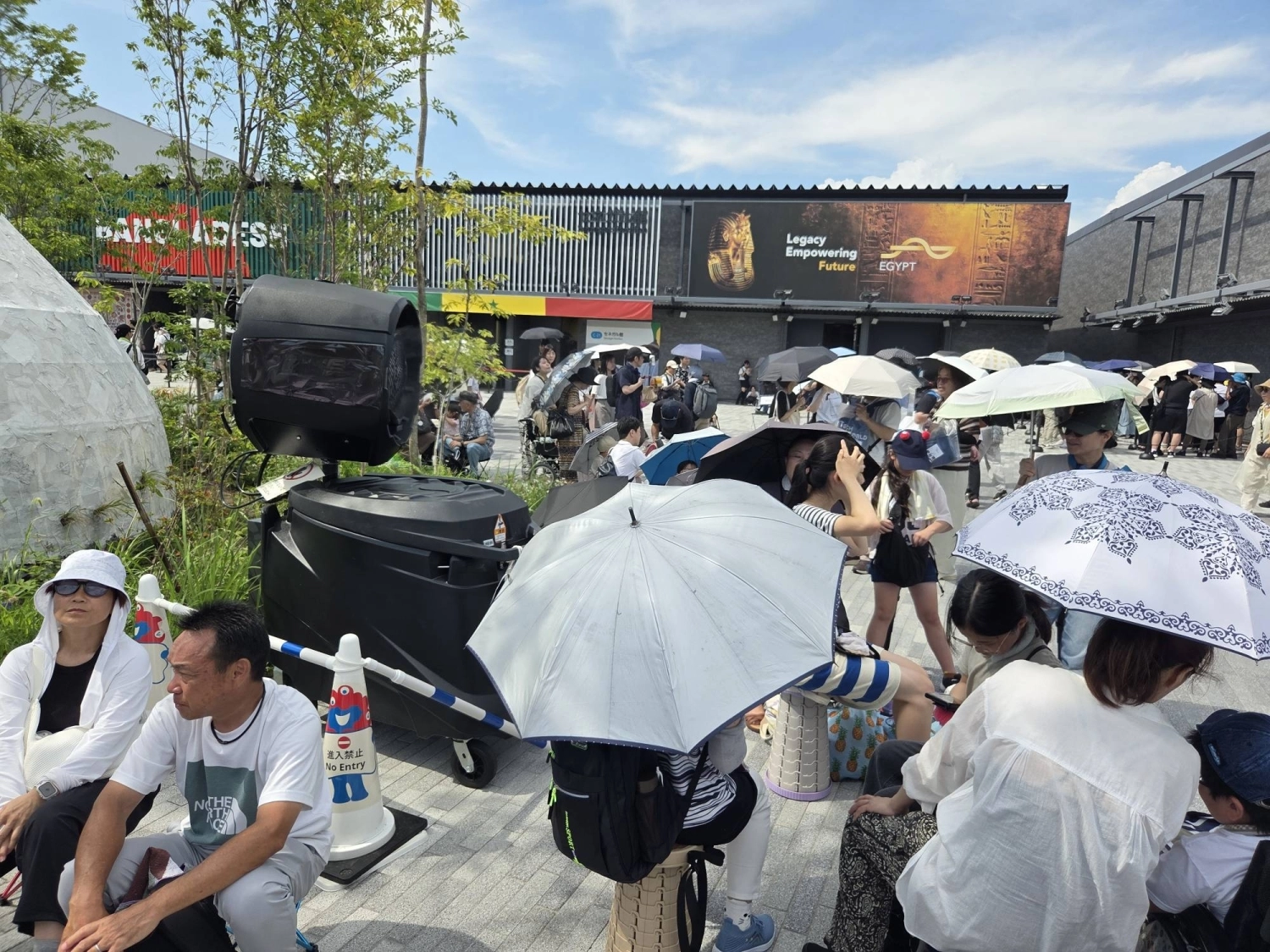
Visitors at the Osaka Expo in July sit near a large fan blowing mist.
| Joel Tansey
Japan, situated in the temperate zone, has long taken four evenly divided, distinct seasons for granted. But it has dawned on many people that, due to warming, Japan may be on the brink of losing its four seasons — and the cultural traditions that come with each. Niki (two seasons) made it into the top-10 list of buzzwords in the annual trend-watching event organized by encyclopedia publisher Jiyukokuminsha.
Another end-of-the-year contest, the kanji of the year, picked the character for kuma, meaning bear in Japanese, as the winner. The number of bear attack victims hit 230 people as of the end of November, the highest since the Environment Ministry started counting in 2008, out of which 13 died, also a record high.
Furthermore, the number of bear sightings has grown exponentially to a record 36,814 this year, up from 20,513 last year. October and November saw a daily deluge of reports of bears being spotted or attacking humans in areas previously unheard of, such as a supermarket and a toilet inside a train station in Numata, Gunma Prefecture, a residential district in Hanno, Saitama Prefecture, and even the backyard of a home in the town of Hinode in western Tokyo.
The government cites a poor acorn harvest as the immediate cause of the surging attacks and sightings in more urban areas, as bears roam into human settlements in search of food before hibernation. Experts also point to a mix of contributing factors, such as the aging and dwindling ranks of hunters and the loss of a buffer area between nature and human habitats due to depopulation.
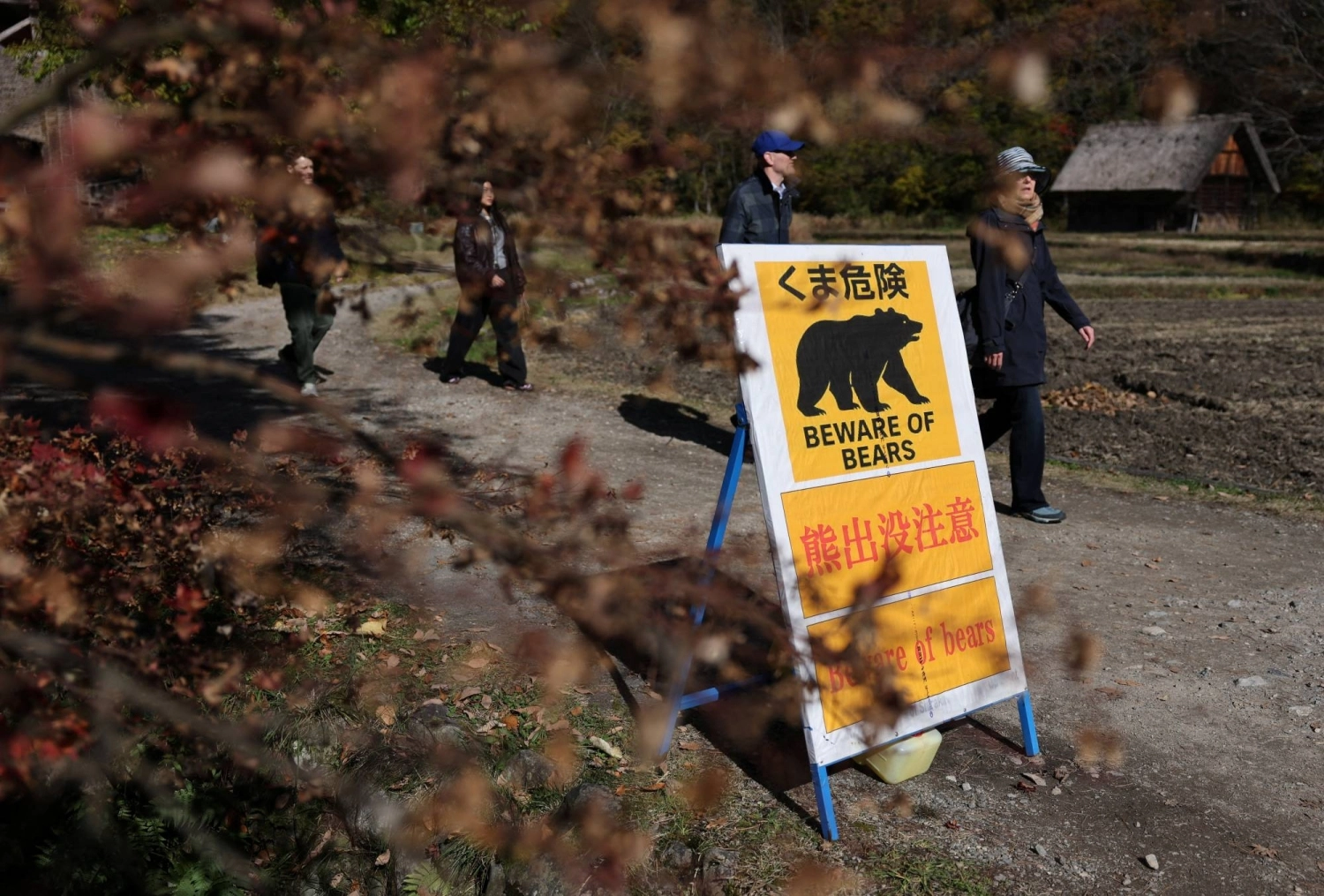
A sign warning people about bears near where a Spanish visitor was attacked by a cub at Shirakawa-go, a popular destination for tourists, in Gifu Prefecture on Nov. 15.
| REUTERS
But it’s hard to deny the effects of climate change, some experts say. Acorns are known to repeat the cycle of rich and poor harvest years. Researchers at the Forestry and Forest Products Research Institute wrote in a 2019 paper that rising temperatures over the past 40 years may have disrupted this harvest cycle and shortened it to two years instead of three to four years previously.
Warm winters driven by climate change are also upending hibernation patterns, with U.S. scientists reporting that black bears are increasingly staying active longer into winter or not hibernating at all. They warn of more human-bear encounters and conflicts in the future.
Despite setbacks, Japan made some gains in climate policy, research and action. In June, the government introduced new rules to fine businesses that do not protect their workers from the dangers of heatstroke.
Schools are stepping up heatstroke measures, too. The city of Kasai, Hyogo Prefecture, started running shuttle buses for its elementary school children from July through mid-September, so they don’t get heatstroke while walking to school. Some other schools have installed freezers to chill the cooling gear children use during their commute, such as cooling pads and towels.
In June, the Basic Act on Sports was revised, outlining the need for national and local governments to prevent accidents linked to climate change. Even the historic Summer Koshien high school baseball championship took steps to adapt, with organizers further adjusting the tournament schedule to have more games take place in the morning and evening to avoid the hottest part of the day.
Adaptation efforts are progressing and becoming more refined. Some farmers in Shizuoka Prefecture, the traditional stronghold of mikan production, have turned their attention to avocados, amid research that shows areas fit for the cultivation of the fruit could dramatically expand across Japan.
This month, the National Agriculture and Food Research Organization (NARO) announced it has developed a system to forecast damage to fruit farming caused by warming days and weeks before they occur. The system, utilizing NARO’s proprietary weather data service tailored for agriculture, allows farmers to predict insufficient coloring, sunburns and frost damage of seven fruits including grapes, apples, pears and persimmons, according to researcher Toshihiko Sugiura.
“Fruit trees are grown and harvested for 30-40 years, so switching to different fruit trees requires a long-term plan,” he told a recent briefing. “This (damage prediction) system we have developed is a short-term measure, to prevent (the climate impact on) fruit damage this year.”
Adaptation requires both long-term and short-term strategies, he said, noting that both farmers and consumers will benefit if farmers gain access to refined forecasting data and take measures only when necessary and thus save costs.
“We hope to expand the system to cover more fruits and more kinds of damage,” he said.