
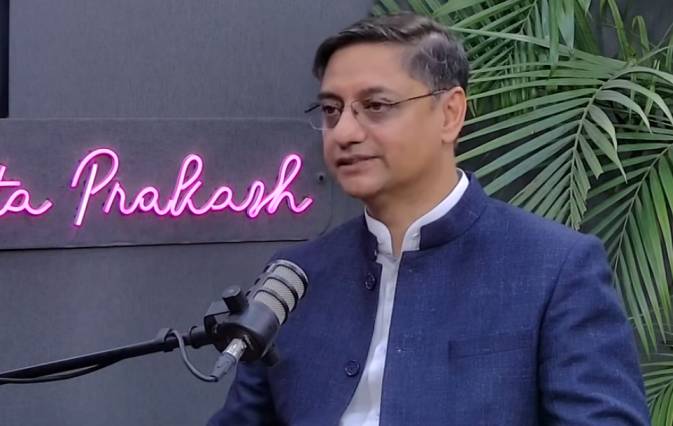
That was like, long, long ago. And we’ve been planning to have you back and it’s never materialized after that.
SANJEEV SANYAL: Good to be back.
SMITA PRAKASH: But thank you so much for coming. Before I begin on the economy and numbers and stuff like that, I want to talk about INSV Kaundinya. Kaundinya was a mariner.
SANJEEV SANYAL: Yes. He’s the earliest mariner that we know of by name from India. And he went off to Southeast Asia, married a local lass, and set up the first Hindu kingdom in the Mekong Delta, what is now Cambodia and Vietnam.
SMITA PRAKASH: Okay, but tell me about these pictures. When are you setting sail and where are you going? And look at that. My goodness. Economist means one thinks that you know, fat, thick glasses and not hip like this that you’re doing. Looks like you needed a lot of training to do this. Who are these people? What are you doing here? Tell me.
SANJEEV SANYAL: So just so that you know, the INSV Kaundinya, as you know, is a stitched ship. It’s a recreation of a fifth century—so what Indian ships would have looked like 1,500, 1,600 years ago during roughly the Gupta period.
And it is based on coins from the Satavahanas and a painting from Ajanta and some texts. And we have recreated it without using any modern technology. So it’s put together without any nails. It’s stitched together with coir rope, and as you can see, it has sails. It has no modern amenities except some safety equipment.
And the idea is to demonstrate that such ships were capable of going on great voyages across the Indian Ocean and exploring the Indian Ocean and beyond.
SMITA PRAKASH: What do you mean it’s got no modern equipment?
SANJEEV SANYAL: Nothing, no engine. So it is basically entirely sail powered. And as you can see from the photographs, that’s me training with the crew to pull the sails up. And so it doesn’t even have a rudder. It basically uses steering oar.
So it’s completely different from modern sailing. I mean it’s not just different from an engine-driven ship, which is most ships, but even modern sailing ships are completely different. So this uses very, very old technology.
SMITA PRAKASH: When you say stitched, what do you mean?
SANJEEV SANYAL: As I said, its hull is not put together with nails. So how does it sit? So basically it uses joinery and stitching. So there are parallel holes on the planks and then ropes are taken literally like stitching a piece of cloth and then held together with that.
And then of course there’s a resin called kudrus which is then used to sort of close all the gaps in the plank.
SMITA PRAKASH: So how does it withstand storms and things like that?
SANJEEV SANYAL: So that is what we’re going to find out. That is the whole point. But we have been training on it for last few months and I have to say she has behaved very well. She has weathered some rough weather.
But obviously if you do a longer voyage, which we plan to do to Muscat in the end of the month, then we will find out how she actually behaves out at sea.
SMITA PRAKASH: Okay, and what trial runs have you done before the Muscat voyage?
SANJEEV SANYAL: So since we put it in water in May and then it was inducted into the navy as INSV Kaundinya and since then—I mean the crew has been obviously, you know, we have gone many iterations, take it out to sea, sail it. There’s something, something.
Also remember that no living human being knows how to sail these ships. So we have had to learn from scratch the behavior of the ship out at sea. So even if you are an expert sailor in modern ships, this behaves in a very different way.
I mean you cannot do certain things you could do with a modern sport sailing ship that many of these sailors and the crew are used to. So we have to relearn many things. I have been going whenever there’s a long weekend going to Karwar myself and going through training myself.
SMITA PRAKASH: So how—who trained you guys to do this? Are they fishermen who are using it? Is it naval sailors? Coast guards?
SANJEEV SANYAL: So this is a navy ship. So the crew, there’s a crew of 15 plus one random economist. And so all the other 15 other than me are navy sailors. Some of them are national level sailors.
But as I said, they all sail modern sports boats which have completely different logic. So we have basically had to learn about how to sail this from scratch, basically take it out to sea so that you’re far away from rocks and things. And then you just experiment and experiment and experiment till you have a sense of, okay, this is what it does when you do this.
And we have had a lot of help from the Omanis who had built a dhow, also an ancient dhow with a later design from a later time, but many similar characteristics. So we did some conference calls with them and one of Captain Saleh, the captain of that ship, also gave us some tips.
But a lot of it is, you know, purely experimental. I cannot exactly tell you how it will behave in an actual real voyage.
SMITA PRAKASH: So what is the reason why you’re undertaking this journey? Why you’re undertaking this project?
Changing the Narrative: India’s Maritime History
SANJEEV SANYAL: So one part of it is to change the narrative of who Indians were historically. See, one of the things I’ve been trying to do, and not just this project, I’ve been writing these history books to show that, you know, Indian history is not what we have been taught to believe, that it’s not the case that Indians were somehow a passive people sitting in India waiting for conquerors to come and give us civilization and sort of we have no agency.
This is not a history at all. I mean, even a very little bit of digging into our own history will show us that this is not our history. We have a history. We’ve got a rambunctious history of adventurers and mercenaries and doing all kinds of interesting things.
And one of the things we did is very early on, long before even the Phoenicians, who are famous mariners of history, we were sailing during Harappan times to the Middle East, for example.
SMITA PRAKASH: Yeah, the seals were found in—
SANJEEV SANYAL: Yeah, the seals and all kinds of things are found. There are records of people called Meluhans going to Sumeria 4,000, 5,000 years ago.
SMITA PRAKASH: Amish has written right on Meluha.
SANJEEV SANYAL: Yeah, he has written fictionalized version, but it’s based on actual history. And we had a port Lothal and Dholavira and all of these places. But even later it continues. And we, you know, that’s why they were sailing out to Indonesia. They were sailing all the way through to Korea.
In fact, Korean history actually begins with the marriage of a local prince to a princess from Ayodhya. You know, so there were—and I, as I said, the ship itself is called INSV Kaundinya. Kaundinya was the name of the first Indian mariner that we know about by name. Before, we don’t know their name.
About 2,000 years ago—we don’t have an exact date—but he went there, as I said, married a local girl, set up a kingdom called Funan, the first Hindu kingdom in Southeast Asia. And all subsequent kingdoms of that part of the world trace their origin to this marriage.
So till even modern times, royal families of, say, for example, Cambodia trace their lineage back to this marriage between Kaundinya and Somalia. You have a country called Singapura, Singapore. There’s a whole another country called Indonesia. It names itself after India. Its currency is the rupiah. They actually have the correct pronunciation, rupiah.
SMITA PRAKASH: Yeah, rupiah.
SANJEEV SANYAL: Rupiah is the correct pronunciation, not rupee.
SMITA PRAKASH: All these countries, when you go, you’ll find frescoes, you’ll find sculptures and things. And you see the boats out there and the people on the boats who are, you know, rowing or taking the stuff out of the boats, the porters and all that. The features are like the people of South India. The jewelry that the—
SANJEEV SANYAL: No, no. So there’s enormous influence. The scripts to this day are derived from Pallava scripts. And unfortunately, this history is simply not taught. Now, of course I’m part of the redoing of the NCERT textbooks and you know, as part of that we are inserting some of this history back.
But just to tell you, the way history was told to us was that as if we were just a passive people. In fact, it’s not just the impression you get from the background. This is something explicitly written. And I’m not talking about colonial history. So colonial times, obviously I can understand, you know, they wanted to tell you that, you know, you have always been occupied. So they invented the Aryan invasion theory.
But even later on basically said, “Oh, you know, you Indians, you never cross the oceans. You are somehow sitting at home waiting for us to come and give you civilization.” Now that is true of 19th century, but even in the 21st century, books are written with this logic.
So for example, there’s a very popularly, commonly common book by somebody called Charles Allen, who passed away a couple of years ago. He published a book as recently as 2017 called Coromandel. So it’s a history of our coastline, the Coromandel Coast. So it’s a modern book, popular. You’ll get it in any major bookshop, Bhari Sons or whatever.
And what does he say in the very first chapter in the second paragraph? He says, basically the Indians have had no interaction with the ocean, except for a brief period when the Cholas raided Southeast Asia.
Now the Cholas raiding Southeast Asia is still taught, is a passing reference in Indian textbooks. But basically the impression you will get is that our interaction with the Oceans is that one Chola raid in 1025, we did nothing before that and nothing after that.
Entirely a misrepresentation of our history. What is going on here is that you are being fed a history where you are made to feel that you have really had no part in world history. You just, you know, maybe a large population, but basically you were hanging around doing nothing, waiting to be colonized.
SMITA PRAKASH: Waiting to be colonized.
SANJEEV SANYAL: And there are other people. Now, this kind of, I would say orientalism is a very important part of how global narratives are controlled. So be under no impression that this happens just like that. There is a fair amount of investment that goes into creating these narratives.
Now, in recent times you will have seen some withdrawal of this. Some of these western writers are beginning to talk a little bit about how great India may have been in ancient times, etc. But do remember that it is a controlled retreat in the face of evidence put together by a new generation of Indian writers.
But it is not the case that they have really changed their mind. What they are doing, be very, very clear, is a controlled retreat.
Breaking the Macaulay Mindset
SMITA PRAKASH: Prime Minister recently said that India is witnessing a psychological renaissance. He called it, and he urged people to break the Macaulay mindset. Could you explain to me what exactly is that mindset and how does India plan to break away from that now?
SANJEEV SANYAL: So the Macaulay mindset is not really about Macaulay the person. What it really is about is this psychological idea that we have imbibed into our nervous system almost that we are somehow functioning because, you know, as I said, civilization given to us by other people and that we have never had agency.
So, okay, the Mughals came and built Taj Mahal. That’s fine. You know, the British can come and do something, but we should not do anything. So now this is imbibed into us in a very fundamental way.
It showed through, for example, when we wanted to build a new parliament. Okay, what was the idea? But oh my God, what will Lutyens’ ghost think about it? Well, you know, it’s a free country. We can build our own parliament.
SMITA PRAKASH: Or those lions are looking aggressive and not smiling.
SANJEEV SANYAL: I know. Which is all strange because if you look at the original Ashokan thing, they’ve sort of got their teeth bared.
SMITA PRAKASH: Where are they smiling and benign lions, I would like to know.
SANJEEV SANYAL: Exactly. And even the original Mauryan lions are meant as a projection of Mauryan imperial power. They are not—they’re symbols of a powerful state. They are not some pacifist thing.
SMITA PRAKASH: Yeah.
The Colonial Narrative and Ashoka’s Reimagined History
SANJEEV SANYAL: And so throughout you will see this thing that if you look at colonial history and then even post-colonial history, you’ll see this veneration of Ashoka. Now, Ashoka was actually an almost forgotten character in Indian history. He was rediscovered by the British historians in the 19th century, and then he was packaged as some sort of a pacifist. There is no evidence of him becoming a pacifist ever. He was clearly a Buddhist before he went into Kalinga, and his edicts clearly suggest that he was not a pacifist even afterwards.
SMITA PRAKASH: But the entire narrative that we studied in school was that the war affected him.
SANJEEV SANYAL: Yes. But there is no evidence of it. It is just pure storytelling. The evidence is absolutely clear from inscriptions that he was already a Buddhist. No ancient text links his conversion to Buddhism, if you can call it a conversion, linked to the Kalinga war.
In the one inscription where he mentions the Kalinga war and his regret for it, you have to see the very next paragraph of the context in which he’s saying it. He’s not saying it as some sort of a regret and apology to the people of Kalinga, because this inscription is not in Kalinga. It’s in far away, in what is now Pakistan, where he says, “Yes, I killed all these people. I feel great regret.” And the very next paragraph, he says, “But if you forest tribes behave badly, I’ll do the same thing to you.” It’s a threat.
And the Sri Lankan text, which are very often used to eulogize Ashoka, the same text tells us about how he carried out massacres of Ajivika, of his brothers, of the Ajivikas, of Jains. All of this, he has multiple massacres that he’s carrying out. There’s no suggestion that he became a pacifist at all. So why was he? So the question is not about this history itself, which is clearly false. The question is, why did the British take it on?
SMITA PRAKASH: Yeah.
SANJEEV SANYAL: Basically, this is part of the same agenda. You have an ancient civilization. There’s clearly evidence that there were great empires in the past. But look, your best and most important emperor was a nice pacifist chap. Okay? So he’s the guy you should follow. Okay. Why? People like Shivaji are somewhat uncomfortable. And you see the same thing in the later period as well. If you read even the freedom struggle.
SMITA PRAKASH: No, you’re always told that the moderates were the good guys, the extremists were the bad guys.
SANJEEV SANYAL: Yeah. The very use of the terms moderates.
SMITA PRAKASH: And extremists, that’s what we studied.
SANJEEV SANYAL: Yes. Whereas the terms, what did Aurobindo Ghosh, later called Sri Aurobindo, call? The same combinations, he called the so-called extremists as the nationalists and the other guys as the loyalists. So the other side is shown in the literature of the nationalists as being collaborators. So you have to be very careful with the use of these terms. The very fact that this terminology is used tells you who told the story after independence into our textbooks.
SMITA PRAKASH: Right. So we have to develop a language of our own.
SANJEEV SANYAL: Yes.
SMITA PRAKASH: Which means not. Does it mean rewriting the past language or is it a future thing?
SANJEEV SANYAL: Look at the original primary evidence and based on that, you write a story that is reasonable. Not all of it will be clear. I mean, we debate what happened yesterday on our TV channels. So it’s not unusual that historians should debate what happened 4,000 years ago. Okay, but then look at the evidence and begin to look at it. It’s not like. Yeah, it’s not like Romila Thapar was having breakfast with Ashoka. She’s also trying to interpret the same text that I have.
SMITA PRAKASH: Yeah, but the allegation is that the BJP or the NDA government, ever since it’s come to power, they are rewriting everything with ineffective information.
SANJEEV SANYAL: And so the point is, it is perfectly fair to criticize where there is primary evidence that contradicts what’s in the textbook. Okay, perfectly fine. If such a thing is found, I will be the first to stand up and say this should be corrected.
However, most of what you have, as I said, I can take you through all the textbooks and every other step you will find some twisting. I mean, something as foundational as Ashoka is fictitious. So you can imagine what is there right through the whole narrative building, right through to modern times.
I mean, all these global indices, for example, will show you Nepal being put 50 ranks above India in democracy index till few weeks before it actually has a coup. So this is the kind of research and narrative building that goes on. Yours and my Wikipedia are continuously being twisted in a particular way. Yeah. So don’t underestimate the effort and energy that goes into controlling global narratives.
The War Against Big Tech’s Narrative Control
SMITA PRAKASH: You’ve literally run a crusade against this push to stop India’s sovereignty when it comes to the big tech platforms, how we are battling it, how India wants to set a narrative. How it is so difficult because the big tech platforms, they own everything, they have the narrative grip on the world. Explain to me this war that you are taking on.
SANJEEV SANYAL: So you have to understand that this is done through layering. So this is not very different from how money is laundered. So what you do is you create many layers. So if any money laundering happens, it comes from some dubious source, then it goes to some Cayman Islands or some such place, they’ll be sent to another place. After many layers of thing, it then comes out as white money somewhere.
Exact same thing is done in managing narratives. So first of all, in supposedly well-known journals or something, some relatively innocuous research will be published. Okay? Now then it will be layered into say a media report or a university paper and so on and so forth. So you will basically create a circular referencing racket which will then pop up on the basis of that in Wikipedia. It will be there in various kinds of social media and then a certain narrative will be built where that becomes the default narrative.
Now you can argue against it, but do remember that even in arguing against it, you are having to accept that framework of discussion. So when you say, for example, you are doing artificial intelligence, okay, now artificial intelligence is being trained on so-called good data, right? It has to be, everybody will agree. No, you should have authentic data and believable data. So what is this authentic data?
So they will say, see, we will take it from well-known institution. Now who decides what is a well-known institution? So for example, then Sweden, there’s an institution called V-Dem, Varieties of Democracy Institute. Now these chaps are funded by the same Soros, the same those kinds of USA type organizations. And there are several of these guys. Now they have on many layers created these indices.
Now you will train artificial intelligence based on V-Dem, Freedom House and all these kinds of things. And I have written papers to show how their processes of research are extremely dubious. It’s the opinions at best of a tiny number of experts who they don’t even tell you who they are. I mean, it’s not some great objective basis on which these indices are being created. They are based on some opinion. And when you question those opinions there is a lot of pushback or they don’t reply and doing all kinds of things. And so I’ll tell you a full story on this just now. So what happens is that artificial intelligence will now be trained on this. Now.
SMITA PRAKASH: So the more the papers that come out from these institutes, the referencing.
SANJEEV SANYAL: Cycle. LLMs begin to catch that. So now supposing your grandkids, let’s say 20 years from now, Google app, “Is India a democracy?” The system will say no, India is not a democracy. Use some term that they are today, innocuously inserting into the conversation that it’s an elective authoritarianism or some funny term will be used and that over time will become hardwired into the system like moderates and extremists.
Yes, and so this is the same thing, the same way in which we completely deny our maritime history and the moderates and extremists we will have electoral authoritarianism or some absurd term which will down by the default. Now you can argue with your grandkids that this is not the case, but this is what they learn in the textbooks and the guys who are writing the textbooks will call the same thing. And so this goes on.
So I have been challenging this for a while and I’ll give you one example of how I have won some of these battles. So the question is, why is all these V-Dem, Freedom House, all these, you know, Press Without Frontiers, Reporters.
SMITA PRAKASH: Reporters Without Borders or something like that.
SANJEEV SANYAL: Some French acronym. Why should they be of any importance? Why should we take them seriously? How did they enter into the ecosystem of intellectual debate? So firstly, obviously the same five, six institutions, various kinds of international NGOs, mostly US billionaires, basically Ford Foundation, Rockefeller Foundation, USAID, Soros, those kinds of guys fund through layers these institutions.
Now these institutions come up with these things, but they still need to be given another layer. So what used to happen is that the World Bank had something called the World Governance Indicators. It had a website and what it did, it created these World Governance Indicators and gave them a stamp of approval.
So when for example, real world people like JP Morgan, let’s say, creates or for example the sovereign ratings, they would use the World Bank’s World Governance Indicators. Part of the, about for sovereign ratings, for example, 20% of the weightage went to this world. Now you think World Bank, World Government stamp of approval. Stamp of approval.
Now you dig into this and you discover the following thing. It’s actually not based on anything the World Bank has done, but on two random researchers who are not World Bank employees, who are the persons who are in charge of this World Governance indicator. And if you research it enough, at the bottom there’s a small disclaimer which states that World Bank and its staff are not in any way responsible for these indicators. And that if you have any questions, go and talk to those two chaps.
So I actually did that because I questioned many of these. Democracy, happiness, all these kinds of indicators.
SMITA PRAKASH: Yeah.
SANJEEV SANYAL: And I wrote to the World Bank.
SMITA PRAKASH: Where Afghanistan is a happier place than.
SANJEEV SANYAL: No, no, everybody is a happy place except India. So I asked them how is this possible? Because we had Reporters Without Borders once. Actually I think it was Reporters Without Borders or somebody where India’s press freedom was less than that of Afghanistan and Pakistan. I remember this two, three years ago.
So I questioned this whole, their methodology, etc. And I wrote to World Bank saying that please tell me, how are you using this? So very quickly they sent me back a letter saying that, sorry, we are not responsible for all of this. These two researchers are. And then you write to them, they will tell you we have not done anything. You write to V-Dem, you see no responsibility.
So I questioned this whole thing. And India and several some other countries also raised this issue about a year and a half ago. And then the World Bank looked into it and I think in late 2024 they issued a notification saying that they’re withdrawing the World Governance Indicators and re-looking at how to rejig it. So pushing back matters, but it requires a lot of intellectual effort. But it is well worth doing it.
The Real-World Impact of Narrative Control
SMITA PRAKASH: Yeah, because it impacts on so many things. If investors want to put in money, they look whether these countries are democracies with functioning systems and things like that or not, and if we are not, as per this V-Dem and the others, then they will not send in the FDIs, won’t come in and all that will happen. Right.
SANJEEV SANYAL: And you see, certain default narratives will get set. Now unless you dig in that far, those devolved narratives will drive a lot of conversation. For example, our sovereign rating, I have been saying for years, is at least two notches below where we ought to be. We ought to be now. One of the rating agencies has upgraded us, so it’s. I personally think it’s one notch down, but the others we are still two notches below.
SMITA PRAKASH: So do we battle it or do we bring out our own ratings? What should we do? What does America do, for example, or Europe?
SANJEEV SANYAL: So basically what you have to do is to battle it. Well, they are not going to battle it because they are beneficiaries.
SMITA PRAKASH: So what do they do to become beneficiaries?
SANJEEV SANYAL: So well, they control the system. Look at who are the, who are the big S&P, Fitch and Moody’s. They are commercial organizations owned by Western shareholders.
SMITA PRAKASH: We have our own billionaires, so we should also have one.
The Kareej Sovereign Rating Model
SANJEEV SANYAL: So absolutely. I have been thinking about this for a long time and since I come from the financial field, at some point I said look, I used to be Deutsche Bank’s global strategist, I am from the pinnacle of their system, so why don’t I attempt to do this?
So a few years ago I actually over a few weekends I created my own system and tested it, just light testing and discovered that I can outperform all of these ratings by backtesting it. But then you see, issuing it from the Economic Advisory Council would not work and giving sovereign ratings to ourselves and the rest of the world, not going to work.
So I then said look, commercial organization should take this project forward. So I then thought, who could it be? Now India’s own credit rating agencies don’t do sovereign ratings. This is part of the narrative thing. They are large companies but we have been told stay in your lane, stay on your lane. And in any case Crisil, which is the largest one, is owned by S&P.
So I took it to Kareej, which is the second largest but it is Indian owned, it has some foreign shareholding but it’s basically Indian owned. So I called them in, they had come to me for some other work and I said look, here is a project, would you be interested? And to their credit they took it on and then they ran with it.
So they sort of built on the methodology, had suggested they refined it, made it much more robust, then took the data through it. I told them don’t need to just use IMF data so that nobody accuses you of—
SMITA PRAKASH: Yeah, data manipulation. Okay.
SANJEEV SANYAL: And in April of 2024 they issued the methodology comments and everybody agreed it was a good methodology. So in October 2024 they issued 39 countries sovereign ratings. They issued it. Now we now have 14 months of data of what happened to those sovereign ratings.
Now you’ll be pleased to know that since they were issued something like 13 or 14 credit events have happened. So either somebody got upgraded or downgraded. Of those 39 countries, this Kareej model predicted every single one of them suggesting that it is actually a better model than that of S&P, Fitch and Moody’s. So it is outperforming that model. But we’ll have to create a longer track record and more models.
SMITA PRAKASH: Right, like this is only for sovereign.
SANJEEV SANYAL: Yeah, we can do it for democracy. We can do it. So I have now talked to a university professor and I’m working with him to create our own democracy index. Of course, once I have created the system, I hand it to them to run because it is not credible for me as a government economic advisor to run them.
And I always make sure that that model that I have put is put up for scrutiny so that there’s academic scrutiny of it. Then tell me if my model, if you think the methodology is wrong, tell me, I’ll change the methodology. There’s a reasonable. But after everybody agrees that this is a credible methodology, then whoever is running it puts data through it and it gives a certain result, then you have to stand by that result.
Tech Platforms and Open Systems
SMITA PRAKASH: Also, tech platforms, you mean you battle with them also? Like can we actually make our own tech platforms or is it going to be this constant battle with the big guys?
SANJEEV SANYAL: I think we should be prepared for constant battle with the big guys. I am not in favor of closed systems, even if China has succeeded to some extent by doing it. Because at some point in time you will end up with the ambassador car problem. You will end up with shoddy products because you have a closed market.
So I am a believer that while we should support our own and encourage them in various ways, it didn’t work.
SMITA PRAKASH: Right. That Koo started, it shut down and it was—
SANJEEV SANYAL: I’m sorry, I did try to use.
SMITA PRAKASH: Even I tried.
SANJEEV SANYAL: So it wasn’t world class.
SMITA PRAKASH: And then the other one, Aaratai.
SANJEEV SANYAL: So that is what now I do not want an ambassador car problem. So I am okay with iterate, iterate, iterate till we get it right. It’s okay. Be open, be willing to support your own, but in an open system so that the systems that you do ultimately generate are genuinely competitive and world class.
SMITA PRAKASH: Yeah, I mean we have done to a large extent this digital sovereignty that we keep talking about our UPI pay systems and things like that. It’s something that the entire world is looking at.
SANJEEV SANYAL: Yes, because we supported our own system, but at the same time it was an open system. So I am a big believer that you have to support your own, but do not do it in a closed system. As I said, you will very quickly end up with a situation where your domestic entrepreneurs will focus on getting themselves protection rather than in investing in R&D and so on.
And so a generation later they will be more interested in sending their kids to set up family offices in Dubai than setting up labs in India.
SMITA PRAKASH: So limited I’m going to get to that part too limited outreach, limited regulation or outreach with limited.
SANJEEV SANYAL: So you keep regulation to the least that you can. Now obviously, if there is clear misuse even by an Indian, if a monopoly pops up, let’s say, then be willing to crack down on it because even an Indian monopoly may manipulate things for their own interests.
So just because I am in favor of capitalism, do not confuse it with the interests of capitalists. Capitalism is not the sum total of the interests of capitalism.
Democratic Health and Global Narratives
SMITA PRAKASH: So what is the democratic health of the country at this stage? Is it completely different from what these indices are showing us?
SANJEEV SANYAL: Absolutely.
SMITA PRAKASH: Or is it? It is.
SANJEEV SANYAL: It is. I mean, we have now since the emergency, we have not had any major breakdown in the transfer of power based on voting. People will debate. In a democracy that’s fine. But rambunctious as it may be, we have been a successful democracy. And just because the results are not the ones that certain foreign think tanks think are in their favor, does not mean that we should.
SMITA PRAKASH: You’re saying it’s just lazy research or it’s motivated research.
SANJEEV SANYAL: It is motivated research because as I told you, this whole layering process is done deliberately. And I’ve written about this too.
SMITA PRAKASH: And why is it? I mean, I understand 200 years ago, not independent, when we were a colony then. Yes, you have a colonial master today. Why would it be?
SANJEEV SANYAL: We are an important part of the global geopolitical and geo-economic landscape. And this controlling us and putting it into a box is an important part of the agenda of other players. Even those who are our friends will not be necessarily happy to cede our space.
So even those who may otherwise wish us well, it’s not like they are being bad. Even within families you will have cousins or friends who will may have been very nice to you growing up, but maybe somewhat uncomfortable if you become super successful. So the same problem. When you say Vasudev Kutumbakam, do remember that families have their own jealousies.
So even those who may otherwise wish you well may actually genuinely want you to reduce poverty and other things. They may, on the other hand, when it comes to ceding space at the global table, not be happy. So manipulating the global narrative in a certain way is an important thing that has been going on by the way, from the beginning of time.
So it’s not a new thing, it is just that we used to take it as a given. But we should now begin to realize that we are now a big boy. We need to punch at our own weight. We can begin to look at the global narrative and reverse the gaze.
So, for example, if there are Khalistani causes raised in the UK Parliament or Canada, I don’t see why we shouldn’t discuss Scottish independence or Quebec independence in the Indian Parliament.
SMITA PRAKASH: Okay, that’s being a bit ambitious because India traditionally has this. We don’t interfere in issues.
SANJEEV SANYAL: We should not interfere with anyone who does not in any way interfere with us. That is true.
SMITA PRAKASH: Yeah.
SANJEEV SANYAL: But I do think that there should be an idea of reciprocity that we should have.
SMITA PRAKASH: Okay. Have an opinion. Okay. When you were talking about the Indian growth story and it makes other countries uncomfortable, we all grew up with the—not grew up. I’d say that in the past 15 years or 20 years since liberalization, post liberalization and things like that, what we were given to understand is that the Western world appreciates India’s growth story, sees us as a partner. But is it making them uncomfortable that our growth trajectory is at a faster pace than they would like it to be?
Navigating a World of Frenemies
SANJEEV SANYAL: Of course, as I said, even your friend, it’s not necessary that they are wishing us ill in the sense that they may be okay with us removing poverty as long as we stay in our lane. Once we are big enough to be and we are now big enough to be a major player, then you have to be willing to accept that it comes with the game changing that you now your car is big enough to be not quite fit into the lane that has been designated.
SMITA PRAKASH: So the west and America are forthcoming with their opinions. You kind of can gauge when they like your rise, when they don’t. How does East Asia look at us? How does West Asia look at us? Apparently the West Asian countries now want to be part of the India growth.
SANJEEV SANYAL: So I don’t think you should think of it as black and white.
SMITA PRAKASH: Okay.
SANJEEV SANYAL: On certain issues they may like it. If they want to sell you energy, they want a growing economy, they want to sell you arms. They may like a growing economy because you have more money to buy their arms or energy or so on.
So it is not like, as I said, you are dealing with a world of frenemies. On some issues they’ll be friends. On other issues they may not be. We should stop having this idea that he is my chadi yaar, believes and he will agree with me on every point. No, this is we need to be.
SMITA PRAKASH: Behaving like adults voyage that you’re taking and showing India as a maritime power. I’m sure countries in Southeast Asia are uncomfortable. For example Singapore, they will look at it right, because they are amazing.
SANJEEV SANYAL: Not necessarily. In fact, I have been talking with them. They are quite excited about the fact that we maybe want to do in 2026 a voyage to Southeast Asia to in fact to the island of Bali. So if this voyage to Oman goes well, then the idea is to take the ship to the other coast and sail it from Odisha to literally recreate the very famous ancient voyage called Balijatra.
Okay, so there is excitement. The question is how do we engage with the rest of the world in a positive way and bring them onto our thing. So it’s about engagement. So there’s two ways of doing this. Either we—I mean just because I’m standing up for India’s interests does not mean that we have to then become jingoistic and push everybody else around. No, we have to look useful to other people’s interests.
The Mood of the Indian Economy
SMITA PRAKASH: Okay, let’s go to the field or to the area of the mood of the Indian economy. How do you see it today? Are we really in the path of a long term growth cycle or is this an over optimistic view of things?
India’s Economic Growth and Employment Reality
SANJEEV SANYAL: Well, long-term growth cycle in the sense that the opportunity is there. I mean we are clearly growing very, very fast. The latest number of course came in at 8.2 for the quarterly number. My own thing is the statistical reasons why it’s running at above 8. But I think we are doing, I mean on a sustainable basis we are doing something like seven, which is not too bad given the overall global, disrupted global environment that we are dealing with. It’s not a bad sort of pace at all.
So are we in a long cycle? Well, some opportunities are there for the demographics, for example, are in our favor for next 25 odd years. But this is not something that naturally happens. It’s not like you do one round of reforms in the beginning and then 25 years. It’s a continuous process. You have to keep adjusting along the way new situations arise. So this is a game that has to be actively played.
So do we have an opportunity to dramatically up ourselves over the next 25 years? Yes. Will it necessarily happen? Well, it depends on how we play. And so at this juncture, I think we are doing a decent job. To have these 8% type growth rates, even if it is for a quarter or two with almost no inflation is not trivial. And there are all other macro indicators also doing well. Whether it’s a banking system is fine.
SMITA PRAKASH: You speak about demographic potential that we have. The big criticism is that India is growing without creating enough jobs. Explain this to me.
SANJEEV SANYAL: So this is actually not true. The best data we have on job creation is in fact the PLFS. Okay, anybody else who is talking about is just giving anecdotal data. I have an uncle who has a son whose friend cannot find a job kind of data, real data is PLFS. PLFS clearly suggests that there is growth in employment. There are other indicators as well, EPFO, etc. But PLFS is the best. But even the other ones also suggest.
And the other simple one is just you go and talk to large companies and see is it the case that they are able to hire easily at certain price points. And all of them will tell you that they are having to push up their wages, which tells you that the wage market must be certainly not weakening. If anything, it is tightening.
And certainly I think that is a fair thing because we also have done consumption driven surveys in recent years and my colleague Shamika Ravi has written a paper on this recently. Yeah, and you can clearly see that the number of Indians who have got all kinds of things from fridges to some sort of a scooter or car, etc. has dramatically gone up in percentage terms.
So the number of households in India who have, using cell phones or various kinds of electronics or refrigerator and so on has dramatically gone up. And this is so, I mean this is not just basic stuff. Like we even decade and a half ago, most Indians did not even have a toilet. And we now have a situation where most Indians actually, I mean most, almost all Indians have a toilet at home. And in addition to that have now got all these other potable water, those kind of things.
SMITA PRAKASH: Things are getting done.
SANJEEV SANYAL: So to say that this is happening without any job creation is absolutely not a reflection of reality.
SMITA PRAKASH: It’s not any job creation, but like we need to create what, 80,000 jobs a day or something like that and several lakh jobs a month.
SANJEEV SANYAL: So you have to be a little careful with those statistics. But it is a large number because do remember there are people retiring, passing away and so on. So some natural job creation anyway happens. But we are a high growth country and there is no example in history of any country growing for a long period of time and not generating jobs. This idea of jobless growth is an utterly fictitious idea.
SMITA PRAKASH: Every country is fighting this, whether it is the developed economies of the west or if it is struggling economies in Africa. Everybody is struggling with trying to find solution to the jobless growth.
The Myth of Jobless Growth
SANJEEV SANYAL: So I am objecting to this idea. There is no such thing as jobless growth. All technology leads to a churn. Okay, so for example, when you created the Internet and so on, certain kinds of jobs got wiped out. But jobs like podcasters popped up. I mean, who would have thought that social media, social media influencer or podcaster would be a job profile? Who thought that Zomato or ordering online would be a job profile? But these exist.
So every technology will destroy some jobs. But the history of technology since the industrial revolution every time has created more jobs than it has destroyed. So far. It has not happened. Maybe something will change, but there is no evidence yet of more jobs not being created through these cycles.
And so this is being true also. Here we are creating enormous numbers of new jobs. Some of them are high quality jobs. After all, almost every large company in the world now has a GCC in India. Those are all jobs.
SMITA PRAKASH: Yeah. Who is it who just now said that whatever technology comes, plumbers will not be out of job in this country or in this world?
SANJEEV SANYAL: This is the sort of thing Nassim Taleb says. But the point is, yes, that is a high skill activity in a certain sense.
SMITA PRAKASH: Yeah, but I’m coming to skill development. Basically that.
SANJEEV SANYAL: Yeah. So the point is to give respect.
SMITA PRAKASH: To skill development in this country. Again, a big thing. BA karna hai MA karna hai PhD. This is the middle class India has grown up with.
Rethinking Education and Skills
SANJEEV SANYAL: Not just middle class India. This has been true for the 20th century. By the way, till the 20th century, people going to university as a routine basis was a very rare thing. It was an elite activity. In fact, it was not even a signal of education, but of wealth to go to university.
So what happens in the 20th century is that there’s massification of university education. This is a 20th century phenomena. Now what you’re seeing is technology is making the lecture based university irrelevant, right? Because artificial intelligence is vastly superior at giving you lectures, even answering your questions.
So now tertiary education has to be completely rethought. And that does not mean that there are no jobs. This is a problem for the skilling system. In fact, we now need to see a collapse between the idea of skilling and tertiary education. Earlier, skilling was seen as something that plumbers did and tertiary education was where all the hi fi people went and they did some great philosophical upgradation of intellectual, intellectual upgradation.
But we are just going to discover that that is going to collapse because you are going to see a situation where I can learn pretty much anything about any subject online and get reasonably good at it. I can have random economists becoming ship designers.
SMITA PRAKASH: What was the disruption happening even when we were in the coaching centers which were coming about? You know that disruption had begun.
SANJEEV SANYAL: Yes. So for example, NIIT did more for creating Indian software sector than all the other degree walas combined.
SMITA PRAKASH: It was just about beginning. I remember when we were getting into college and all that that, if you didn’t get into IIT then you get into REC. If you don’t get into REC then you got into NIIT and then it became the NIIT people.
SANJEEV SANYAL: Were doing it on the side. I mean many people may be doing an English degree and doing NIIT on the side.
SMITA PRAKASH: But then slowly.
SANJEEV SANYAL: Yeah, so this will become the standard because at any age you can learn new, you will need to learn new skills all the time. The current system is what you go to university till age 25.
SMITA PRAKASH: This is the reform that you are thinking was going well, this is going.
SANJEEV SANYAL: To happen whether I reform my system or not. Okay, so what used to be the case that till 25 you got some education but because knowledge is stable and technology is, relatively speaking in the context of a lifetime of person over 30 years is relatively stable, you have therefore that education takes you through. Okay?
And so today what will happen is in a high changing environment, the guys in their 50s who are now in their positions of power are the most outdated guys in the system taking decisions. So this whole education system is gone, right?
SMITA PRAKASH: You have been posting a lot, writing a lot about the UPSC and this obsession, national obsession to take the UPSC. Waste of time.
SANJEEV SANYAL: Because frankly you and I are products.
SMITA PRAKASH: Of that in the sense that our parents were.
SANJEEV SANYAL: Our parents were. And it may have been a great idea in the 1960s, but times have changed. I mean, being a stenographer may have been a good option for somebody in the 1940s. So what? So technology has changed. And it is not just changed, it has now become a routine affair. Every few months your phone is getting upgraded and is able to do something new.
Now I cannot have a curriculum that can keep up with it in the way that university education currently functions. Upgrading my entire professor faculty in that way is very difficult to do. So AI will just be vastly superior at delivering cutting edge knowledge.
Now that doesn’t mean that universities have nothing to do. They just that doing it the way they are doing it today is a waste of time. So what you need to do is to much more oriented toward apprenticeships. And actual skills because the industry is ahead of academia. Yeah, right? So you need to get people into job market, into jobs early.
In fact, there are people like Elon Musk or Vembu in here in India who, and I subscribe to that. You should actually think that at 18 people find jobs and they go to work and they do degrees on the side and immediately somebody will say, oh, but what about the social aspects of going to university? Well, guess what? Till the 20th century, people didn’t have social lives. In fact, even today the bulk of human beings don’t go to university, don’t have social lives.
SMITA PRAKASH: I just felt I was wasting my time in college. I mean I was getting the education, but there were five to six hours where I was doing nothing and I.
SANJEEV SANYAL: I hardly ever attended the class. So I mean I enjoyed university, but nothing to do with attending class and imbibing.
SMITA PRAKASH: Yes, I do so much more because.
SANJEEV SANYAL: I would have said if systems allowed me then I would have preferred to be at work at 18 and do my classes online and take exams and yes you can. For practicals, for example, if you want to learn surgery, you still have to go and learn it or whatever. For those kinds of things you have classes.
SMITA PRAKASH: So different models.
SANJEEV SANYAL: Different models. Different models also.
SMITA PRAKASH: So this universalization which the BJP gets attacked for that you want to universalize and you want to make one model for the entire country for everything, including education.
SANJEEV SANYAL: But that can be, then you see, it can be free and open. So already the IITs this morning only they announced that if you want to leave after three years, you’ll get a BSc from IIT and I think IIT Madras or somebody has just issued this. I think it’s great and I think this should be allowed.
So there are many things in the new NEP that allow for this freedom. The problem is it also includes outdated ideas like four year university degrees. Why do you need to go to university for four years if I can do three degrees in one year? That’s my problem.
SMITA PRAKASH: It’s going to cause disruption in many ways. And that disruption is good, you feel?
Embracing Technology and Disruption
SANJEEV SANYAL: Absolutely good. We need to embrace it. Artificial intelligence needs to be embraced. And will it cause a great deal of disruption? Yes, it will. But those of us who imbibe it fast, we’ll be able to use it as a tool to upgrade ourselves.
After all, what is technology? Technology is basically something that allows a low skill person to do a high skill job. Okay, so now somebody with lower skills can do things that would have required a lot of training and education earlier. So it would have taken you a long time to reach the level of knowledge of a top end lawyer. Today AI can make a 18 year old with a high school degree be able to get to at least some part of the, some part of the journey.
Now you may still need some at the margin. Non codified knowledge of a lawyer will still be needed, but 80% can be done.
SMITA PRAKASH: Sanjeev, you are an economist, you’re an academician, but you’re also sitting in bureaucracy. You’re sitting with the bureaucrats around there formulating policy. Do you see them adapting to this new world?
Municipal Reform and Urban Management
SANJEEV SANYAL: I think you will be surprised how fast Indian bureaucrats adjust. I think the mental image of Indian civil servants needs to be upgraded a little bit. Now I’m not speaking for every single one, but anybody who knows me knows that I am an extremely disruptive person.
SMITA PRAKASH: Yes, that’s what I want to know. You’re a lateral entry. How do they accept you and your radical ideas?
SANJEEV SANYAL: You will be surprised how many of my radical ideas have been implemented just in the last few months. And so you will be also surprised to know that there are several fairly radical civil servants in the system. Like for example, you have Mr. Rajiv Gauba who has been given the job of doing the reforms. He’s now in Niti Aayog, but former cabinet secretary. And you have seen a slew of reforms which are driven by his office. I work very closely with him and there are many others as well.
So what it requires, you see, as in any large number of people, there are always 20, 25% of the people who want to go out, do stuff, are adventurous, intellectual, want to be intellectually challenged. And there are always 20, 25% who don’t want change or are, etc. And then there’s 50% who go with whatever is the prevailing culture. That’ll be true of your organization as well.
SMITA PRAKASH: Culture has—you see there are also those status quoists who have benefited for generations from that. And they’re going to perpetuate or they want to perpetuate.
SANJEEV SANYAL: Absolutely. So this will be true of any large even in a corporate. So the question is therefore who is the leadership. So in a government system it’s a political leadership. So the political leadership provides opportunity and encourages the change makers, the reformers. Then the overall culture also shifts. It’s not just they succeeding. About 50% who are generally go with whatever is the prevailing culture will also shift to that. Suddenly you will have 80% of the system delivering in a particular direction.
SMITA PRAKASH: So what is that one reform that India hasn’t tackled as yet, which keeps you awake at night?
Supply Side Reforms and the Next Generation of Change
SANJEEV SANYAL: Well, I sleep very well, so it doesn’t keep me awake. But I would say that I think if you see all the big central government reforms that needed to be done, labor laws done, insolvency and bankruptcy, cleaning up of the banks now, more recently, pulling back all the QCOs, the quality control orders, I think at the central government, we have now reached a point where our systems are reasonably good. I’m not saying you can’t improve it. There are some more things we can do. I think if you saw the honorable finance minister talked about cleaning up the custom system and so on.
SMITA PRAKASH: Supply side reforms.
SANJEEV SANYAL: Mostly what we are doing is supply side reforms. I am a supply side person. I have no question about it. That doesn’t mean we don’t care about the demand side. The demand side, however, is managed as a stability, not a driver of growth. So we are very much into macro stability. So we do pay attention to the demand side. But you will see we are very, very conservative. Even at the height of COVID we made sure the monetary and fiscal side was very restrained.
So that has resulted in good things that has anchored our system. It has brought inflation down structurally. But that is not what generates growth. It creates the stability of the system. To do the supply side part, which are all these process reforms, the structural reforms that we are doing, and you will see a few of them announced all the time, I write extensively about them. So that is what generates the forward movements, like a bicycle. There is a balance part, which is the demand side, and there is a forward movement which is the supply side.
Now, if you try to generate forward growth through the demand side, for the most part, it will generate bad outcomes, except during a shock. So, yeah, I understand if there’s a demand shock, you may want to—like during COVID. But even there, if you remember, we were much more—we were very, very restrained. And we did some, but we were restrained about it. So this is something we think about a lot.
And we are doing continuous reforms now on the central government front. We are doing very well. The next generation of reforms has to be about something somewhat different. And there are two things that I have spoken about extensively. One of them is we’ve got to be serious at some point about judiciary and judicial and legal system reforms.
SMITA PRAKASH: Correct?
SANJEEV SANYAL: Right. This is something absolutely critical. The second thing, we have got to do something about municipal management. This is not a central government thing. We’ve got to do something about our cities.
SMITA PRAKASH: Yes.
The Crisis of Indian Cities
SANJEEV SANYAL: So let me explain. 30, 35 years ago when I was at university, I used to think that our cities are badly run and the amenities are poor and so on, because we were a poor country. And that’s true. But now, 35 years later, we have certainly become richer than that. We are still poor, maybe by global average or whatever, but we are certainly radically richer than we were 30 years ago.
But our cities have not really improved. The odd metro system may have come in, etc. But by and large the quality of life of our cities is not significantly better in the public sphere. The private sphere may be different, better restaurants are there. They have replaced the old movie theaters with now fancy multiplexes, etc. From the private sphere, it has upgraded. The public spaces, however, have not really upgraded for the most part. Yeah, and this is something we need to take seriously.
Compare that with, for example, Vietnam country, which is roughly at the same per capita income. You go to Ho Chi Minh City, you go and look at the public communities. They are clean. There’s not a case of lot of money to be spent. This is a matter of civic pride. So we need to think through our municipal management.
And it is not that we cannot clean them when we set our minds to it. After all, I remember Indore being just one of the most dirty industrial towns, like any other. They got cleaned up. So when we—same systems, same IRS officers and bureaucrats. So if you set your mind to it, you go to Bhopal, also reasonably clean. And then you come to the national capital.
SMITA PRAKASH: No, you can see the degeneration. Chandigarh used to be so clean, so good. Which used to compare it to Surat, which, or rather used to say that, here you have a city which is so close to Delhi. But look at—
SANJEEV SANYAL: So I think we need to take—
SMITA PRAKASH: And look at the pollution in Delhi.
SANJEEV SANYAL: Absolutely no excuses for it. There are many reasons for it. First of all, as a people, we need to get serious about what the issues are. So unfortunately we’ll have pointless debates about Diwali, which has nothing to do with it. It’s one day. And that day, by the way, if you look at the statistics, barely different from the day before or after. Whereas there are serious issues about stubble burning. That is one part of the issue. It’s not the only issue. There are serious issues about construction dust. Yes, there are serious issues about burning of garbage and so on and so forth.
SMITA PRAKASH: And public transport and public transport. Functional public transport. We have the Delhi Metro, but even—
Walking: The Foundation of Urban Transport
SANJEEV SANYAL: Here, even there, the conversation has to be about serious things. So let me now take that particular thing and show you. Delhi Metro is actually a fairly large network. Now, it’s not a small network as it may have been. By any standard, the Delhi Metro is a decent system. But what is the problem? You come out of the Delhi Metro into absolute chaos. Why? Because we do not invest into the next layer, which is walking.
SMITA PRAKASH: Yeah.
SANJEEV SANYAL: When I talk about last mile connectivity, it becomes about how to allow some three wheeler or some other such thing and try. No, all public transportation has to be based on the last mile being walking.
SMITA PRAKASH: Yeah.
SANJEEV SANYAL: Okay. Not anything else. Not even cycling. And very often we then have these fuddy duddy ideas of adding cycling to walking. So I am a big cyclist. I spent years cycling back and forth from work. But it’s not to be confused with walking. Walking is the single most important form of transportation in any city.
SMITA PRAKASH: Yeah.
SANJEEV SANYAL: It is cheap, it is egalitarian and essential to all public transport systems. And yet we don’t invest in sidewalks when you come out of anything. In fact, we have some euphemism called “road widening.” What is road widening? It is narrowing of the pedestrian space.
SMITA PRAKASH: And the pedestrian space is for people to sell their wares.
SANJEEV SANYAL: Absolutely.
SMITA PRAKASH: Cannot invest in a shop. They sell their wares. It’s for cyclists to ride on.
SANJEEV SANYAL: We need to have a serious conversation as citizens of cities. And those conversations have to be driven by citizens and not by activists. This is another very important issue.
SMITA PRAKASH: Okay, get that? Activists, yes. Citizens, yes. But also of the city planners. We don’t plan our cities.
City Management Over City Planning
SANJEEV SANYAL: So here also I have a somewhat radical view. This problem is not a problem of city planning, it’s a problem of city management. Let me separate the two out. The reason for that, I’ll explain. You see, what we call planning in India is actually not planning. It’s called master planning of a certain kind. Basically what we do, we take a 2D map, we draw various kinds of straight lines on it, then some great theoretician will come and decide various kinds of zones.
And I’ve gone through this process, by the way, even for Delhi and many others. And they will say, “Oh, we have studied 30 years of past data and so we now know that this industry should be here.” Hello. If you know which industry is going to grow over the next 30 years, why are you spending time in town planning? You should be in the stock market.
So this is an utter waste of time. What you need to do and you do need to plan. You need to plan the trunk infrastructure. You need to plan the look and form of what the city will look like, not what that building will do and what is in the private space. Instead, if you look at our building codes, the BIS building codes mostly go on and on about how much gap there should be between the boundary wall and your building. What you should be doing about the staircases inside your house. They are not about public space at all.
So we need to have a conversation when we talk about planning. The planning has to be more about the management because cities are continuously changing. So it’s about transition management. It has to be about the look and feel of the city. It has to be about walkability. It has not to do with zoning except for a few dangerous industries. We should allow everything inside the city.
SMITA PRAKASH: If you allow it. For example, the Ambani Cultural Centre has been built and it’s huge and BKC has happened. It’s huge. But the way to that is—so you invested and the same with the Bharat Mandapam. Lovely, everything nice. There was the trade fair thing, which was earlier.
SANJEEV SANYAL: So you build the infrastructure for it.
SMITA PRAKASH: But there was no infrastructure around.
SANJEEV SANYAL: So build the infrastructure for it every day. One part of it is of course bad signage, which is another debate to be had. But you need to invest for these things.
SMITA PRAKASH: And manage it and make the infrastructure. Private sector making its infrastructure. Build the flyovers, build the signages and stuff like that. Plant the trees before.
SANJEEV SANYAL: No. So this is where I am disagreeing with you. The point is, if we were also wise, then Gurgaon would be still a retiree town. If you went back to 1990 before the IT boom and back office boom and you asked some civil servant to plan Gurgaon, he would never have built for what the city became.
SMITA PRAKASH: Yeah.
SANJEEV SANYAL: So this whole idea that we should have some wise town planner and he will very wisely think about what will happen 30 years and he will build infrastructure is a waste of time. You’ve got to do this as it happens.
SMITA PRAKASH: No, but I went to Navi Mumbai and they have—they have done everything so—
The Gurgaon Model: Evolution Over Planning
SANJEEV SANYAL: Exactly. And has Naya Raipur succeeded? No. It’s an empty, large empty space. It will never be anything if you do not allow it to evolve. That’s the point I’m making even in Haryana.
Let’s go to Chandigarh. Why didn’t Chandigarh, which is supposedly planned, become the hub of all this great BPO and all of these kinds of activities? Because it couldn’t be done there. Because Le Corbusier, who was the great town planner, never envisaged that you would have essentially large white collar factories.
Gurgaon, for all its failures, simply allowed it to happen, maybe through all kinds of breaking of rules. But if we had gone with the so-called building codes, we would never have that sector would not have emerged.
So rather than complain about changing times, adapt to it. How do you build for it? Continuously invest into it. And that requires many of the things that you now need to invest into. Gurgaon do not need you to have some great planning. Removing garbage did not need planning. You knew if there is a city, it needs garbage removal.
Yeah, it does not require great imagination to think that the green spaces being taken over by wine shops is not great for environment. I have nothing against, I’m not a teetotaler and I have no problem with wine shops being there. But does every green space have to be taken over by one?
SMITA PRAKASH: And you don’t need every two miles, you don’t need a wine shop.
SANJEEV SANYAL: Yeah. So you need to manage the city. So do not let off today’s city managers on grounds that there was no planning. All cities evolve. All living cities evolve forward by continuous upgradation and management of transitions.
The Millionaire Exodus and Business Elite Churn
SMITA PRAKASH: Sanjeev, you also heard about millionaires and sons and daughters of billionaires leaving the country. 23,000 millionaires have left India since 2014. Supposedly it’s a major reason—it’s not tax. Many people say it’s because of tax.
SANJEEV SANYAL: Well, some part of it. Some people will make the excuse for genuine. I don’t know that we can tax.
SMITA PRAKASH: Or whatever quality of life.
SANJEEV SANYAL: So one part of it’s quality of life to some extent. Yes, I can have some sympathy on air quality and issues like that. But let us also be very, very clear. Some part of it is that we are not seeing enough churn in our business elite.
And so what is happening is that if you create a business elite which is relatively static, after a few generations, they will lose the fire for innovation and they will ask for protection of their industries in India while they set up family offices in Dubai. Every elite will do it across the world. Nothing unique to even India.
So this is very, very important therefore that you keep renewing your elite. That is the reason I talked to you earlier about the Ambassador car problem. After all, there are in the same Bangalore which all kinds of problems. There are startups doing amazing things. Yes, sure. Those kids are sitting there in somebody’s backyard or garage or something and doing new things.
So why does it need these millionaires’ children to be sitting in Dubai? They don’t. So let us not excuse our business elite who are not investing in R&D. They are using their occasional CSR activities as some sort of a substitute for the hard work of being knee deep in the mud of their factory doing shop floor work. And this happens to every few years, to every elite, not just an Indian. This has happened.
SMITA PRAKASH: It doesn’t worry you?
SANJEEV SANYAL: No. So the key solution to this is to keep our system open enough that it allows for continuous churn. This is why I’m a big, big believer in insolvency and bankruptcy. You have to allow continuous insolvency and bankruptcy. You have to be completely okay with large companies dying continuously.
So you know, if you go back to 2017, there was, you will remember our banks were in very bad shape. Yeah. How did we clean them? We absolutely bankrupted some of India’s largest companies. Did it make our corporate sector weaker? No, it came back much stronger.
And we have to allow this continuity. We allow Jet Airways to die out. That allowed for some other airlines to grow. If those companies are unable to keep up with better compliance with airlines civil aviation norms and so on, we should have no problem with allowing this kind of churn back.
The Duopoly Debate and Market Churn
SMITA PRAKASH: Since you talked about civilization, let me come to that. The criticism is that your government allowed for this duopoly to exist. The other airlines fell off and as a result of that the customers are suffering.
SANJEEV SANYAL: No. So I have a different view on this. We should allow continuous churn, allow keeping alive Jet Airways. We would have ended up here as well. So we should have no problem with allowing—see you cannot tax success.
If there’s an airline that is successful, we should not be unhappy with it till such time that that monopoly space is in any way misused. At that point, the regulators and society at large—regulators are only in a democratic country—society at large has to be okay with disciplining them in whatever way is necessary. It could be market discipline through how customers behave or regulatory discipline. You have to allow that continuous churn.
India’s Financial System and Risk-Taking Capital
SMITA PRAKASH: One question which I want to ask you is that, you know our financial system that we have, it’s been very robust till now, but is it ready to support India’s next stage of growth that we have? I’m talking about banks, NBFCs.
SANJEEV SANYAL: And so the single biggest source of risk-taking and innovation money is actually not never going to be banks and NBFCs. They’re actually going to be equity money.
And let me say that India’s stock markets are currently, and you know, capital markets more generally are currently being able to finance more money raising than even London. I mean I was in the financial markets, I started in the mid-90s. I would never have believed that Mumbai would be more important as a money raising center than London or Singapore or some of these big centers.
In fact, I remember that Bangkok was a more important financial hub than Mumbai back in the 90s. So the fact that Mumbai allows for this kind of money raising is an extremely good sign.
Debt capital is important. Banks are important. I’m not saying they’re not important. And there are areas where debt matters. Right. But in the end, risk-taking money is important. You need venture capital, you need equity money, you need large successful new companies listed in the Indian stock market and India has created many of them.
So my measure of Indian success will be that in next 25 years that we talked about that in 25 years time the large company, the top 20 companies of our stock market are completely different from the ones that are there today.
And I’ll show you how that has worked. China, if you look at, go back and look at it. Large companies of 20 years ago you would have counted some large petroleum companies, some public sector banks, etc. 20, 25 years ago. Today their largest companies are Alibaba, Tencent. You hadn’t heard of BYD? BYD I hadn’t heard of till like 36 months ago. It’s one of the largest car companies in the world. You can even see BYD on Indian streets now.
So this is what an energetic country does. And even for all the criticism you can do of the US, US still has this energy. It is still able to create a Google, Facebook, SpaceX, Tesla. Look at their continuously churning. That is what generates the energy of the US.
Now I’ll contrast that with Europe. Look at Europe’s companies 30 years ago are the same companies today. They are billionaires who are basically producing leather handbags and furniture.
SMITA PRAKASH: Stagnation.
SANJEEV SANYAL: That is stagnation. Even India’s billionaires do things which are telecommunications or petrochemicals or whatever ports.
SMITA PRAKASH: Diversified. Diversified, yeah.
SANJEEV SANYAL: So I want to see the next generation should be—that’s why the churn is very important. We should not, we should be completely comfortable with people going bankrupt which should not be held as a moral failure. It is a byproduct of a risk-taking society.
And this goes back to my whole point about the voyage of INSV Kaundinya that we have to have this risk-taking culture. For all the Kondiyans that reached the Mekong delta and married a local princess and set up a kingdom, there must have been many, many others who perished making the voyage or got killed by local tribesmen or whatever bad things happened to them. But that was our culture.
Europe when it came out of, became, you know, through Renaissance and became dominated the world, it had—you may not think Christopher Columbus and Vasco da Gama were good people, but you cannot deny their risk-taking ability to sail off into the unknown.
State Bankruptcies and the Freebie Culture
SMITA PRAKASH: Talking of bankruptcy in the private sectors and allowing that to happen, talk to me now about governments, state governments which are facing bankruptcy because of the freebie regimes that are happening. Can we get into that? What is your view on this?
SANJEEV SANYAL: So I have always been very, very uncomfortable with freebies. But I will distinguish between freebies and safety nets. So some amount of safety net is needed in any risk-taking culture because some of it will go wrong by definition.
And don’t think only on billionaires, trillionaires. A risk-taking culture is taking risk all the time. Whether it is even setting up a Kirana shop is a risk at that level. So if that is what is happening and you are allowing technology to cause churn, you have to allow for the fact that there will be some people falling off at the edges all the time and you have to have some safety nets for them. So that safety net I am in favor of.
Okay, so I want to clarify here. I am also in favor of some passing of benefits to the poorer sections to give them the ladder to climb up. That also I have no problem with. Okay, so if you want, for example.
SMITA PRAKASH: So normal trickle down is not happening.
SANJEEV SANYAL: Or is it happening? Some will happen.
SMITA PRAKASH: The trickle that you put out with that Shamika had put out, which is like.
SANJEEV SANYAL: So both happen. Both you have to do what I will call assisted trickle down. Some will trickle down to some people, some will not trickle down. For every story you will see of a rickshaw puller’s daughter who cracked the UPSC exam or got into IIT or whatever, there are others who didn’t.
So both have to be done. You have to create the pathways up and some people, some people will climb, some people will climb the ladder and some people have to assist it after they pulled up. So that is fine.
What I have a discomfort with is this idea that you, for example, you know, freebies or women can do ticketless travel in buses. Now it doesn’t really—it’s not targeted whether you’re rich or poor. A poor man is as worthy of being supported on public transport as a woman. This is just a clear case of freebie. It’s not a large amount usually and most people should be able to pay that. You can subsidize it to some extent, but this is an example should be.
SMITA PRAKASH: Tied to the economics of it all.
SANJEEV SANYAL: Yeah, but you wouldn’t be able to do it in a public. Any case. Most people using public transport come from a relatively lower strata. You can subsidize it up to a point, but having these populist things that you know.
SMITA PRAKASH: But all these mahila things of Behna, this.
The Pension Time Bomb
SANJEEV SANYAL: So you have to be very, very careful with doing all of these kinds of things. And I am particularly uncomfortable with creating, many states have done, having very generous pensions for civil servants, for example.
You know, you have to be very, very careful about doing this because you are effectively creating liabilities for the next generation. Because most pensions you can have pay-as-you-go schemes, but if you are creating systems that will be paid out of current revenues, then be very, very clear that as our demographic turns at the end of this cycle, after 25 years, the population of working age will shrink and you will be loading that shrinking working population with the pensions of the previous generation and they will not be able to pay it.
And so what you have, for example, in Europe, you are continuously extending out the retirement age. You know, there is discussion, several European countries of taking it as high as 75. France today has more people getting pension than it has people working.
So you will have a serious breakdown if you do not do these kinds of, you know, think these ones through and begin to promise pensions. So I always tell young civil servants who are, you know, entering the workforce today that, look, do not be too excited about very generous pensions in the old pension scheme framework, because be very clear, through your working life you will be taxed over the next 35 years.
But when you turn up at the top of the queue for getting it, be absolutely clear that there will be no money to pay you. So you should be the one bunch of people who should not be excited about this because the demographics will not support it. It just, the arithmetic doesn’t work.
State Resources and Budget Allocation
SMITA PRAKASH: Okay, what about those states which complain that, you know, we don’t have money now for this growth story. We don’t have money to build our bridges, we don’t have money to build our public infrastructure. What do we do? Like Chief Minister has already said that and he’s competing against Chandra Babu Naidu who seems to have a lot of funds.
SANJEEV SANYAL: So yes, I can’t comment on individual states because I’m official of the central government. But let me say that the amount of resources that are now available to states whether it’s from their share of GST or other sources or for that matter there is also opportunities of doing any other things from monetizing land and other assets. To say that you do not have resources at the state level. Of course everybody wants more resources. That is generically true. The whole field of economics is about how to do trade-offs for limited resources. But you know some of these states.
SMITA PRAKASH: Like for example Bengal has complained against your ministry not giving enough funds.
SANJEEV SANYAL: Well I am not in any ministry but the Finance Ministry. Look that’s part of politics. I cannot comment about it. But let me say the amount of resources now available is order of magnitude higher than what it was a decade ago to all states and at the central level. And if people, if there are states that are finding it difficult to have resources then I think the citizens of that state need to have an honest look at what the budget is spent on.
India’s Position in the Fragmented Global Order
SMITA PRAKASH: So as I’m concluding I want to ask you about the position that India occupies in this fragmented global order. Where do you see India now? Is it a balancing power? Would you say it’s a swing power? How do you see India?
SANJEEV SANYAL: So we are now well after obviously this, we live in a world of the big two. There are clearly two big economic and military powers in the world which one is being the US and the other being China. And then there is a next layer. So I would say we are in that next layer which includes of course Europe, it includes us and maybe Japan or whatever other countries you want to add to that layer. We are a part of that layer. But of course we are growing faster.
So you know at some point we will become in the next whatever 24, 36 months we’ll become the world’s third largest economy. Our geo-strategic position and military capabilities depending on which space you look at we are I would say after the big two we are in the, depending on the field we are in the next two, three countries to be cared about.
So if you’re taking a military view of the world then Russia will be in there. If you take an economic view you may take the European Union in there. So it depends which space you’re looking at. But we are an important player. Most fields we would be a serious player in the next tier.
SMITA PRAKASH: Do the G1 and G2 want us closer to them or do they want the distance between us?
SANJEEV SANYAL: It would be very unusual from a human psychology perspective want us to be closing the gap even if some of them may want us to be allies in certain activities. So as I said, we should think of the world as a world of “frenemies” who will collaborate with us in certain areas and oppose us in other areas.
Now this is not to suggest that we should consequently sort of go back into some shell. No. If you want to play in the world you have to play your flex game. Play the flex game. And it’s not just about flex. You have to collaborate with others. You see in order to be something useful to the you have to for them to be useful to you, you have to be useful to them.
SMITA PRAKASH: Pick your partners carefully.
Multi-Alignment vs Non-Alignment
SANJEEV SANYAL: Pick your partners in the space. What I’m repeatedly saying, multi-alignment is fundamentally different from the idea of non-alignment. Non-alignment general idea is the world is a dangerous place, let us be union leaders of the poor countries and somehow keep away. That is not multi-alignment.
Multi-alignment is that we are a player in the world. We matter and we will align given our own interests with different countries and different spaces depending on what works. Now that what works will have to work for the partner country in that space as well. So if we have a free trade agreement with some country it should work for us. But we should also be clear that it has to work for the other guy. Otherwise why should they do it?
SMITA PRAKASH: Why would they?
SANJEEV SANYAL: So it is not a passive withdrawal. It is an active act of being a part of the world.
India-China Relations and Economic Engagement
SMITA PRAKASH: The CEA he recently said, Mr. Nageshwaran said that China does not want to allow India to grow the way west allowed China to grow. So now how does this align with India’s China policy? What’s going to happen with that now?
SANJEEV SANYAL: So Anant’s view is not different for what I’m saying. Look, the west encouraged China at a particular point in history partly because do remember when did that rapprochement happen? It happened in the 1970s. It happened in an environment where the west was trying to wean China away. And then it sort of built up a certain relationship which the Chinese, to be fair to them, they maxed out, used it maximally to build themselves up and good luck to them.
I mean I don’t hold it against them that they use the space so beautifully to sort of build themselves up. We may be in a different environment and it’s maybe that the Chinese do not want but look, there are areas where we may collaborate with them in BRICS and other places.
SMITA PRAKASH: On economy can we like for example. Yes, you said we have BYDs on our streets now we threw out TikTok.
SANJEEV SANYAL: So we have to where it suits us. We need to be willing, let’s be very, very clear, for goods imports, China is our biggest supplier of all kinds of inputs. Even the success of our Apple phones would not work without input from China. So this whole idea that we have to somehow, you know, that’s why I keep going back. If you want to be a part of the global supply chain, then you have to be a part of the global supply chain. So you can either say that I will not play a game of tennis or you go in there and occasionally you will, you know, you have to be willing.
SMITA PRAKASH: That you will not be alternate supply chains. Be part of everybody.
SANJEEV SANYAL: Yeah, you be in part of the. And then create and be, you know, be able to play that game. So if you want to be in the global game, you have to enter the arena.
GDP Growth and Measurement Methodology
SMITA PRAKASH: Okay, finally, India posted 8.2% GDP growth in July-September quarter. Economists argue that our GDP estimates rely heavily on, not on formal sector data but they are indirectly they are, they’re using data points which are not formal. Like what is, where is the problem and is it fudged? I’ll ask directly.
SANJEEV SANYAL: Of course not. I mean this is based on a very well established system. This whole criticism is coming because of IMF’s C grade that it gave. But be very careful about this because the IMF has basically what has it said. It has said very clearly that we need to update our indices which are already still stuck in 2011-12. By the way, I happen to agree with the IMF’s criticism.
SMITA PRAKASH: Yeah, you said this often that we have old tools we are using to measure.
SANJEEV SANYAL: Yes. When we upgrade them, ironically the level of our GDP, not necessarily the growth rate, the level of our GDP is actually going to be higher one because if you for example have an index or so you come to different backlaws.
SMITA PRAKASH: That the reason is different, your motive is different because you say we would be higher.
SANJEEV SANYAL: Yes, because you see, so the point of the matter is supposing you have an index which still includes say typewriters in there. We don’t produce typewriters in any significant quantity. But it doesn’t have adequate weightages for say cell phones or something. We now produce will the size of GDP go up or down? It’ll go up.
So when you upgrade the thing in a changing forward moving economy, the upgrading of the index where everybody is screaming for will lead to the level of GDP being higher than being measured. Other countries also nothing new. Other countries that do this also see the level goes up. Vietnam did it some time ago and it turned out Vietnam’s GDP was a little bit higher than what they were originally measuring it. It will happen here as well.
If all our indices, there are many sectors that are not there. For example, podcasting may not be a major sector in there. Maybe today it is. I don’t know. And by the way informal sector is measured in different ways. Some accounting of that happens. But if we add that back, the economy is not going to shrink. It will be bigger than.
So this awkwardly for the critics who are not making a methodological point, those who are saying methodologically, I’m with them, those who are making a political point, they awkwardly if and when this upgrade happens, which by the way will happen in February, March of 2026. So not budget. You’re talking just a few months from now.
SMITA PRAKASH: Okay.
SANJEEV SANYAL: And when that happens, there will be more complaints. That is actually causes GDP level to.
SMITA PRAKASH: Isn’t that an international way of mapping this?
SANJEEV SANYAL: Yes, absolutely. This is common every decade. We are supposed to do this. We have not done this because the year 2020, see, we went from 2011-12, we should have done 2021-22. But the 2021-22 data had a problem because those were Covid years and the data would have been all over the place. So you had to wait. Now we will do it on 2023-24 data which is the.
SMITA PRAKASH: So we make our own measuring tools now which are going to be more reflective of the.
SANJEEV SANYAL: Of the current. Yes, absolutely. So for all my criticism of Delhi’s air quality and municipal management, let me also say that all this construction is also GDP. You can see it all around you. It’s not some theoretical thing. I mean you go to any city, go to Mumbai, look at the new airport, the new coastal road. All of this is GDP growth.
And then it facilitates further GDP growth. Because one, building it as GDP growth and then using it is also GDP growth. So this is what GDP growth is. So you could visually see that, you know, economic activity is growing.
Infrastructure, Jobs, and Enabling Technologies
SMITA PRAKASH: See, many of the states say this, that okay, you build this big data center. Like for example Bihar will say that data center banaya apne. But the jobs that they give out are not enough. They are not. There aren’t many jobs there. And even if they have, say 3,000 jobs, most of them have come from Bangalore and they’re taking the job. So what does one do then?
SANJEEV SANYAL: So first of all, data center is a particularly bad example because it is a data center. Of course, the construction of the data center, managing it, etc. just create some jobs. But data centers are by definition data centers. But it’s an enabling infrastructure for doing everything else.
SMITA PRAKASH: With AI, they’ll have 15 people doing it.
SANJEEV SANYAL: Maybe 15, maybe not. But AI is an enabling technology for allowing millions of other jobs to happen. So you would not be able to have Blinkit or Zomato or even airlines today without those data centers. So if you’re having, let’s say you are saying you want tourism, then let’s say all the new small hotels that are popping up and are able to market themselves online, they are based on this data center.
So to say the data center itself did not generate jobs, first of all, is meaningless. We need these data centers in order to be able to do that. Secondly, to run that data center, you need all kinds of other jobs. You need the energy input into it. You have to build the data center, the inputs into the data center, managing the data center. There’s a huge number of jobs that are created by data centers.
So just simply mining the part of our growth story. It’s a part of our growth story. To look at a data center and say that it doesn’t have a large number of people is not a meaningful way of thinking about it.
SMITA PRAKASH: Okay, thank you so much, Sanjeev. Thank you for coming on the show and demystifying a whole bunch of issues for us. Thank you and all the best for your voyage.
SANJEEV SANYAL: Thank you so much.
SMITA PRAKASH: Thank you for watching or listening to this edition of the ANI Podcast with Smita Prakash. Do like or subscribe on whichever channel you’ve seen this or heard this. Namaste, Jai Hind.
This episode is powered by easemytrip.com.
Related Posts