
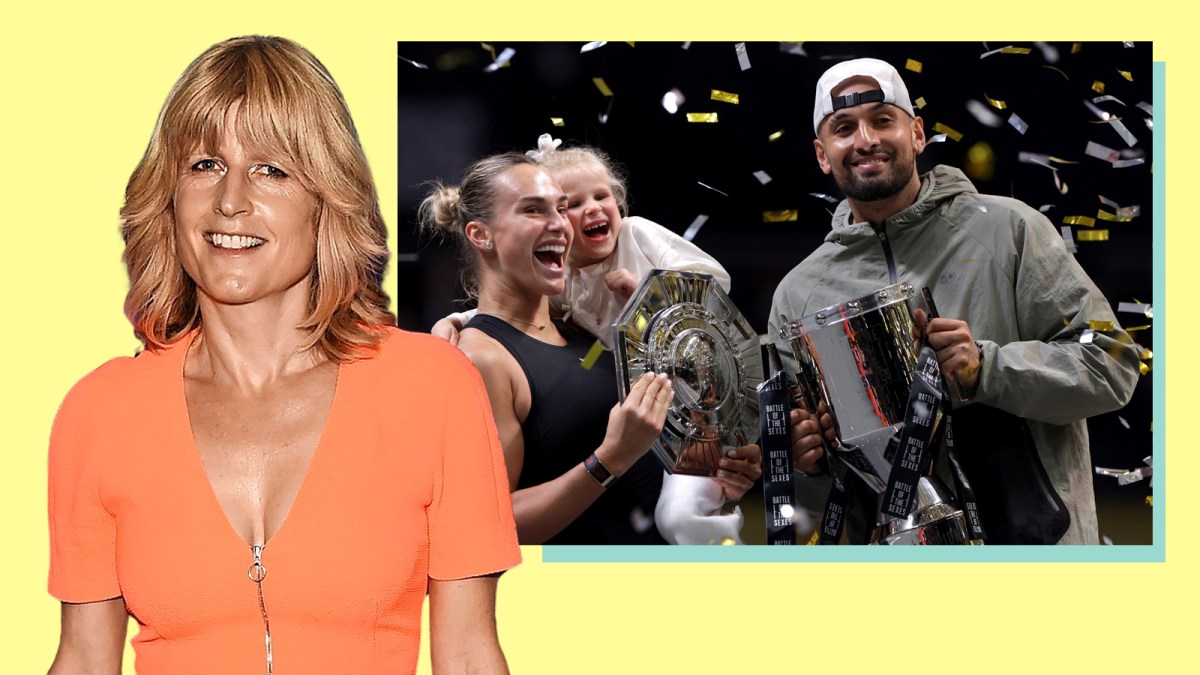
It was unbearable to watch. There was that Procrustean court, as twee and as tragic as the “lady’s tee” on a golf course, shrunk on Sabalenka’s side to give her, in theory, some spatial advantage over Kyrgios. That was awful.
So was the one-serve rule, which would supposedly prevent the 6ft 4in Kyrgios sending unreturnable Exocets at his 5ft 11in female opponent. Despite these unforgivable mitigations in what was billed as a top tennis match and raw, pulsating entertainment, we still had to endure the pantomime of watching the top-seeded women’s player in the world, a glorious stone-cold glamazon goddess, losing to a dopey Aussie in a baseball cap, ranked 671, who looked as if he had been bed-rotting for most of 2025.
I could only watch for one set, through splayed fingers. The outcome was never in doubt.
After most matches you can come away saying, “Tennis was the winner,” but I think we can agree there are exceptions. This was one. I might also mention here the time I hit with Cameron Norrie.
He was the British No 1 at the time. I was a very average middle-aged player who had just been dropped from the ladies’ fourth team. Before we went out on court I joked, “Well, you’re going to need a big box of Mansize Kleenex to wipe your tears when I beat you,” and he gamely laughed because, well, look at the physical facts of the matter.
• Cameron Norrie: I want to be world No 1 — that’s why I act like it
Off court, the 6ft 2in Norrie is quiet, unassuming. On court, he is a beast. Dominant, physical, with screaming footwork and a looping forehand that kicks like a donkey, a flat backhand freighted with lethal spin and a demonic drop shot — basically your complete all-court game, with what the commentators describe as “tremendous hand skills”.
All his returns whistled past me or overhead. I didn’t even see his serve. After only ten minutes I was wheezing from chasing his backhand down-the-line returns. I felt I would throw up. In the end I won one rally. Someone said I also served an ace, but if I did I don’t remember it.
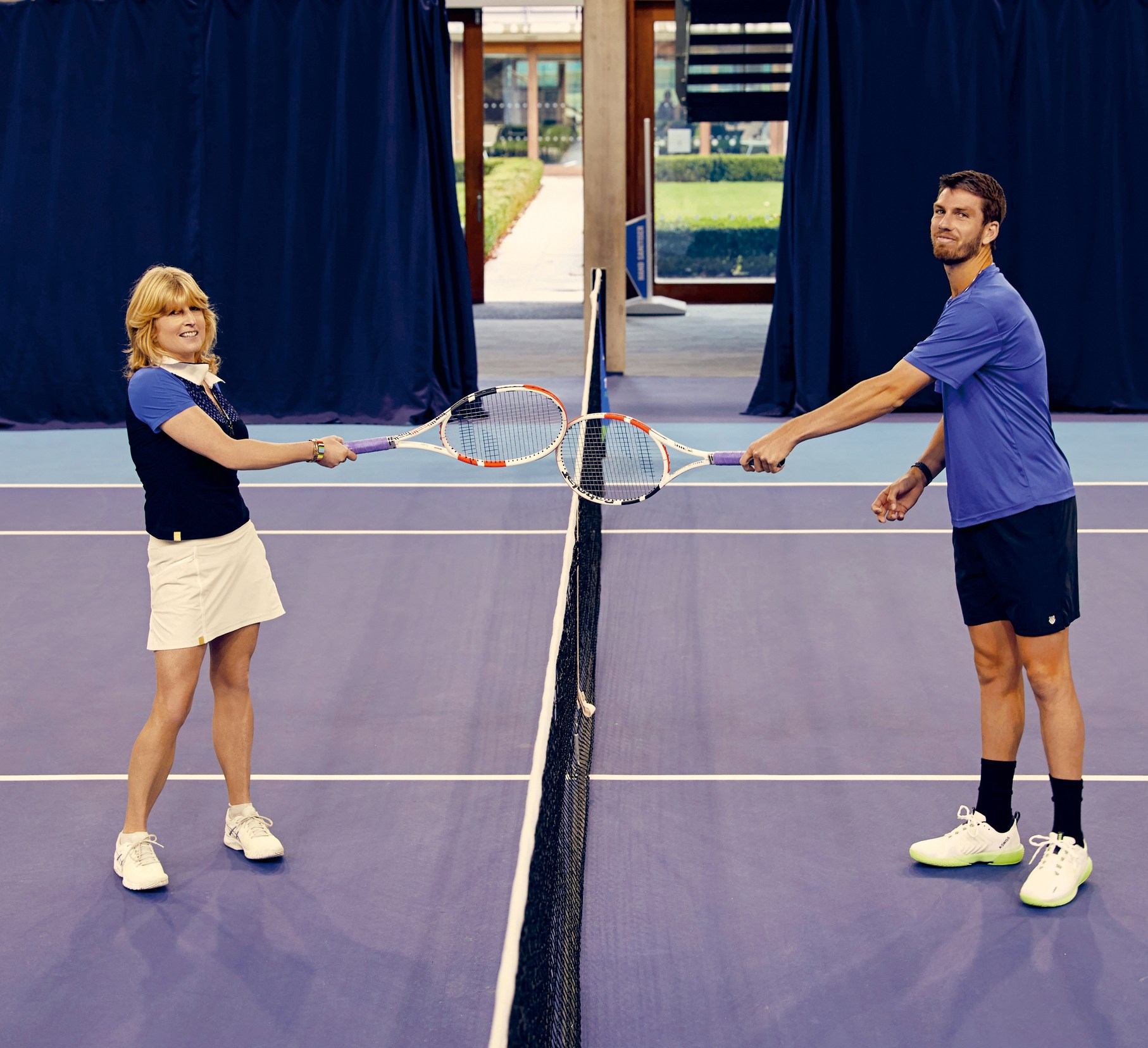
Johnson with Cameron Norrie
MARK HARRISON FOR THE TIMES SATURDAY MAGAZINE
Now, Norrie is a champ, an elite sportsman young enough to be my son, and this was some light rallying for a profile piece I was writing. It therefore doesn’t count. As soon as you introduce real competition between the male and the female players, however, it’s different. Whenever a man plays a woman at tennis in an actual match, it’s always a battle of the sexes. It’s existential. And there’s no question in the male mind that it’s the natural order of things that the stronger and bigger sex has to dominate the weaker. The male has to win. And he almost always wins too.
Where I play, tennis is both same-sex and mixed. There’s mixed doubles and mixed singles. And I’ve often noticed that if I’m playing a singles match against a bloke, they don’t take any chances.
They arrive lugging vast sports bags containing several rackets and an assortment of “strap-ons”, such as knee braces, elbow supports and powerful muscle guns to massage their calves and other areas, and often, disconcertingly, lie on their backs to perform a series of hip-flexor exercises prior to knocking up. I regard this as part of the “haka” that men perform prior to any contest.
Or they tell you they’ve just had “a new knee” or a hip replacement and this is the first time they’ve played since surgery. Invariably they proceed to tear around the court like teenage roadrunners. Whatever it takes, they want to win. Indeed, they have to win, even the 85-year-olds, who will resort to anything, a game of underarm serves, drop shots, funky line calls and lobs, just so long as they are never, ever beaten by a woman.
• Clare Balding: Mixed sex is the future for many sports
Even so, sometimes I win; but let’s face it, those I beat just aren’t very good. For example, while I always lose against Brother Jo, David Cameron (a talented and nifty “leftie”), my son Oliver and most other able-bodied chaps, I sometimes win against Brother Boris and my husband, but only because female players are like Avis — we try harder. I have to dig deep to triumph.
The facts of the matter are that whether you are playing the sport as an elite competitor or recreationally, a man and woman of the same age and level of fitness are not evenly matched. It can almost never be a level, equal game of singles.
“A Battle of the Sexes can never be fair,” says one female sports agent, who also loathed the spectacle screened from Dubai yesterday (until the feed thankfully failed when I was watching it in a barn in Somerset). “Men are stronger. They hit the ball harder, and they’re quicker to get to the ball.”
I very much wish the BBC hadn’t screened it. What did it prove, apart from everyone has their price and that an unfit Kyrgios could stroll into an arena in the oil-rich Middle East, wheeze and sweat in front of some trophy footballers, such as Kaka and Ronaldo and Peter Crouch, and still beat the best female player in the world?
• The tennis Battle of the Sexes is now an opera
It was clear from the off that the Aussie punk was going to beat the Belarusian with his junk tennis. I was furious I had fallen for the gimmick. This was the fourth edition of the Battle of the Sexes, and it’s clear it’s time to retire this returning format.
Back in 1973, Billie Jean King accepted the challenge of the proud and avowed male chauvinist Bobby Riggs, 55, as he claimed he could beat any woman despite not having picked up a racket for 15 years and being a huge plonker. Riggs lost, of course, and King pointed out yesterday that the only similarity between 1973 and yesterday’s game was that “it was man versus woman”.
King was playing for the progress of women’s sports and rights. I’m not sure what Sabalenka and Kyrgios were playing for apart from publicity and the strings of greenbacks.
There was no winner here, only a clear loser — women’s tennis.