
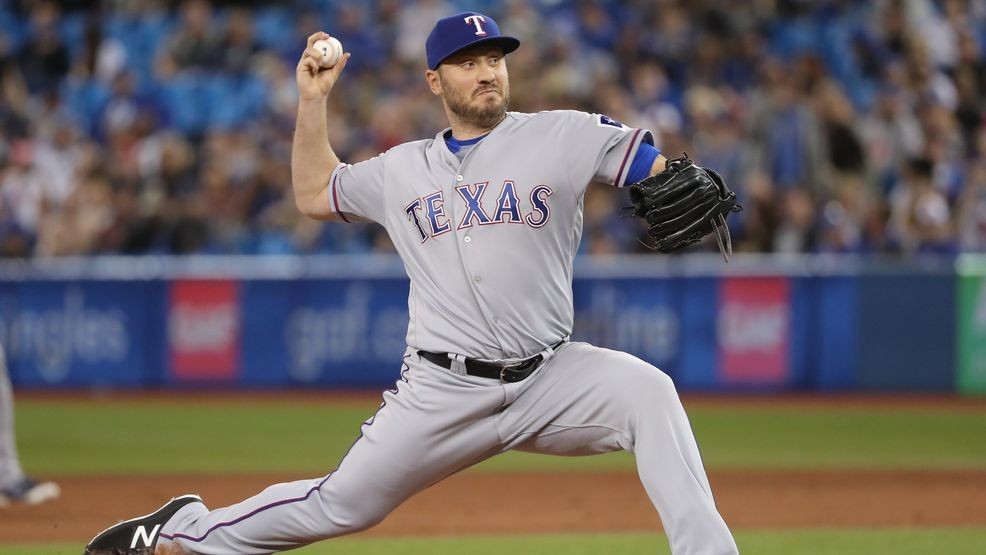
The Major League Baseball debut of former Bishop Manogue High pitcher Kevin Jepsen was like a page from a movie script.
It was Sept. 8, 2008. Jepsen, who will lead a class of 14 inductees into Manogue’s athletics Hall of Fame in January, was making his MLB debut for the Los Angeles Angels in Anaheim against the New York Yankees.
He faced a “Yankee Murderers’ Row” of three of the best players of that era. Up first was Hall of Famer Derek Jeter. Then came All-Stars Bobby Abreu and Alex Rodriquez.
“I was standing on the mound, putting my foot on the rubber, looking for the sign and then Derek Jeter walks in,” recalled Jepsen, who was about to throw the first pitch of a 10-year major-league career.
“I remember as a kid, watching him play,” Jepsen said of Jeter. “So, I stepped off the mound, kind of reset for a bit. ‘Yes, this is happening. This is who you are facing and now your job is to get him out.’ I still remember all of that.”
His heart beating through his chest, Jepsen threw Jeter a curve ball. He hit it back to Jepsen. One out. Abreu then hit a ground ball to the shortstop. Two outs. Then A-Rod, who had 696 career home runs, flew out to right field as Jepsen retired the side in a perfect inning.
“I went 1, 2, 3,” the now 41-year-old Jepsen said.
Over the next 10 years, Jepsen would also play for the Minnesota Twins, Tampa Bay Rays and Texas Rangers, earning a reputation as one of the best set-up relievers in the American League. He saw Jeter again in his career, but proceeded with caution. Throughout his career, Jepsen relied on four pitches he mastered — a four-seam fastball, cutter, curveball and changeup.
“I threw (Jeter) that (curveball) the first time,” Jepsen said. “After that, I just kind of stayed away from him. And you’ll have to fact check this on me, but I don’t think he got a hit off me.”
Yes, Jeter was 0-for-5 against Jepsen with two strikeouts in five plate appearances from 2008-10, according StatHead Baseball.
Jepsen enters Manogue’s Hall of Fame as one of the most decorated athletes in school history. At Manogue, Jepsen became the school’s first and only athlete to be named the Nevada Gatorade Baseball Player of the Year.
“That was definitely unexpected, especially in the state of Nevada because you’re competing against Vegas,” Jepsen said. “The accolades were not something you went for (at Manogue). It was all about winning state championships and winning for the team.”
Jepsen also was a member of the 2008 U.S. Olympic Baseball Team, becoming the team’s top reliever. He allowed no runs in 5.2 innings over four games. He earned the save against Taiwan, and in the bronze-medal game against Japan threw two scoreless innings to close out an 8-4 victory.
“It was at a different level,” Jepsen said. “It was like playing in the playoffs in the major leagues. That’s what I can compere it to — playoff baseball.”
Jepsen takes much pride in “the sheer honor of being on the Olympic team. Our goal was to win the gold but at least winning a medal felt like it was a major accomplishment.”
Jepsen reached the major leagues a couple of week after those Olympics, achieving a goal set at an early age.
“Baseball was something I loved ever since I was a little kid,” he said.
He recalled when his tunnel vision about baseball landed him in hot water.
“I remember getting in trouble in middle school when we had a career day,” Jepsen said. “We had tests that tell you what you should want to do and mine wasn’t on there because I wanted to play major-league baseball. And I remember my dad got a call from school because I was not doing the assignment correctly because on the tests being a Major League Baseball player was not an option.”
Later, his father, Randy, enrolled him at Manogue for the academics, not sports.
“My dad was discipline orientated,” Jepsen said. “If you are committed to something, then you follow through. And so one of the reasons my dad sent me to Manogue was because that was the standard they held there, not only in sports but academically as well. At Manogue, sports were big, but it was all about the academics. Everybody was going to college. It was, like, 98 percent of those who graduated from Manogue went to college and graduated from college.”
Jepsen chuckles he was the exception after he passed up college to seek a major-league career. But things worked out well. After his baseball career, Jepsen returned to Reno and became a businessman. He’s now the owner of two successful restaurants in Reno — The Red Rock Cafe and Sports Bar and South 40.
“Obviously I was in that 2 percent because I never went to college, but that was for a different reason,” Jepsen said. “But at Manogue, academics came first. There was no leeway. If you didn’t get your grades or score well on a test, you just didn’t play.”
At Manogue, Miners baseball coach Charles Oppio became a major influence in Jepsen’s development.
“He was great,” Jepsen said of Oppio. “He didn’t put up with anything. He was a no-nonsense guy. Show up, bust your butt. But he was teaching us how to be men, to go on into life after high school, how to handle yourself.”
One lesson learned from Oppio still resonates with Jepsen.
“Work hard when nobody is looking,” Jepsen said. “And that has gone a long way with me, not only in my baseball career but in life.”
Jepsen blossomed at Manogue as a sophomore in 2000 when he became the Miners’ top pitcher in a talented rotation. By the time he was a senior, Jepsen’s games had such strong interest from pro scouts the Reno Gazette-Journal’s Joe Santoro referred to Manogue’s schedule as “Kevin Jepsen’s Magical Mystery Tour.”
“He’s a once-in-a-lifetime talent,” Oppio told the RGJ in 2002.
In his Manogue career, Jepsen went 22-4 with a 1.09 earned-run average in 165 innings. He allowed 61 hits, striking out 269 and walking 52. Jepsen also pitched four no-hitters, two as a senior, according to the RGJ.
Jepsen credits family friend and baseball scout Dennis Banks for his early development as a pitcher. Working with Banks, Jepsen’s fastball went from 92 mph to a consistent 95 mph. Then, scouts clocked Jepsen’s fastball at 98 mph before the 2002 draft.
“I could not have done it without Dennis Banks,” Jepsen said.
Soon after he was drafted, Jepsen told the RGJ’s Santoro: “I have no doubt that if I did not work with Dennis Banks the past few years that all of this would not be happening to me.”
Shortly after his senior season, Jepsen was drafted in the second round of the 2002 draft by the Anaheim Angels with the 53rd overall pick.
“Obviously that was a huge, huge part of my life,” Jepsen said. “All I wanted to do as a kid was play professional baseball, and step one was getting drafted. The high that I was on at that point, it is hard to describe.”
Jepsen’s celebration ended with a thud. This wasn’t high school. This was a business.
“The way baseball works, that (draft celebration) was short-lived. “Jepsen said. “You’re shipped off, get on an airplane, go down and start playing minor-league baseball. You’re one of a thousand kids, and everybody there was the best in their city or town. ‘OK, you got drafted.’ But now it’s about playing, putting up numbers and how bad you want it.”
Jepsen played minor-league baseball for seven years before getting called up to “The Show.”
When he was just 20, early in his career, his throwing shoulder was surgically repaired, putting his career in jeopardy. Jepsen said he’s proud he played 14 years after that surgery, even though it was painful.
“I don’t know if I would do anything different,” he said. “It hurt, but I could go and throw. So that’s what I did. I just got through it. I don’t know if that made it worse or not. I tore my labrum, they put three or four tacks in it and I remember the doctor saying, ‘Look, you’re 50-50 if you are going to pitch again and I don’t know if you’ll ever get back to where you were before. We won’t know unless you just go out and try it.’ And then I spent 14 more years on it. So, obviously, I got through it and I got to the point where I had to take shots in my shoulder and it just didn’t work.”
Jepsen’s last season came in 2018 when he made the Texas Rangers’ opening-day roster as a reliever. Rangers manager Jeff Banister was upbeat about Jepsen coming out of spring training.
“Jepsen has a very interesting look — high-hop fastball, swing-and-miss offspeed pitch down,” Banister told MLB.com. “He is a veteran, and I don’t think the situation will be a challenge for him.”
Yet after nearly two decades of professional baseball, Jepsen’s arm and shoulder were not going to make it through the season.
“I was the set-up man for the first month,” he said. “I think I threw in 13 appearances, had a 1.00 ERA. But my body, my arm wasn’t doing it anymore. After that first month, I got a cortisone shot in my arm and I just decided that if I felt that I could play I would just keep throwing.”
His last appearance came on May 19 in 2018 against the Chicago White Sox, closing the book on his 17-year professional career.
“If I could do it, I’d go out there,” Jepsen said. “And so I took the shots to my shoulder and then the next month it did not go very well. It would take me a couple of hours of showing up to the park (early) before I could even get it ready to go out and play catch. So, it just kind of took it’s toll.”