
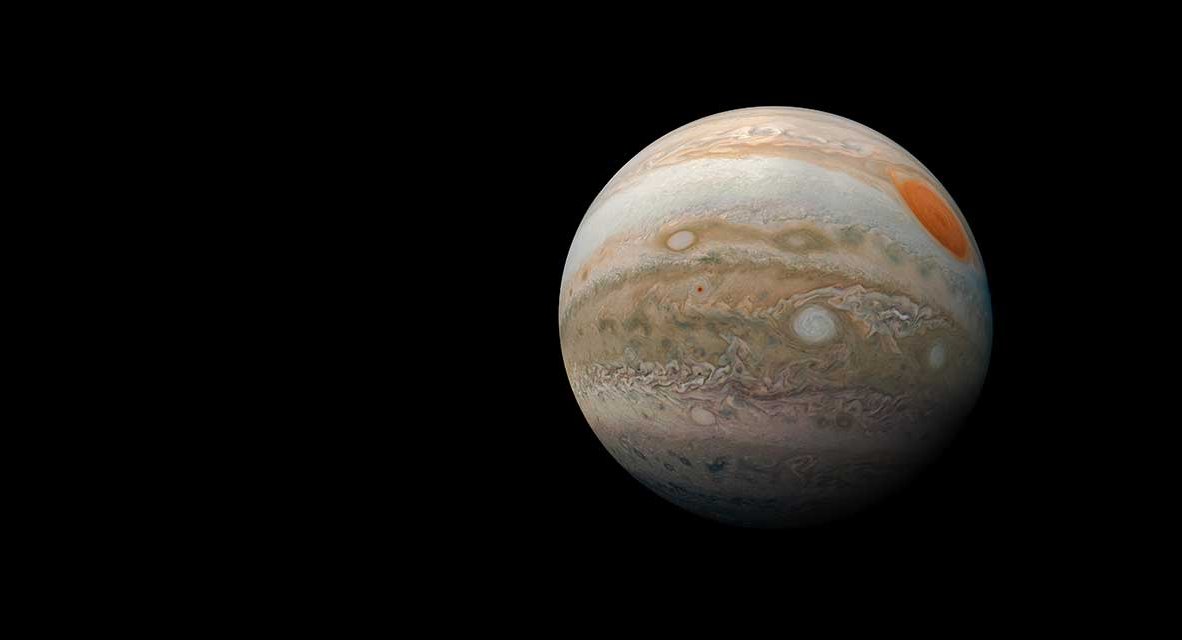
It’s prime time for gazing at the largest planet in the solar system.
On Jan. 10, Jupiter will be extremely bright and easy to find in the night sky. That’s because the gas giant will be in opposition, meaning it will be on the directly opposite side of the sun from the Earth.
“It is a really good month to look for Jupiter,” said Jackie Faherty, astrophysicist at the American Museum of Natural History. “Jupiter is high in the sky, and is up all night throughout the month and looks really awesome.”
Jupiter will be one of the shiniest objects in the sky from sunset to sunrise. Don’t mistake it for a star — planets have steady lights, unlike stars that twinkle. On Jan. 4, Jupiter will appear next to the full moon. The planet is visible with the naked eye, but to see its four Galilean moons, you’ll need binoculars.
While Jupiter is the main event for January, stargazers could also catch the first meteor shower of the year, and the winter constellations that will be easy to find, even in light-polluted New York City. Other planets will be on view, too.
The second largest planet, Saturn, will also be bright and visible until 10 p.m. throughout the month. Uranus and Neptune will require binoculars or a telescope.
Don’t bother looking for Venus, Mercury and Mars.
”Mercury and Venus are too close to the sun to be viewable. The same thing with Mars. So right off the bat we’re skunked with Venus, Mercury and Mars,” said Bart Fried, member of the American Astronomical Society.
January is the only chance until April to observe a meteor shower. The Quadrantids started in December and run through Jan. 16, with 10 meteors hourly traveling at a speed of 90,000 miles per hour. Under perfect conditions with dark and clear skies, it’s possible to see 200 shooting stars hourly, according to NASA. The showers can produce fireballs, which are large explosions of light and color.
The peak for the Quadrantids is Saturday, Jan. 3, which occurs during the full moon. On the night of the peak, New York City Urban Park Rangers are hosting an astronomical event at Inwood Hill Park in Manhattan at 5 p.m. The event is free and open to the public of all ages There will be telescopes and binoculars available for use as well as an expert guide. The show runs until Jan. 16.
The easiest constellation to spot in January is Orion. Look south in the early evening for three super-bright stars in a line that form the hunter’s belt. Orion’s key stars are blue-white Rigel in Orion’s knee and reddish Betegeuse in his shoulder.
To the right of Orion’s belt is Aldebaran. The star is the red eye of Taurus the bull.
Follow the line of the belt just past Aldebaran and you’ll see a hazy bluish patch of stars, the Pleiades star cluster. A good spot to see the star cluster is Brooklyn Bridge Park. Also, on Jan. 25, the Urban Park Rangers is hosting a viewing event at Salt Marsh Nature Center in Marine Park, Brooklyn. The site is an excellent spot in the five boroughs for stargazing.
”Right now our winter sky, our sky is dominated by the rise of Orion and Taurus,” Faherty said. “When you go out at night or get out after work, these are the constellations that are going to strike you because they’re going to be rising and they’ve got all the bright stars that your eyes are going to be drawn to, and they just do a little lap around around your zenith and set by the end of the night.”