
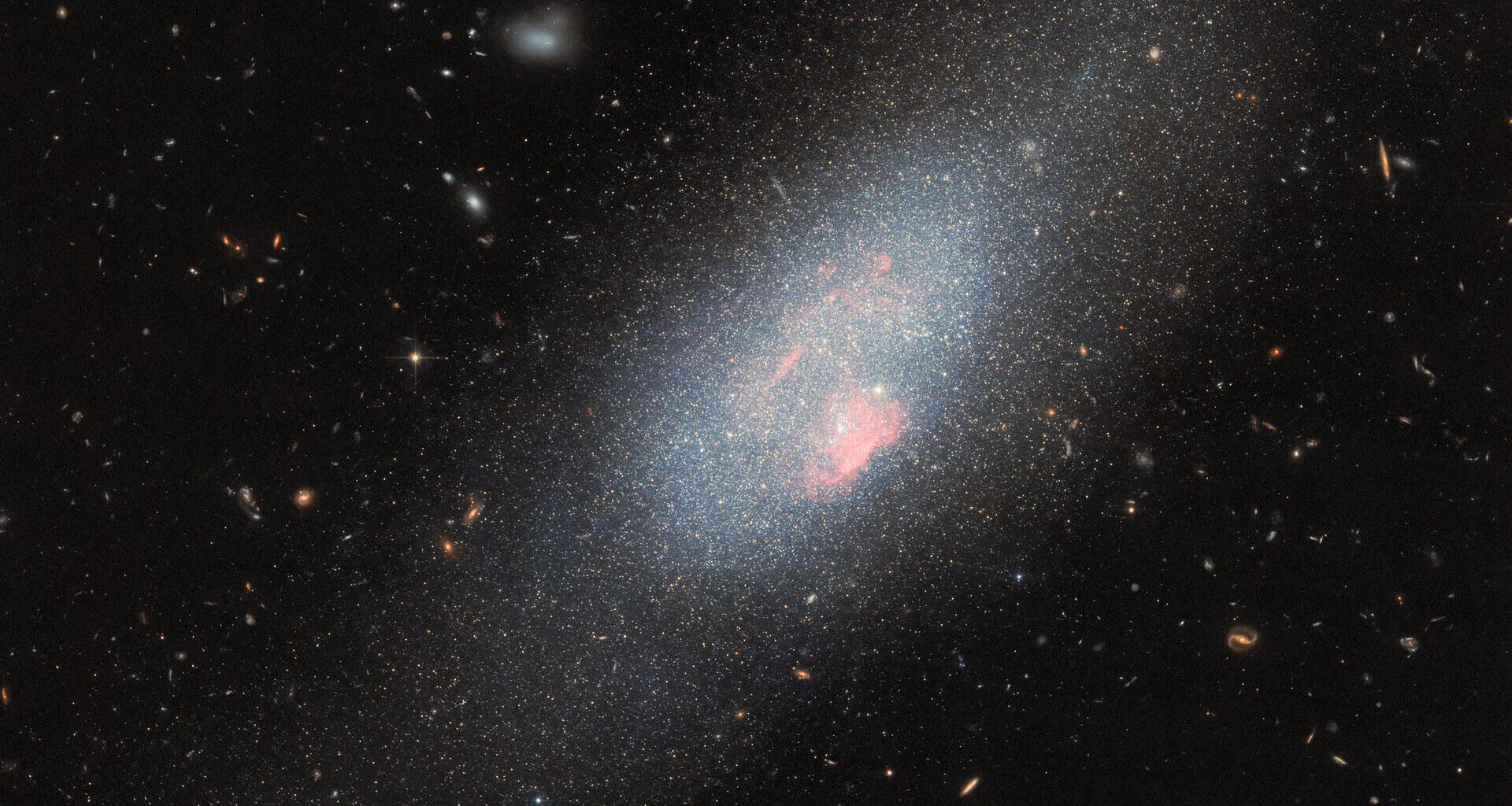
Recently, the Hubble Space Telescope captured an image of a dwarf galaxy in the constellation Ursa Major. Markarian 178 (Mrk 178) is one of over 1500 “Markarian galaxies,” a class defined by their unusually strong ultraviolet emission first catalogued by Armenian astrophysicist Benjamin Markarian.
This small, cloud-like galaxy is dominated by clusters of young, hot, blue stars, yet it also contains a striking red-tinged region. This reddish glow is the signature of something dramatic happening inside: a population of massive, short-lived Wolf–Rayet stars whose powerful stellar winds carve their imprint directly into the galaxy’s spectrum.
What is it?
Wolf-Rayet stars are in a brief, turbulent phase of their lives. Having exhausted the hydrogen in their cores, they shed their outer layers in violent stellar winds, producing strong emission lines—particularly from ionized hydrogen and oxygen—that appear red in specialized Hubble filters. Wolf–Rayet stars live only a few million years, so their presence indicates that new stars formed very recently. Yet astronomers were initially puzzled as Mrk 178 has no obvious large neighboring galaxies that could have triggered such activity. It’s a puzzle that continues to be a focus for many astronomers.
You may like
Where is it?
Mrk 178 is located around 13 million light-years away in the constellation Ursa Major.
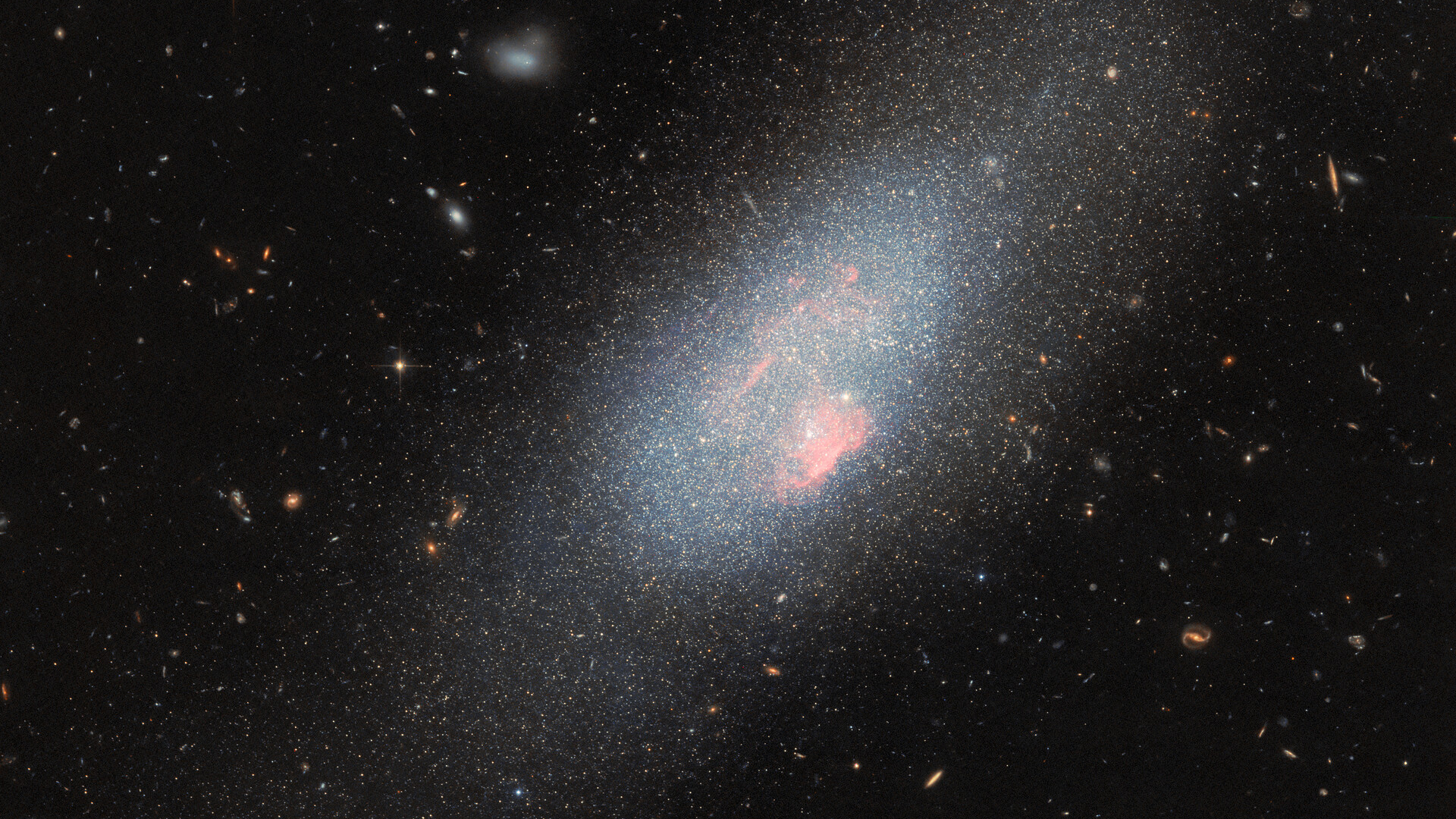
A mystery surrounding Mrk 178’s Wolf-Rayet stars is a headscratcher. (Image credit: ESA/Hubble & NASA, F. Annibali, S. Hong)Why is it amazing?
Galaxies like Mrk 178 resemble the small, rapidly star-forming galaxies that populated the young cosmos. Studying them today provides clues to how the first galaxies built up their mass and how heavy elements spread through the universe.
As Hubble and ground-based telescopes continue to probe its structure and history, this glittering blue dwarf will help illuminate some of the most powerful forces shaping our cosmos.
Want to learn more?
You can learn more about dwarf galaxies and star formation.