
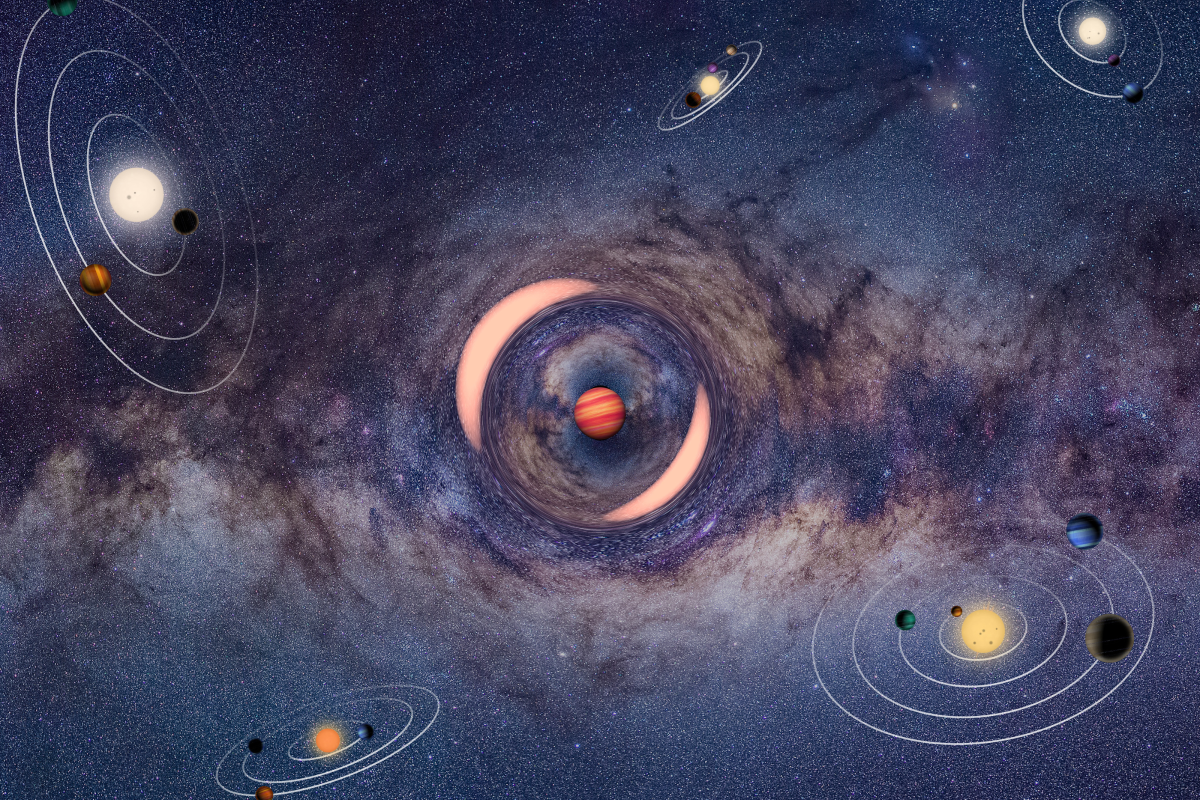
Astronomers have detected a rogue planet with a mass equivalent to that of Saturn, and by taking observations from both the ground and space, they have also been able to measure its size and distance from Earth.
While most planets are bound to one or more stars, there has been a growing body of evidence that distinguishes free-floating—or rogue—planets that lack any type of stellar companion. They usually only reveal themselves through subtle gravitational effects on background light (since they do not emit much light themselves) known as microlensing.
Unfortunately, microlensing typically can not determine the distance to these planets or make an accurate prediction of their mass, since the movement is usually only detected in one singular location.
However, a team of astronomers, led by Subo Dong from Peking University, the National Astronomical Observatories and Chinese Academy of Sciences, have now reported the discovery of a rogue planet detected via a fleeting microlensing event that was observed seperately from locations on Earth and in space.
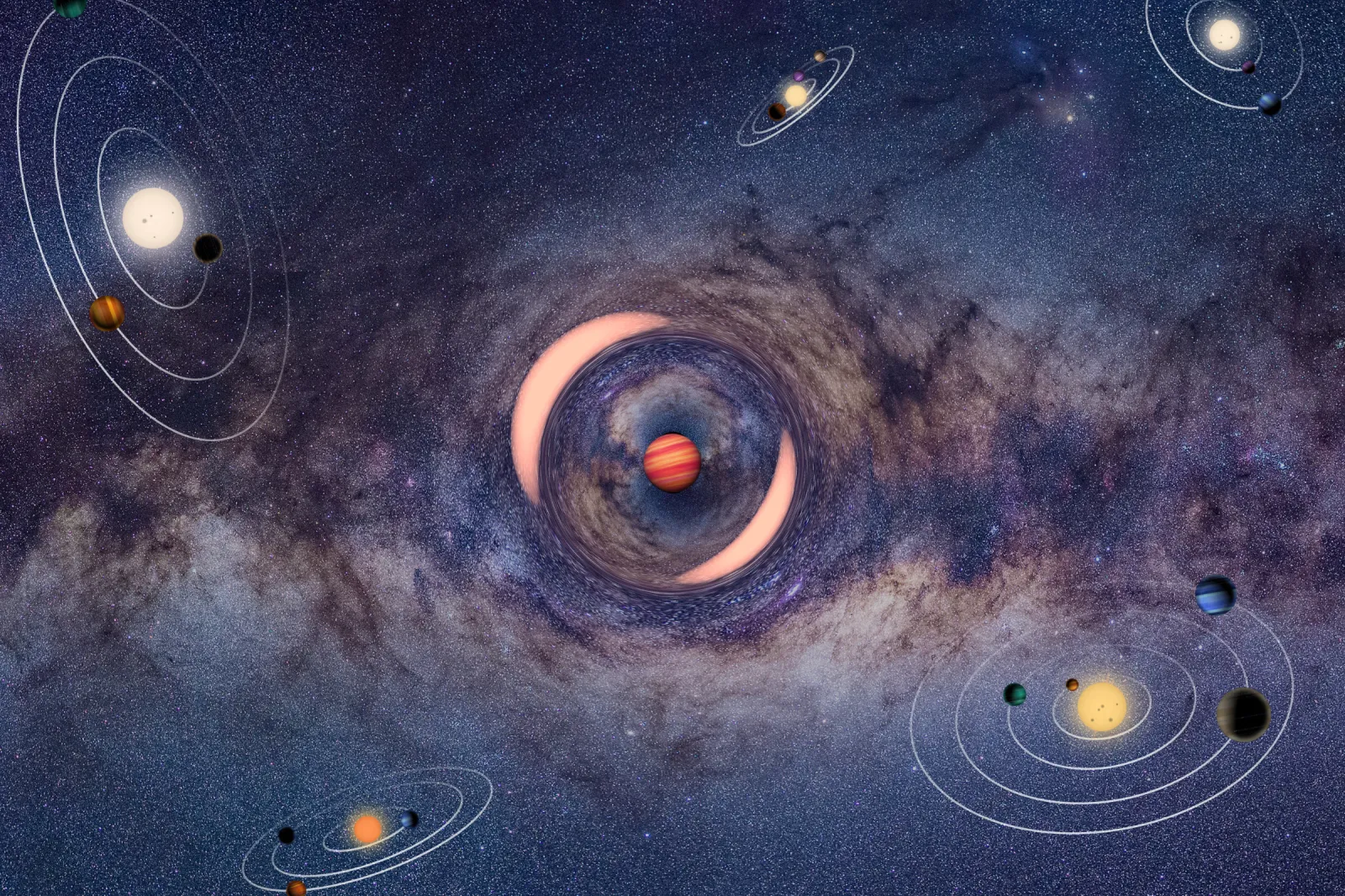
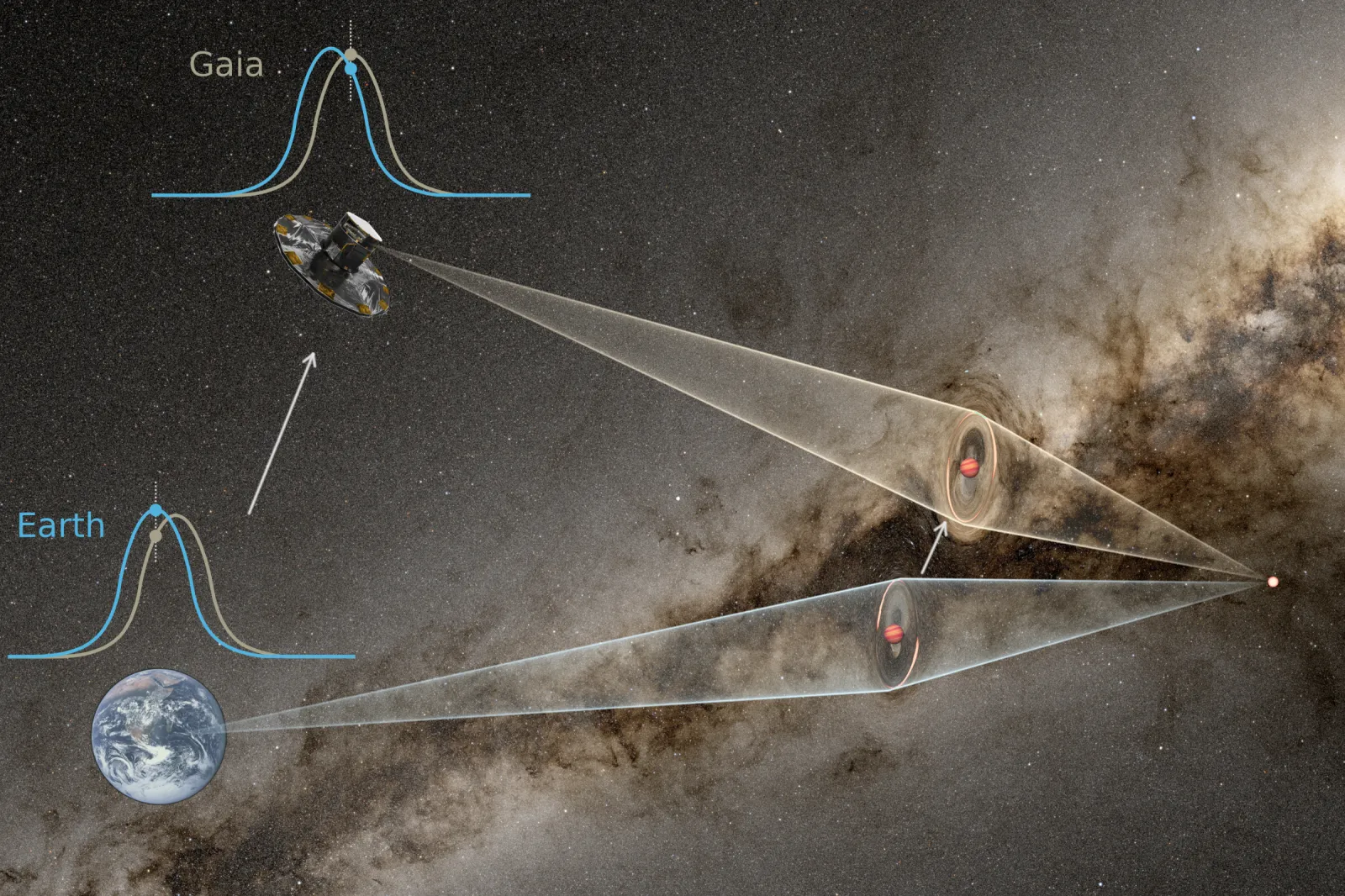
The team analysed data from several ground-based surveys in tandem with the Gaia space telescope, 930,000 miles from Earth, to pick out the rogue planet. They noted tiny differences in the times when the light reached each vantage point, enabling them to measure the planet’s mass and distance from earth.
The researchers estimate that the rogue planet is approximately 22 percent the mass of Jupiter, and lies roughly 3,000 parsecs from the center of the Milky Way.
As the planet’s mass is comparable to that of Saturn, the team suggest that it was likely formed within a planetary system, as opposed to being formed in isolation (much like a small star).
Low mass rogue planets are believed to be born around stars and subsequently expelled through gravitational upheavals, such as disturbance of neighboring planets or an unstable stellar companion nearby.
The findings may also offer insights into the diverse pathways that planets take if they are cast adrift into interstellar space.
Studies in the past have revealed a handful of free-floating planets before, but microlensing is not without its limitations as a discovery method. Astronomers have not previously been able to determine the distance to these wandering worlds planets nor make independent measurements of their mass.
As a result, much of the information we have about these elusive rogue planets remains speculative. Yet, detections may increase in the years ahead thanks to the NASA Nancy Grace Roman Space Telescope, scheduled to launch in 2027.
Do you have a tip on a science story that Newsweek should be covering? Do you have a question about quantum mechanics? Let us know via science@newsweek.com.
Reference
Dong, S., Wu, Z., Ryu, Y.-H., Udalski, A., Mróz, P., Rybicki, K. A., Hodgkin, S. T., Wyrzykowski, Ł., Eyer, L., Bensby, T., Chen, P., Wang, S. X., Gould, A., Yang, H., Albrow, M. D., Chung, S.-J., Han, C., Hwang, K.-H., Jung, Y. K., … Breedt, E. (2026). A free-floating-planet microlensing event caused by a Saturn-mass object. Science, 371(6619), 96–99. https://doi.org/10.1126/science.adv9266