
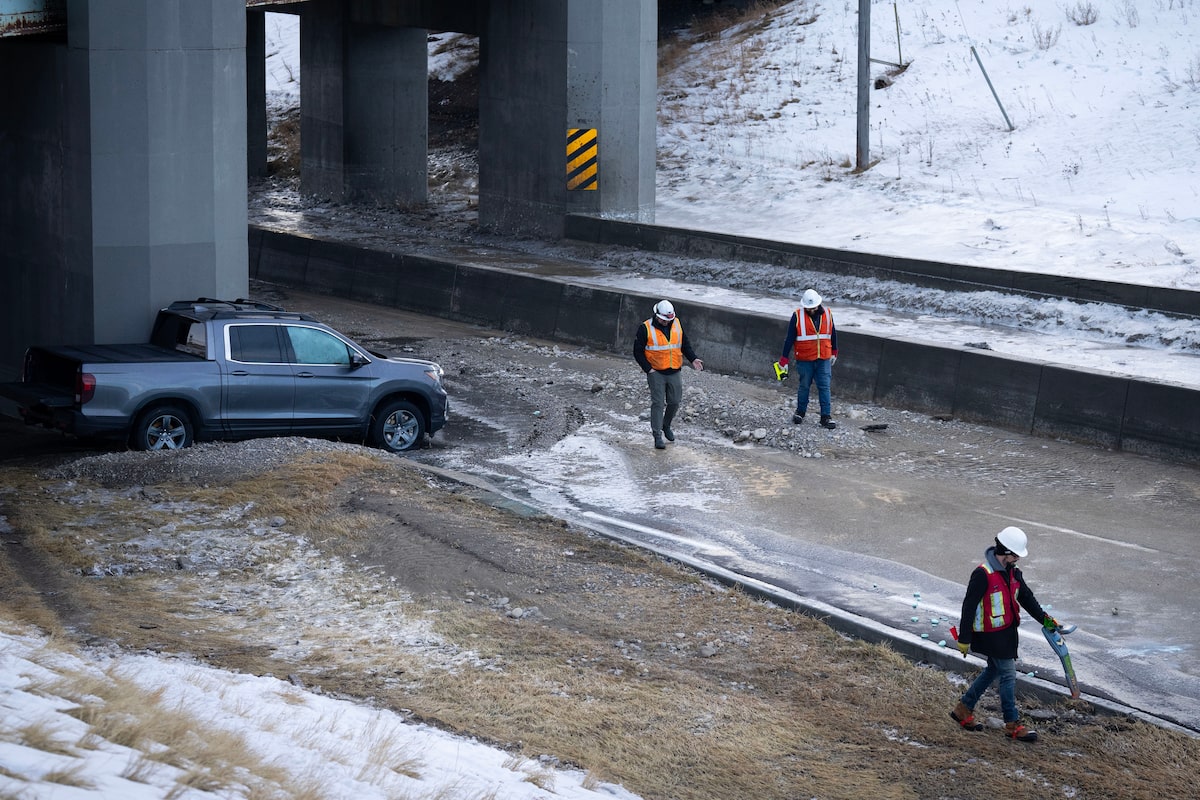
City crews check for damage on the Trans-Canada Highway from a water main break in Calgary on Wednesday. About 3,100 homes remain under a boil water advisory.Todd Korol/The Globe and Mail
Calgarians are being asked to have shorter showers, run dishwashers and laundry machines only when full, and flush toilets less, after the second catastrophic failure of an essential water main caused a dangerous shortage of the city’s water reserves.
Nearly 80 million litres of water were lost after the Bearspaw South Feeder Main ruptured without warning on Tuesday evening, trapping more than a dozen travellers in their vehicles in the icy current, and leaving city officials rushing to identify the cause and repair the damage.
About 3,100 homes remain under a boil water advisory, and city officials are pleading with residents to conserve water by making small changes to their water consumption.
“Reducing water use right now is critical,” said Calgary Emergency Management Agency chief Sue Henry. “Every litre saved helps stabilize the system and speeds up our recovery. Adequate water levels are needed to ensure collectively we have enough water for critical infrastructure, emergency services and Calgarians.”
Calgary issues boil water advisory after water main break floods streets
Eric Wisniewski and his wife, Amanda, were driving in the city’s Bowness area around 8 p.m. on Tuesday evening, when they saw a white SUV in front of them being lifted six feet into the air on what appeared to be a wave of water. Mr. Wisniewski said water then began rushing across the road, and within moments, had risen to the top of the hood of the couple’s truck.
“The water cascaded completely over the top of the vehicle, and I couldn’t see anything,” said Mr. Wisniewski, a former professional driver. He said the truck stalled out and began to turn sideways in the water, becoming pinned against a train bridge in the current. The couple escaped by climbing through the sunroof.
They were among 13 people rescued in harrowing conditions that Calgary Fire Department acting deputy chief James Docherty said “could have turned tragic very, very fast.”
It is the second major failure involving the Bearspaw water main in less than two years. The pipe previously suffered a serious break in the summer of 2024, leading to water restrictions, drinking water issues and a looming water crisis that lasted for several weeks in one of Canada’s largest cities.
Speaking to the media in a technical briefing on Thursday afternoon, Calgary Mayor Jeromy Farkas described Tuesday’s break as “a major failure in critical infrastructure,” which required immediate action to protect public health and water quality in the city.
While he said the immediate emergency has been stabilized, the city is “still very much in the red zone,” with an “incredible” amount of work still to be done.
He described the Bearspaw as “the critical artery” in Calgary’s water system.
The Bearspaw water main has been the subject of ongoing assessment, repair and monitoring since the 2024 breach, and officials say the cause of this week’s rupture is not clear.
“We don’t know why the pipe failed,” said Michael Thompson, the city’s general manager of Infrastructure Services. “We need to take this piece of pipe out of the ground, go and understand why it broke, and then understand how this needs to inform the way we’re looking at that rest of the pipe.”
He said wire snaps – which can be one indication that an area of pipe needs immediate repair – have not been detected in the area where the pipe burst for two months.
But while crews work to repair the immediate damage, Mr. Farkas said city council is united on two megaprojects that will add significant new water infrastructure in the city. Work is already under way on the projects, one of which will see six new kilometres of pipe running parallel along the existing Bearspaw feeder main, and eventually replace it.
Mr. Farkas has said that until that happens, the line is “a ticking time bomb that Calgarians will continue to live with.”
He said, “A city like ours cannot accept uncertainty in something as very fundamental as water.”
The second project will add a new feeder line to the north area of the city.
“We will get this done faster than anything we have ever done before, and it will be done right to last us for the next century,” Mr. Farkas said.
With reports from Alanna Smith and Matthew Scace