
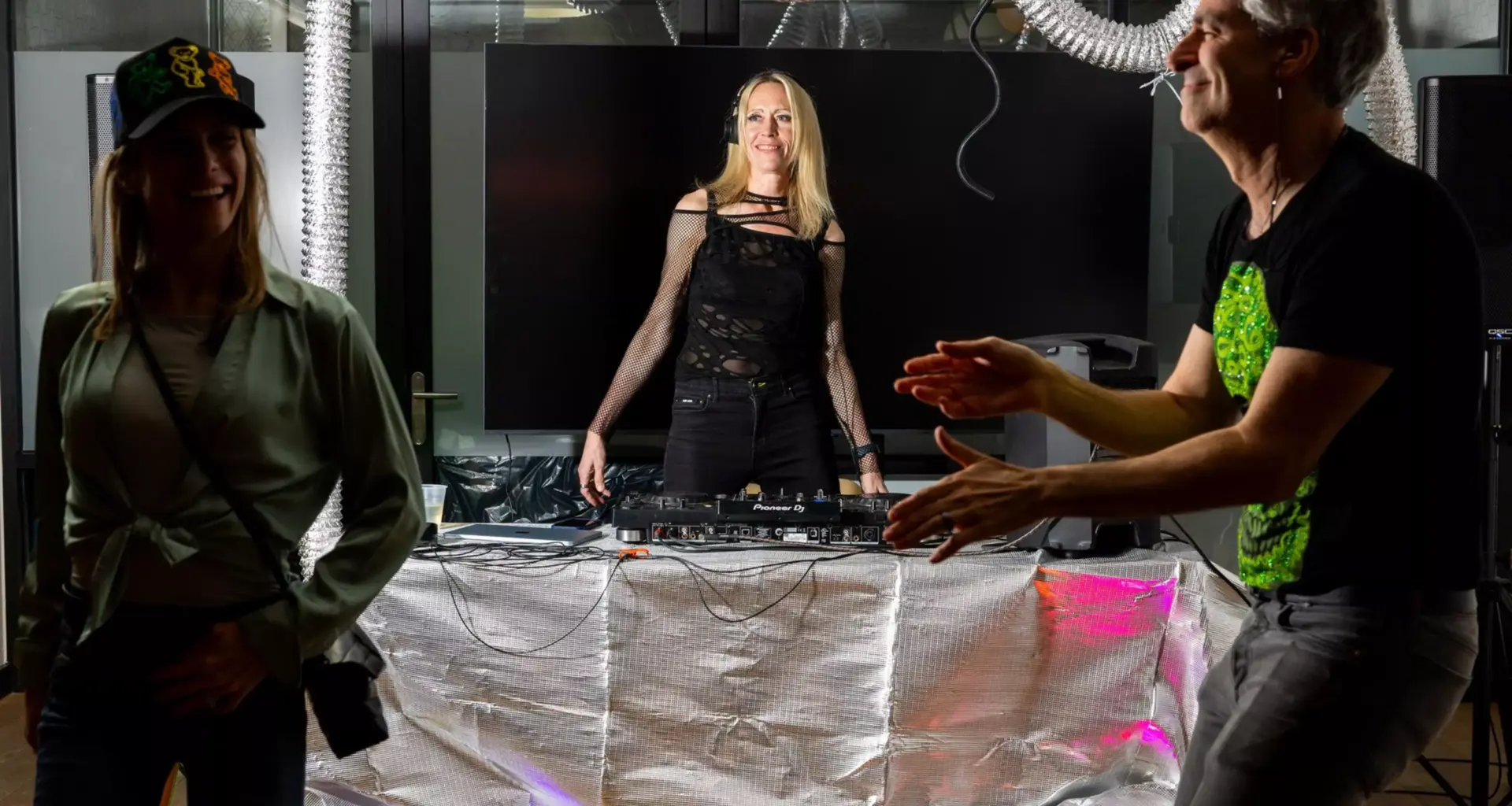
Luke Sequeira, a self-described nomadic autodidact, spent five days in early December preparing for an unusual rave. The protocols was strict: no psychedelics or other substances for 72 hours prior, no alcohol for 48 hours prior, no caffeine for at least six hours. In two mobile apps, he logged his mood, sleep quality, energy, sense of connectedness, and food and water intake.
The 40-year-old headed to Frontier Tower on Market Street for the main event Dec. 9. His fingers were pricked and four blood samples taken to measure levels of GDF15, a stress-related biomarker, and cytokines, immune proteins that signal inflammation. Saliva was collected to track his cortisol and oxytocin, and a $195 electroencephalogram wearable (opens in new tab) was clipped to his ear to record his brain waves.
Finally, Sequeira and 12 other rigged-up participants headed to the dance floor, where a DJ played five techno tracks. The playlist was designed for the occasion by sound engineers, with each track lasting a precise length (eight to 12 minutes) with varying intensity measured in beats per minute. The dancers mostly bobbed on one spot; big moves were discouraged, lest the EEG sensor detach. After almost three hours, the rave was over. Sequeira, along with the others, had his blood and saliva retested before he left.
Joyspan is important to longevity but has the fewest metrics attached; there’s no Oura ring for belonging or Eight Sleep score for joy.
“It was more of a science experiment than the rave of my life,” said Karim Asry.
The event was the Longevity Rave (opens in new tab), part of a project called the JoyScore Experiment. The project is the brainchild of Tina Woods, CEO of Collider Health (opens in new tab), which has advised the U.K.’s National Innovation Centre for Ageing on longevity research and AI initiatives for the National Health Service.
Though not a full-fledged clinical trial, the JoyScore Experiment is ambitious. If dance and music create feelings of joy and connection, could that be measured through biometric signals from brain activity, heart rhythms, or biomarkers like oxytocin and cortisol? Could that data then be converted into a “JoyScore,” providing a metric for induced happiness? “If you can measure it, then you can put a value to it [and] deliver increases in your health,” said Woods. “That’s a really big opportunity. Dancing tends to promote human joy. We’re trying to put science-backed rigor behind that.”
That said, happiness is notoriously subjective and difficult to measure: How happy? For how long? And how often? This fuzziness, though, makes happiness the latest target for quantification. If we can put numbers to it, the thinking goes, perhaps we can optimize it.
 Josh Miller gives a saliva sample.
Blood draw first, dance floor second, at the Longevity Rave.
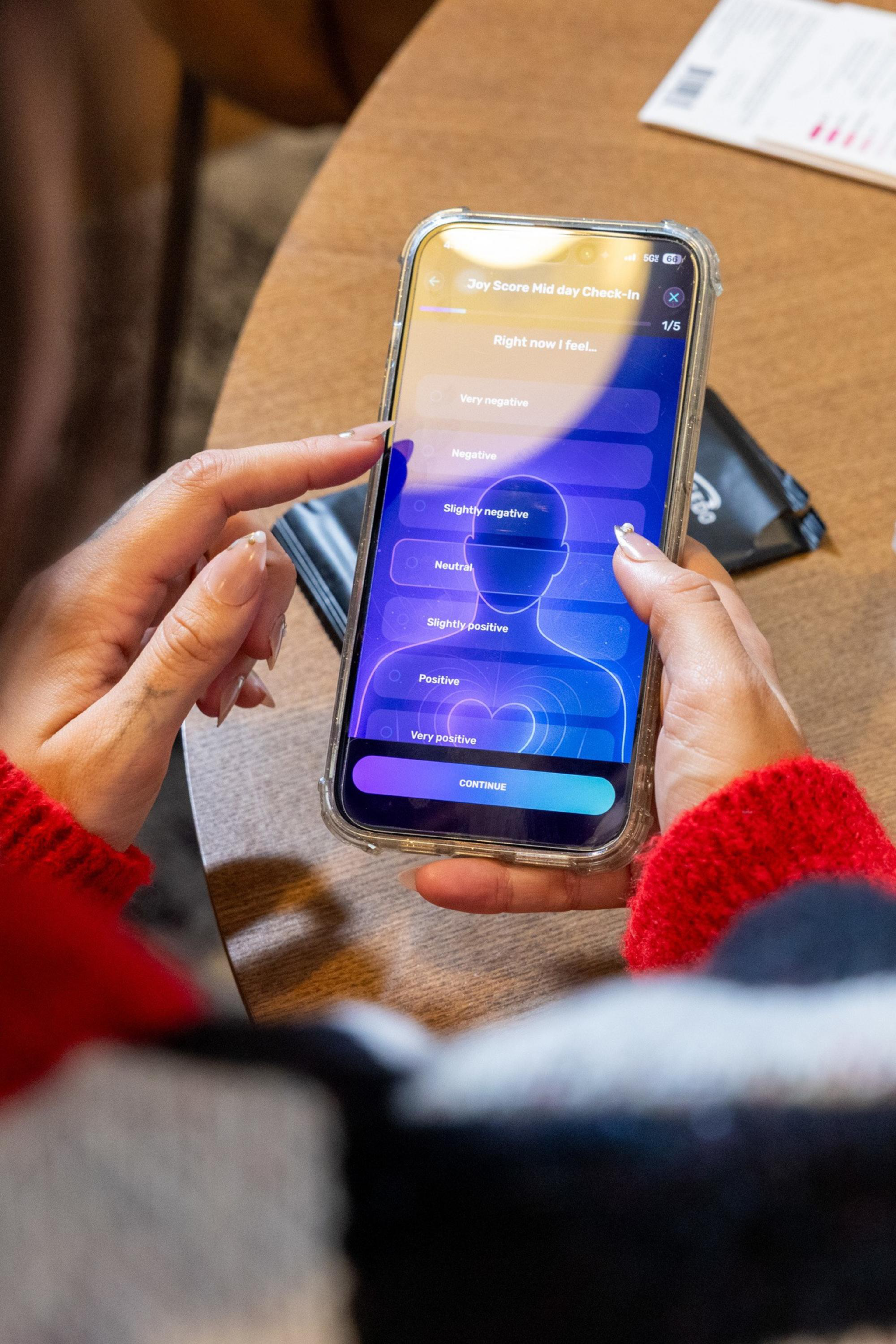 Tracking joy, one techno track at a time.
Attempts to quantify happiness date back to 1789, when the English philosopher Jeremy Bentham (opens in new tab) outlined a formula for measurement that factored in intensity, duration, and frequency.
By the mid 20th century, the research had moved from philosophy to psychology, with social scientists designing self-reporting tools that attempted to distinguish between immediate joy and a sustained state of happiness. These include the Cantril Self-Anchoring Striving Scale (opens in new tab) in 1965 (used by the U.N.-sponsored World Happiness Report and by Gallup (opens in new tab) to track overall satisfaction) and, four years later, the Bradburn Affect Balance Scale, a multiple-choice scale that measures happiness as the balance of positive versus negative feelings.
Biologists, meanwhile, have attempted to measure happiness by tracking various signals and metrics, including heart rate variability (opens in new tab), mood (opens in new tab) and movement, (opens in new tab) and blood and saliva biomarkers, and through the use of positron emission tomography (PET) (opens in new tab) scans to observe endorphin release during laughter. The common goal of the grab bag of approaches is to transform our somewhat squishy feelings of joy and happiness into something that can be detected and tracked with precision, physiologically.
There has been some progress. Studies have found that people who self-report high levels of joy often have higher HRV, lower (opens in new tab) salivary cortisol (opens in new tab)and less inflammation. (opens in new tab) But it’s also apparent that happiness cannot be forced; the very act of chasing happiness can paradoxically (opens in new tab) lead to unhappiness, since people start to obsess. Sample sizes in these studies have been typically small.
Suzanne Dikker, a neuroscientist and NYU professor who studies brain synchrony, noted that “it is very hard to infer directly from an [EEG] signal that people are indeed happy or not.” Dikker, who wasn’t involved in the JoyScore Experiment, also notes that correlation isn’t causation. “What you can do is show that a neural marker is correlated with people’s self-report of happiness or joy,” she said. “But you have to make sure it doesn’t co-vary with something else you didn’t intend to measure.”
Whether a readout of blood, saliva, and brain waves, coupled with self-reports, can lead to a joy metric is TBD, according to experts. “There’s no thermometer for happiness,” said Sonja Lyubomirsky, a psychology professor and happiness science researcher at UC Riverside. “I’m skeptical that you can measure something directly with a physiological or biological measure.”
Some physiological signals, including EEG patterns and cortisol and blood biomarkers, do correlate with happiness, she noted, “but not very highly.” Someone could be ecstatic, but that might not move any markers, due to cortisol levels or other “noise” in the body, Lyubomirsky added. “It’s a very, very messy, imperfect measure of happiness.”
One reason longevity seekers are focused on quantifying joy is the loneliness epidemic, which was deemed a public health crisis in a 2023 report (opens in new tab) by Dr. Vivek Murthy, the U.S. surgeon general at the time. According to the advisory, loneliness increases the risk of premature death by 26%, making social isolation comparable to smoking 15 cigarettes a day.
For the tech crowd, loneliness stands as just another problem to solve, one potentially made worse by AI. In her study proposal, Woods argued that “in an age of AI‑driven techno‑isolation, we position raves as counter‑technology that restores human connection and preserves what makes us human.”
 An ear-mounted EEG records brain activity as techno pulses through the room.
“The holy grail of longevity science is to develop interventions that actually have application to you as an individual,” Woods added later. Prior research has failed to produce a universal joy score, but they didn’t have today’s tool kit, Woods said, noting developments in how “blood samples are collected, what can be measured, [with] labs developing new techniques all the time.”
This appealed to Sequeira, who, in addition to attending the rave, is conducting solo research on AI and well-being. “A joy score will create more awareness that joy is a factor to work toward, because what we don’t measure, we cannot manage,” he said.
That notion — that anything worth caring about should be quantified — has long been axiomatic in Silicon Valley. It’s especially true in the longevity space, where tracking fundamentals like diet, sleep, and exercise is viewed as a baseline for extending both lifespan (years spent alive) and healthspan (the duration of life spent in good health).
Those twin concepts have been joined of late by “joyspan,” a way to measure time with optimal social health. The term was coined last year by gerontologist Dr. Kerry Burnight as a shorthand for how relationships can extend life and lower health risks (opens in new tab). Of the three “-span” concepts, joyspan has the fewest metrics attached; there’s no Oura ring for belonging or Eight Sleep score for joy.
The joyspan concept has growing support from experts. The quantification of flourishing “gives us a way to ground what can feel like abstract ideas, like joy, purpose, and connection, into something we can measure, track, and ultimately improve,” said Keith Comito, CEO of the Lifespan Research Institute, (opens in new tab) a Mountain View nonprofit.
That’s why Karim Asry, 43, was at the Longevity Rave. The director of Espacio Open, a maker space in Bilbao, Spain, Asry spends half his time in San Francisco. He has long sought “actionable metrics” for his own happiness, and the rave promised to be at the forefront of developing those targets. Participants would be classic early adopters, helping to build “a new scientific metric of human joy and connection, using cutting-edge neuroscience and movement data,” according to the event flyer.
Still, Asry wasn’t convinced these specific markers would hold up. “How do you get metrics that are rigorous without oversimplifying the human experience to two to three KPIs?”
Asry, wearing the de facto rave uniform of a tee, jeans, and a hoodie, left feeling hopeful, if less elated than he feels after most raves. “It was more of a science experiment than the rave of my life,” he said. An app connected to the EEG sensor behind his ear allowed him to watch his brain waves seesaw in real time. “If I started reading something, it would go into a very calm state,” he said. But whether those fluctuations corresponded to joy was less clear.
Sequeira also geeked out on the data during the event. “Every time the track changed, the [app showed] there was stress in my system — for a few minutes — and then my system came back to baseline,” he said.“The big takeaway for me is that sudden change results in stress. I’m rethinking what kind of music I listen to and how I go about listening to that.”
In the end, the experiment had some wins and some misses. Initially, the JoyScore team hoped to measure synchrony, a shared sense of rhythm and connection, among the attendees. But due to the slim turnout and some technical glitches with the EEG wearables, the synchrony measurement was dropped in order to focus on measuring individual happiness.
“The main thing is that we had enough people to actually give us some meaningful information for the next stage of the study,” said Woods, who is planning an Institutional Review Board-approved study this spring in a “network state” in Roatan, Honduras, to test this formally. “This is a real punt into unknown territory,” she added, “but you have to experiment to get the data.”
The future of longevity might look less like a lab and more like a rave.
Ravers’ bodies become the data set.
As for the rave, the participants’ neural activity data was time-stamped to specific music tracks and will be compared against their baseline data (pulled from a “control” rave held five days prior). Blood and saliva samples will be analyzed for biomarkers linked to inflammation and mitochondrial stress, then modeled alongside self-reports to see whether subjective spikes in joy can be mapped to bona-fide physiological changes. The analysis is expected by late spring.
Even with the nebulous outcome, Lyubomirsky, the happiness researcher, said such studies matter. “Happier people are more likely to recover from surgery, they are less likely to have heart disease or cancer, have less pain, are less likely to get colds,” she said. “Happier people basically live longer.” Still, she cautioned against drawing firm conclusions. “I’m not sure that you could say this biological outcome, when it’s higher, means that you’re happier. … No one’s really been able to show that yet. Maybe in the future, but we’re just not there yet.”
Regardless of the scientific challenges, some ravers were just glad to be there. Serabeth Mullaney, 29, who lives in the Mission and works at a startup, left feeling upbeat. “I’ve always been really interested in neurology and how our brains affect our mood,” she said. And anyway, she added, “it’s hard to find people that are also passionate about the same things as you.” ”