
When Brian Ferriso became the Portland Art Museum’s executive director in 2006, he inherited a staggering $20 million deficit of loans and unpaid pledges and a flummoxing architectural tangle. A year before, his predecessor renovated and expanded the museum, connecting its elegant Pietro Belluschi–designed complex to the neighboring Masonic temple, which the institution had acquired back in 1992. The result: poorly proportioned galleries, which a visiting curator once described as “bowling alleys,” joined by a dimly lit underground passage with elevators and stairwells so puzzling visitors nearly needed breadcrumbs to find their way back and forth.
Equally sadly, the two updated landmarks’ larger campus design committed the most profound of sins, failing even to attempt a meaningful connection to the surroundings—turning its back, in particular, on one of the city’s proudest new achievements, America’s first streetcar line built since World War II.
Retiring the debt took nine years. The architectural fix took 20—with an added price tag of $116 million.
Time, tenacity, and considerable design prowess on the part of the Chicago-based Vinci Hamp Architects and Portland-based architects of record Hennebery Eddy Architects has healed many wounds by building an addition, opened in November, that overcomes those earlier missteps and positions the museum as a crossroads between art and the urban context.
“The architectural mission for us here was connectivity,” according to Tim Eddy, founding principal of Hennebery Eddy. “What we tried to create is a giant welcome mat.”
At a previous career stop, Ferriso oversaw the Milwaukee Art Museum’s dramatic but costly Santiago Calatrava addition and, with Vinci Hamp, a redo of its historic galleries. Early in his Portland tenure, the director chased a whale-sized donor with a more theatrical architectural proposal connecting the Belluschi building and the Masonic temple. But when that individual shrugged, and Ferriso realized both the depth of the museum’s problems and Portland’s more minnow-scale donor base, he shifted. “Completely ignoring philanthropy,” he asked, “what’s the right architectural solution?”
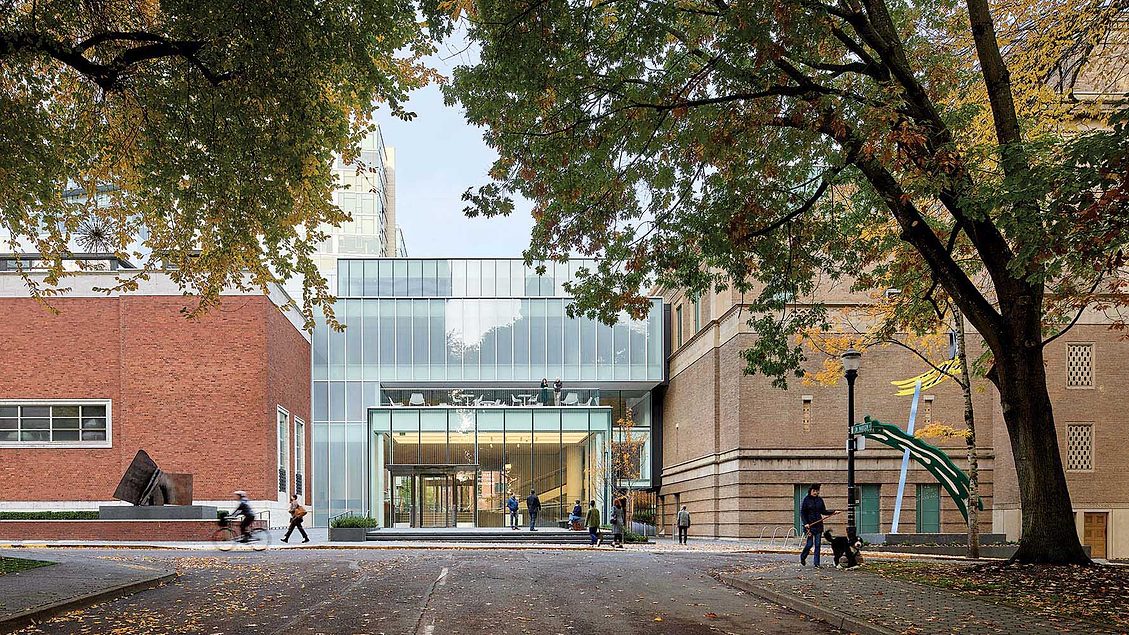
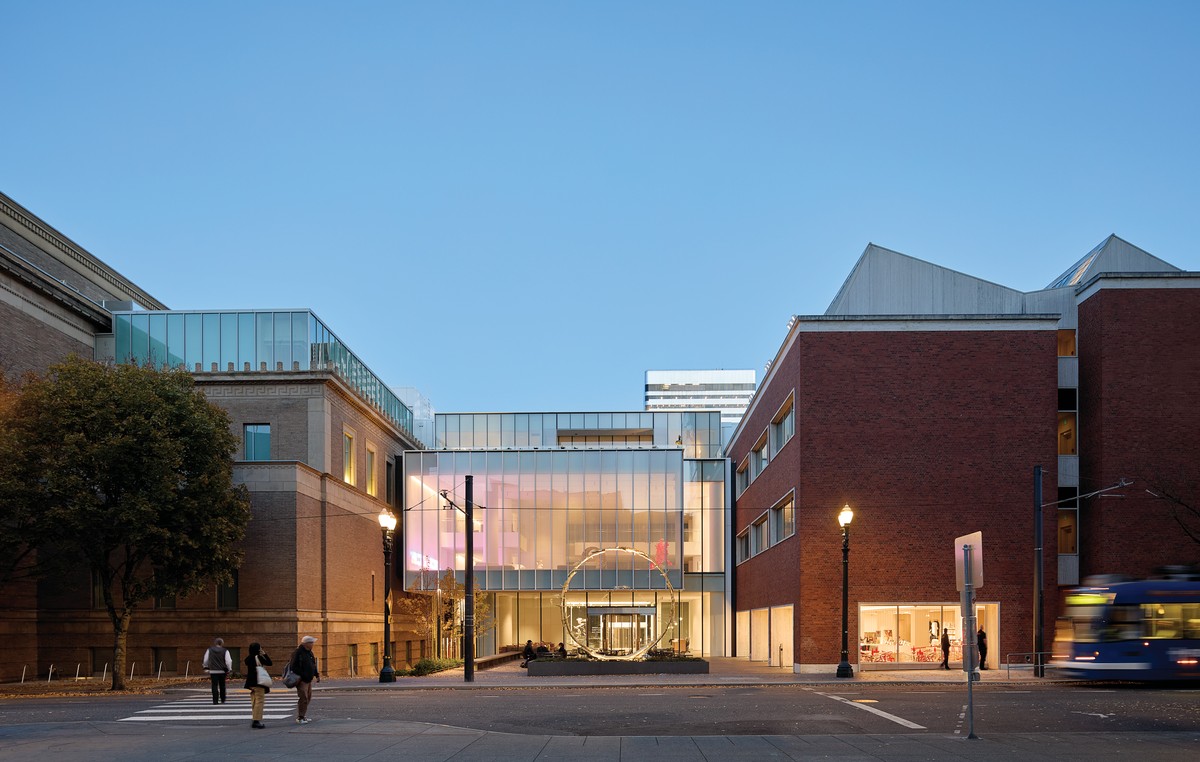
The 24,230-square-foot addition is named the Mark Rothko Pavilion, for the eponymous painter who spent his childhood in Portland, had his first exhibition at the museum, and whose heirs will rotate loans to the museum through 2036. The project is basically a wide breezeway that links each building’s four floors. Set back from both edifices’ front and rear facades, the pavilion is entirely glazed. Variously fritted to modulate light, save energy, and deflect birds, it offers a new main entrance, defers to its neighbors as a kind of hyphen between them, and stands as a gently glowing nighttime beacon.
“A third building wasn’t the solution,” says Eddy. Adds Philip Hamp, cofounder of Vinci Hamp, “Facades that would deftly and gently connect these two Portland landmarks was.”
Both architectural firms have records of skillful preservation. The pavilion’s glazing and mullions, modeled on the proportions of the eclectically styled temple’s windows, draw out this hulking brick-clad mass’s finer details. Carefully articulated setbacks in the addition’s curtain wall preserve the steady rhythms of both buildings’ fenestration. For a new black-box gallery, the architects repurposed the temple’s most beautifully proportioned room, carefully preserving its ornamented beams and painted ceiling.
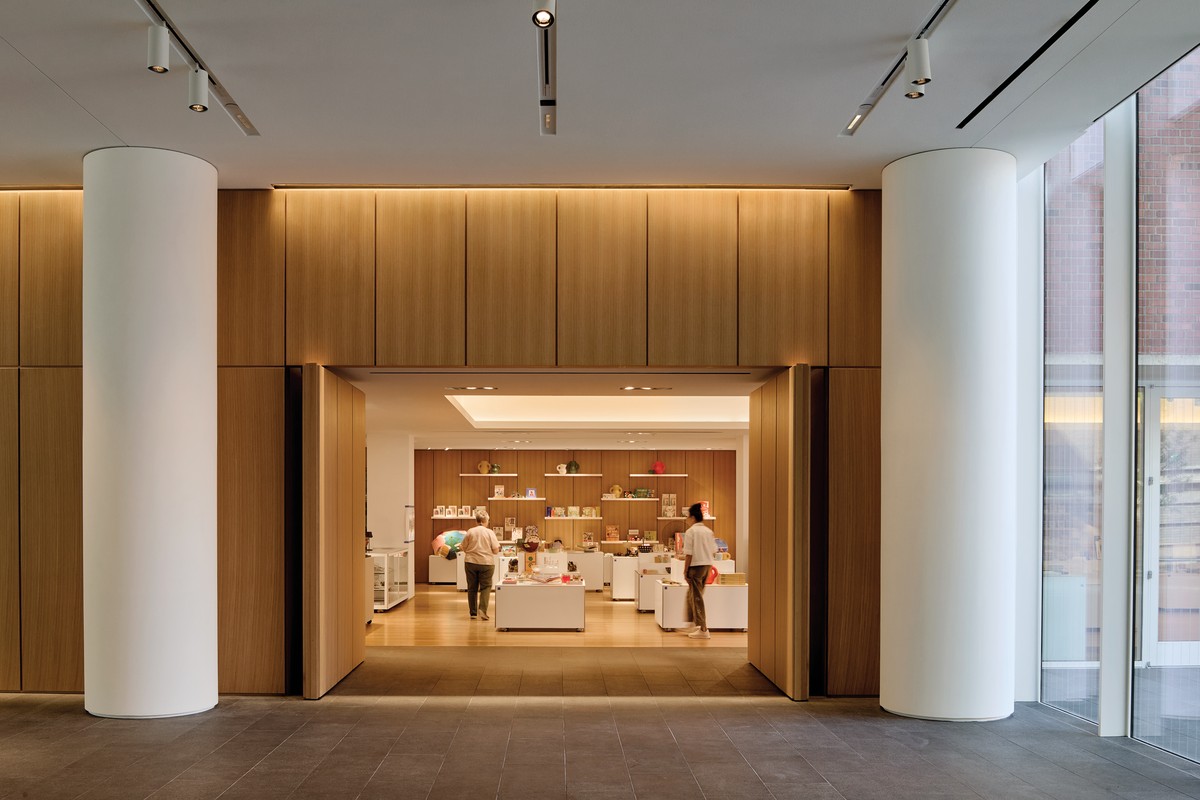
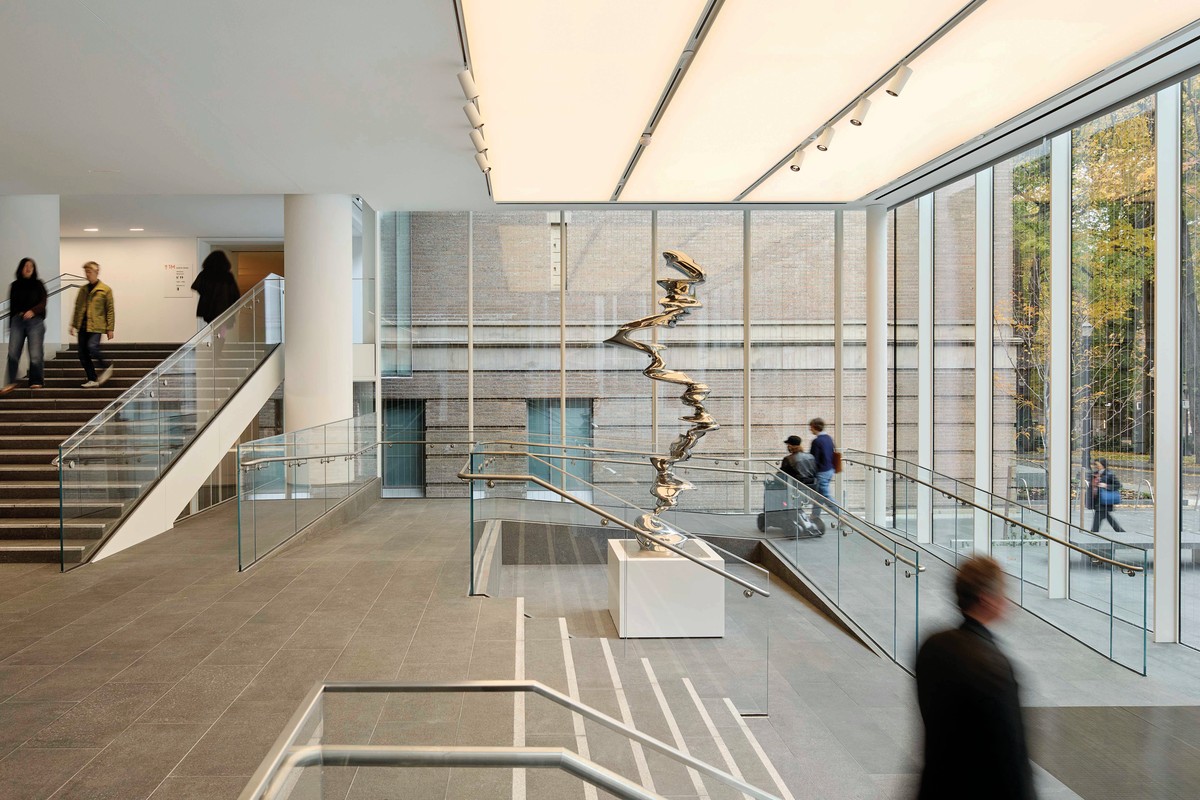
But the expansion’s fealty to history is more than skin-deep. Belluschi designed the museum’s first purpose-built structure in 1932 for a director who pioneered some of the country’s first public art-education programs—thus tailoring his early modernist aspirations as a friendly urban invitation to interact with art. The generous travertine-framed entrance is a mere seven shallow steps up from the sidewalk. Gracious windows welcome natural light and views of the adjacent parks, trees, and buildings. Belluschi followed up with a well-balanced symmetry of two additions in 1937 and 1970. The new pavilion expands on both these formal and civic repertoires. At ground level, paved in simple gray granite, it acts as an intimate street through the museum, fronted by an enlarged café and bookstore and opening to both the linear park and streetcar. Two upper-floor decks offer treetop city views.
Even without the mess left by the 2005 expansion into the Masonic temple, connecting the two landmarks posed no shortage of challenges. The original museum’s loading dock, awkwardly situated between the buildings, had to move to one of the city’s busiest bike and transit corridors. Wealthy neighbors and disability advocates demanded 24-hour through-block access between the buildings, resulting in a costly tunnel beneath the pavilion. Both buildings are protected by their landmark status, so the pavilion had to be structurally isolated; it only touches them with 9-inch-wide seismic joints. And none of the buildings’ floor plates aligned—even at ground level—due to the sloping site.
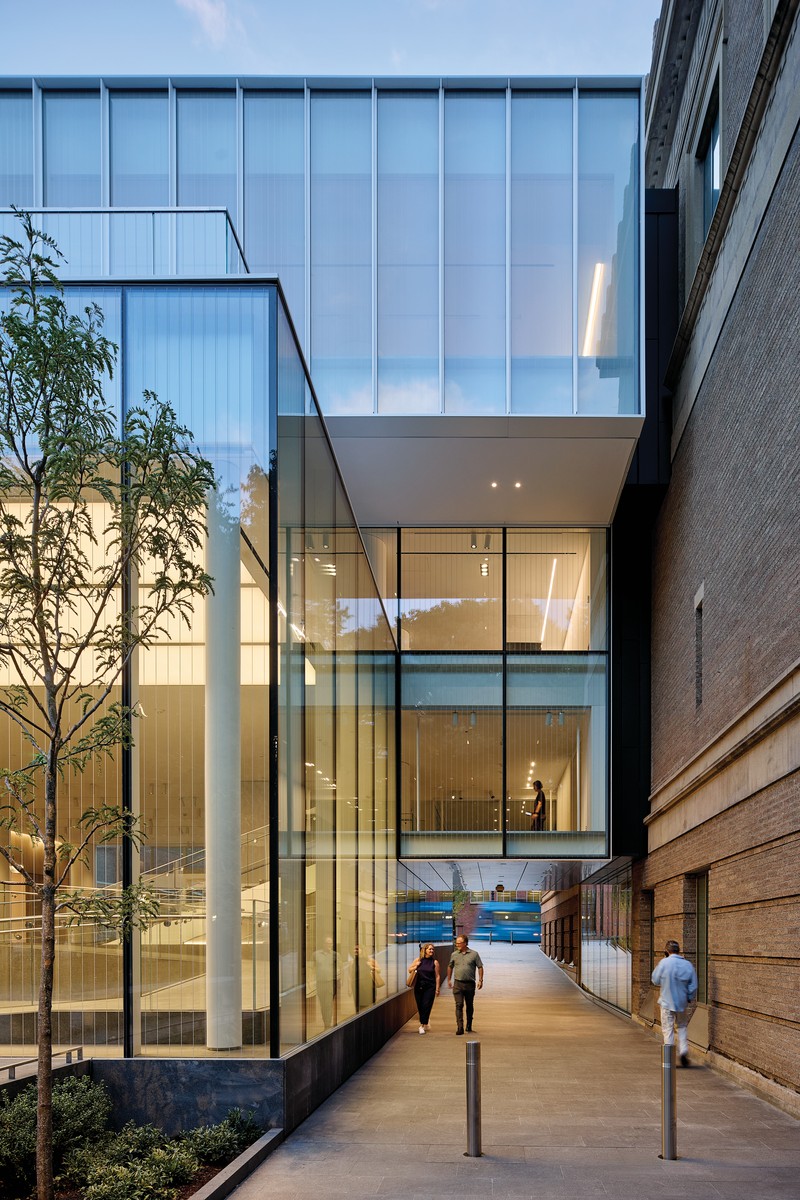
The Mark Rothko Pavilion spans two historic landmarks (top of page) but provides the public with through-block access via a tunnel (above). Photo © Jeremy Bittermann
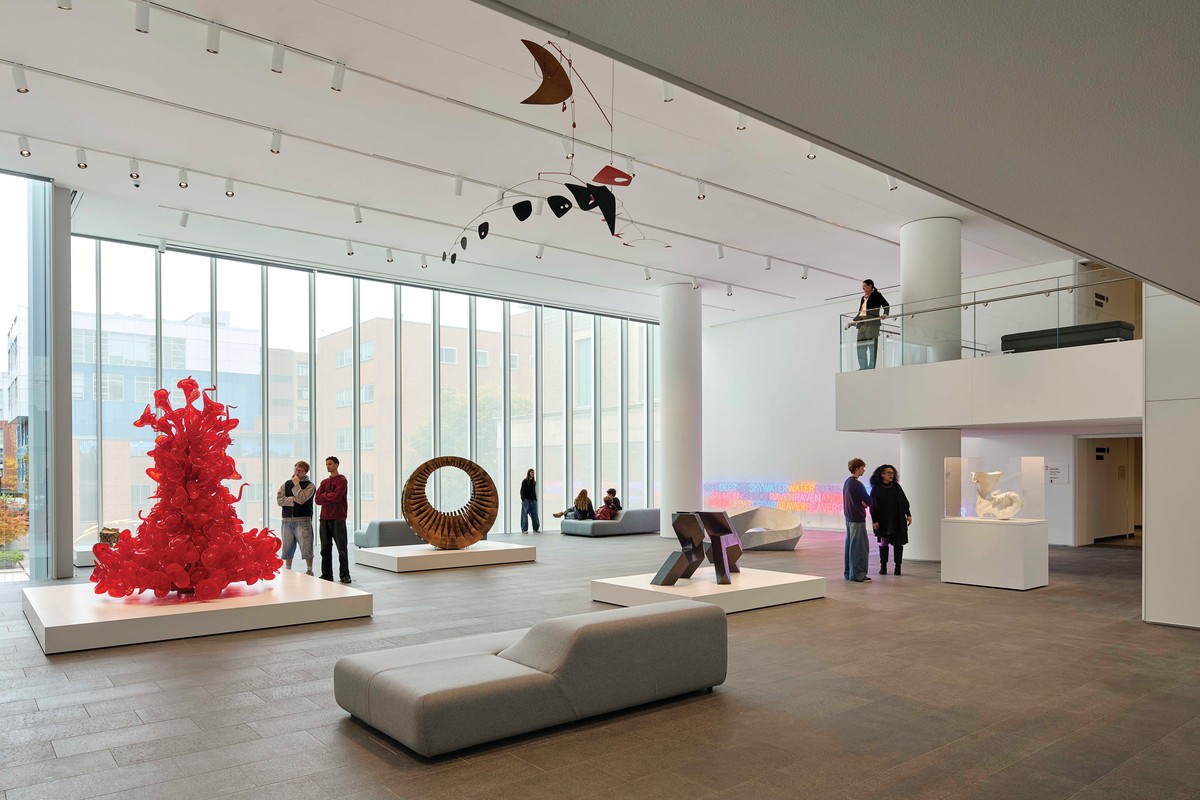
Yet, in every trial, Vinci Hamp, Hennebery Eddy, and the museum’s curatorial team found opportunity, often expressing the museum’s still deeply embedded ethos of education, accessibility, and connection. The new loading dock might have resulted in a garage-like graft onto Belluschi’s gently muscular massing. Instead, the designers built atop it, capping the dock with a gallery featuring a large window that picture-perfectly frames the stately Gothic church across the street. The tunnel is generously glazed at the basement level, offering passersby views into a soaring 6,270-square-foot Black Art & Experiences Gallery, both showcasing major artworks and hosting workshops. The architects tamed the many level changes (some only fully revealed after demolition) into an intricate knit of stairs, ramps, and barely noticeable grade changes that firmly position the pavilion as a navigational center with long, uninterrupted axial views deep into both buildings’ galleries.
3
The intervention leads to new gallery spaces (3) and a gift shop (4). Photos © Jeremy Bittermann
4
As with almost any addition to historical buildings, there are losses and unsolved issues. Belluschi’s taut travertine-framed entrance is now gated, a second control point and easily deleted operational-budget redundancy. The dreariest of the temple’s “bowling-alley” galleries now opens to the pavilion, but some spaces continue to be frustrating dead ends. But these concerns quickly fade against the successes in what Hamp described as the “visual generosity” the design team aspired to.
1
The intervention sits back from the street (1) and creates a new main entrance (2). Photos © Jeremy Bittermann, click to enlarge.
2
Ferriso, newly hired to direct the Dallas Museum of Art, leaves his successor a far better-functioning museum and a complete reversal of his predecessor’s Portland mistakes. Indeed, Ferriso’s favored spot in the Rothko Pavilion is the fourth-floor deck, for its “whole new perspective on the city,” he says. “Seeing the streetcar go by represents Portland values. For the museum to be visually part of that is really special.”
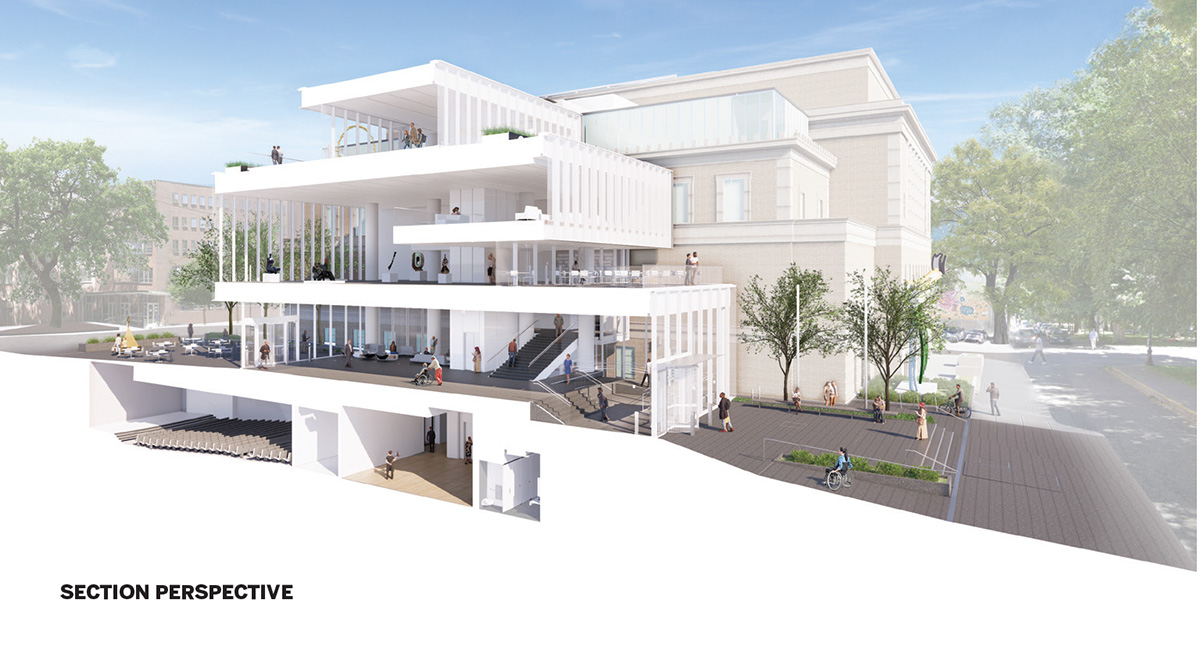
Image courtesy Hennebery Eddy