

 (Donald Trump via Mike Stobe/Getty Images)
Donald Trump is in legacy-building mode. With three years left in the nation’s capital, Trump has spent his second term focused on the physical legacy he will leave behind.
Demolishing the East Wing of the White House to construct a $400 million ballroom is the most obvious example, but there are others. Trump renovated the Rose Garden and Lincoln Bathroom. He recently announced plans to build a massive “Triumphal Arch” between the Lincoln Memorial and Arlington National Cemetery. The Kennedy Center’s board has added his name to the building, and the UFC is scheduled to host an event on White House grounds this June, coinciding with Trump’s 80th birthday.
Then, there is golf. Trump has tried to play peacemaker by brokering a deal between the PGA Tour and LIV Golf. He has met with Tiger Woods multiple times at the White House and even delivered the PGA Tour’s talking points directly to Saudi Crown Prince Mohammed bin Salman during his trip to the Middle East in May.
But with the PGA Tour and LIV Golf seemingly no closer to announcing a deal, Trump has turned his attention to a new project: renovating D.C.’s public golf courses.
Last week, the Trump administration terminated the lease agreement for three public courses in Washington, D.C. These taxpayer-owned golf courses — Rock Creek, East Potomac, and Langston Hughes — are currently managed by National Links Trust (NLT), a nonprofit that was awarded a 50-year lease in 2020 during Trump’s first term.
The Trump administration says NLT’s lease was terminated because the organization owes $8.8 million in unpaid rent and failed to make capital improvements on time.
On the surface, that sounds reasonable. However, after reviewing the 28-page lease agreement and NLT’s annual tax filings, the details tell a different story. National Links Trust has done everything it promised, and the Trump administration isn’t retaking control of D.C.’s public golf courses to make them nicer and more affordable for taxpayers. They are doing it to create an upscale venue that can host a Ryder Cup, replacing the promise of affordable golf with prices most taxpayers cannot afford.
Each of D.C.’s three primary public golf courses has a unique place in history. East Potomac’s prime location and reversible design made it one of the country’s nicest municipal golf facilities when it was built in the early 1900s. Local leaders then doubled down with a redesign of Rock Creek in the 1920s, and Langston Hughes was one of only 20 golf courses that welcomed African Americans when it opened in 1939.
These courses are listed on the National Register of Historic Places and have been managed by the Department of the Interior’s National Park Service (NPS) for more than 75 years. While this structure helped maintain the promise of affordable, accessible golf, it has also turned these courses into shells of their former selves.
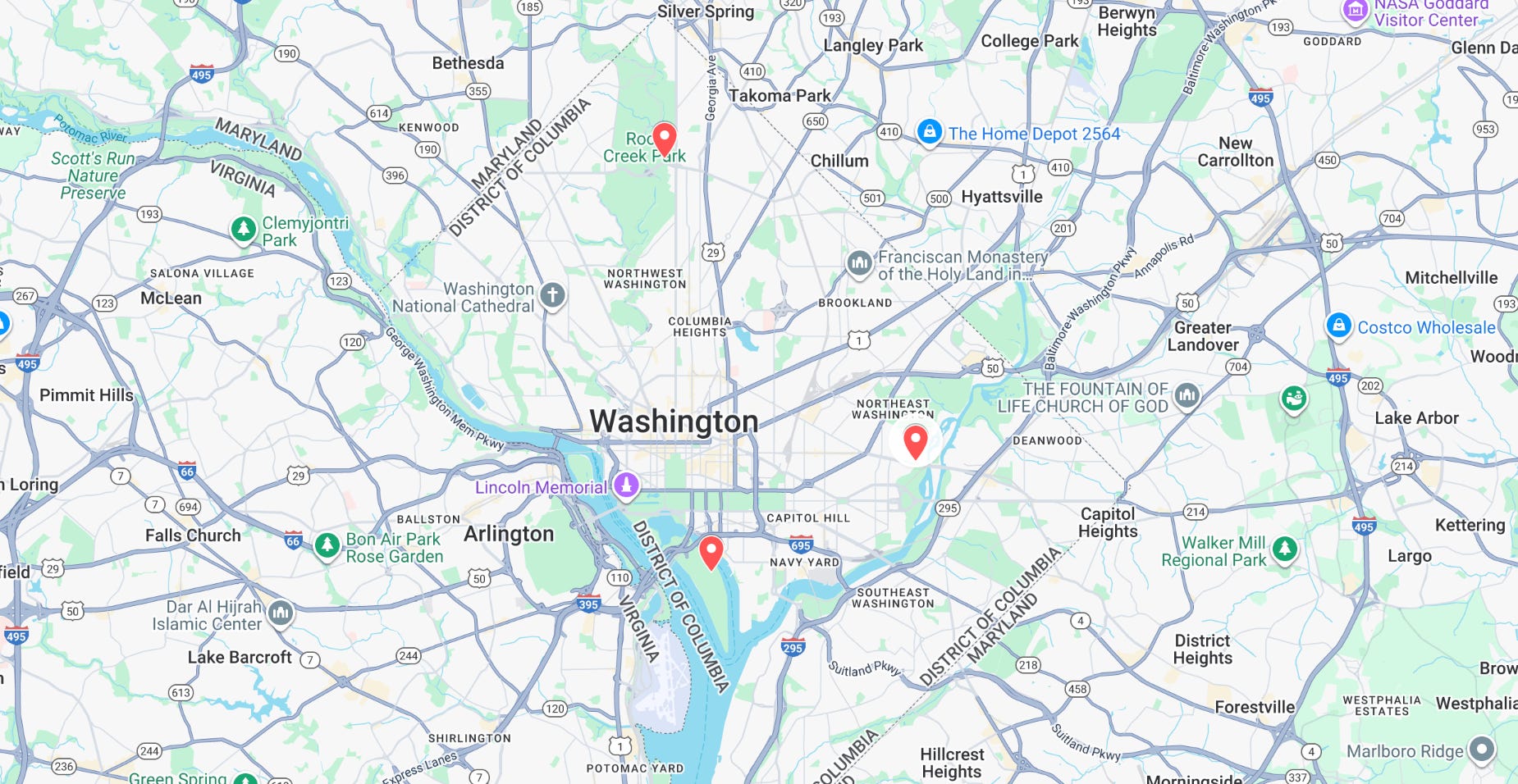 Rock Creek (top), Langston (middle), and East Potomac (bottom)
The National Park Service oversees more than 85 million acres of land and has a $23 billion backlog of repairs. They literally don’t have the time, money, or experience required to run these golf courses. Historically, NPS solved this problem by hiring an operator to manage the properties day-to-day. But the problem with this approach is that there is no incentive for capital improvements. Operators were always working on short-term contracts, and since NPS owned the land, nothing got fixed or updated.
The National Park Service eventually realized this was an unsustainable model and decided to try something new. In 2019, NPS asked potential operators to submit proposals for a long-term lease for its three golf courses in D.C., effectively acknowledging that the federal government lacked the capacity to save these courses.
In October 2020, the National Park Service signed a 50-year lease with a newly created nonprofit called National Links Trust (NLT). Co-founded by Mike McCartin and Will Smith, NLT’s executive team played these courses growing up and brought extensive experience in the golf industry, from hosting events to designing world-class courses.
NLT was awarded the lease by positioning itself as a vision keeper. Recognizing they were not course operators, NLT agreed to subcontract daily management to Troon, the world’s largest golf management company. Not only would this immediately bring institutional-grade standards to the facilities, but it would also enable NLT to focus on fundraising and capital improvements. In fact, as part of NLT’s proposal, the group convinced architects Tom Doak and Gil Hanse to help renovate the courses for free.
NLT began its lease by fixing the obvious stuff (potholes, irrigation, etc.). NLT also spent $1 million renovating the country’s oldest mini-golf course at East Potomac. The nonprofit installed Toptracer technology at both East Potomac and Langston, launched a paid internship program for 30+ students, and has implemented several community programs, including free lesson Fridays, a student caddie program, and a cleanup project that removed 8,000 pounds of trash from a lake adjacent to Langston.
As a result of these changes and programs, NLT says the number of rounds at its courses has doubled over the last five years. And financially, the numbers are even better. According to NLT’s 990 filings, the organization’s revenue increased from $10.7 million in 2021 to $15.1 million in 2024. Total assets have also grown, from $2.85 million in 2020 to $18.3 million today, with NLT’s total liabilities still under $4 million.
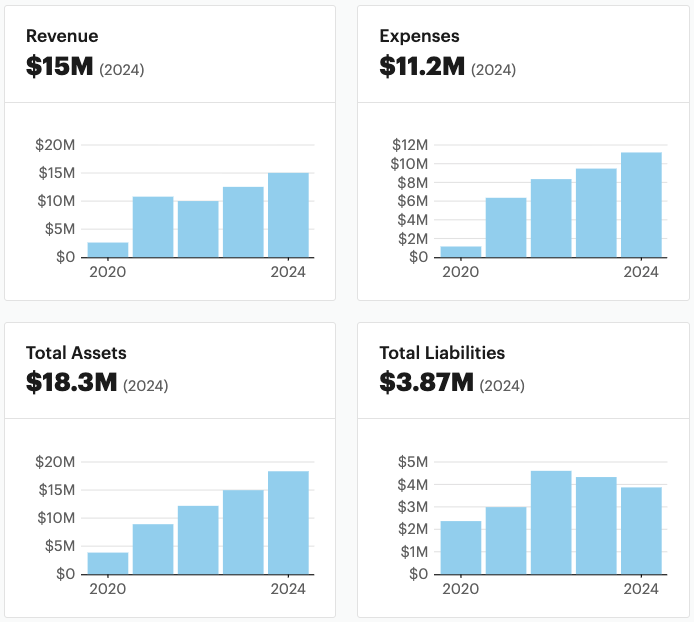
Perhaps the most impressive part of NLT’s financial performance is that 65% of its total 2024 revenue came from “program services” — green fees, cart rentals, and range buckets. This indicates that golf operations are not dependent on donations to keep the lights on. Donations ($3.6 million) are now effectively profit for reinvestment.
As a bystander, NLT’s lease agreement with the National Park Service appears to be going exceptionally well. More people are playing golf at nicer facilities for the same price. Improved financials have enabled the organization to start larger, multi-year renovation projects at Rock Creek and, soon, the other two courses. But despite this progress over the last five years, the Trump administration apparently has other ideas.
 (Donald Trump via Timothy A. Clary/Getty Images)
The Trump administration has been planning to take over D.C.’s public golf courses for months. During the summer, NLT’s leadership team was approached by William Doffermyre (now solicitor for the U.S. Department of the Interior) with a proposal.
NLT’s renovation plans had already been delayed by several years due to the inevitable red tape that comes with any project taking place on national park land. So, rather than continuing to play that game, Doffermyre presented a solution: NLT should leverage President Trump’s ability to raise money and cut red tape to expedite their renovation plans. NLT was excited about the idea, but I’m not sure they had an option.
By the time the plan reached the Oval Office in August, it was drastically different from what NLT and Doffermyre had initially discussed. Rather than helping the nonprofit raise money and cut red tape, Department of the Interior Secretary Doug Burgum and Doffermyre pitched Trump on transforming East Potomac Golf Links into a high-end, professional-level course named “Washington National Golf Course.”
The following month, Doffermyre issued a formal default notice to NLT. Trump then sent dirt from his demolition of the White House’s East Wing to East Potomac Golf Links (because it would be needed for a renovation anyway). And then last week, the Department of the Interior formally terminated its lease with NLT 45 years early.
The Trump administration says it terminated its lease with NLT because 1) NLT failed to make capital improvements on time, 2) NLT did not provide a “reasonable and credible” cure proposal after receiving the initial default notice, and 3) NLT owes as much as $8.8 million in unpaid rent to the National Park Service from 2020 to 2025.
But after reviewing the lease agreement, none of these allegations contains substance.
While NLT’s renovation timeline has been slower than anticipated, the nonprofit has already invested $8.5 million in capital improvements. The timelines NLT provided during lease negotiations were also estimates, subject to change depending on approval timelines. NLT has been trying to start its renovation plans for years, but operating on National Park Service land triggers the National Environmental Policy Act (NEPA). This has significantly slowed the process.
NLT didn’t provide a “reasonable and credible” cure proposal after receiving the DOI’s initial default notice because the notice was only two sentences long and didn’t include specific reasons for terminating the lease. If NLT doesn’t know why its lease is being terminated, how can they put together a plan to fix it?
The allegation of unpaid rent contradicts the lease. According to the agreement, NLT must pay 16% of gross revenue as rent. However, the lease also includes a structured mechanism allowing rent offsets for capital improvements. In other words, if NLT spends money on fixing an irrigation system or removing trees, that payment is offset against their rent, reducing the amount they owe NPS.
Considering that the $8.8 million in unpaid rent allegation almost exactly matches 16% of NLT’s total revenues, the DOI is essentially trying to argue that all of the organization’s capital expenditures were unapproved and shouldn’t reduce rent.
The only problem with that approach is that every rent offset must be preapproved. NLT has also held monthly meetings with the National Park Service throughout the duration of its agreement, and no concerns were raised until the August default notice.
 (East Potomac Golf Links via National Links Trust)
If the Trump administration is successful in terminating its lease with NLT, all three public golf courses would return to government control. But let’s not kid ourselves: the government has no interest in Rock Creek or Langston; East Potomac is the prize because of its views and proximity to the White House and the National Mall.
Trump would likely be able to raise whatever money is required to renovate the East Potomac course. Some people have even speculated that Trump might hire his own company to handle the renovation or manage the course once it is complete. But just because the course will be nicer than it is today, that doesn’t mean it will be better.
Trump says locals will get discounted rates, but the operating costs of a Tom Fazio championship course require higher revenues per round to break even. That means the same person who pays $48 to play 18 on the weekend might soon have to pay $200.
There is also a chance this renovation will never be completed. Even if we ignore the fact that hosting large events like the Ryder Cup would require stadium seating and mass transportation, NLT decided to renovate East Potomac last because 1) it was making money while Rock Creek was losing money, but 2) East Potomac can’t be renovated until the government completes a nine-figure seawall renovation project that will stop the course (and park) from flooding. If that extends the renovation by a few years, who is to say the next administration doesn’t end the project altogether?
The politicization of this project is the most frustrating part. NLT’s model was seen as the future of municipal golf. While public courses nationwide are shutting down due to financial and land constraints, NLT used its 501(c)(3) status to access philanthropic funding for public infrastructure. Donors passionate about historic preservation were happy to give money because NLT secured renovation commitments from industry-leading architects, and national park status meant the courses wouldn’t disappear.
For five years, NLT did everything right. Executive compensation was low, with each founder taking home just $50,000 in 2024. Revenues were reinvested back into the business, creating a nest egg to fund future renovations. NLT even spent five years (and millions of dollars) navigating government bureaucracy to obtain construction approval. But now, D.C. golfers might be looking at a very different future.
If the Trump administration gets its way, the promise of affordable, accessible golf in the nation’s capital is on its way out. The course that replaces East Potomac may be a masterpiece capable of hosting a Ryder Cup, but does that really matter if most of the locals who enjoy playing the course today are boxed out from playing it in the future?
If you enjoyed this breakdown, share it with your friends.