
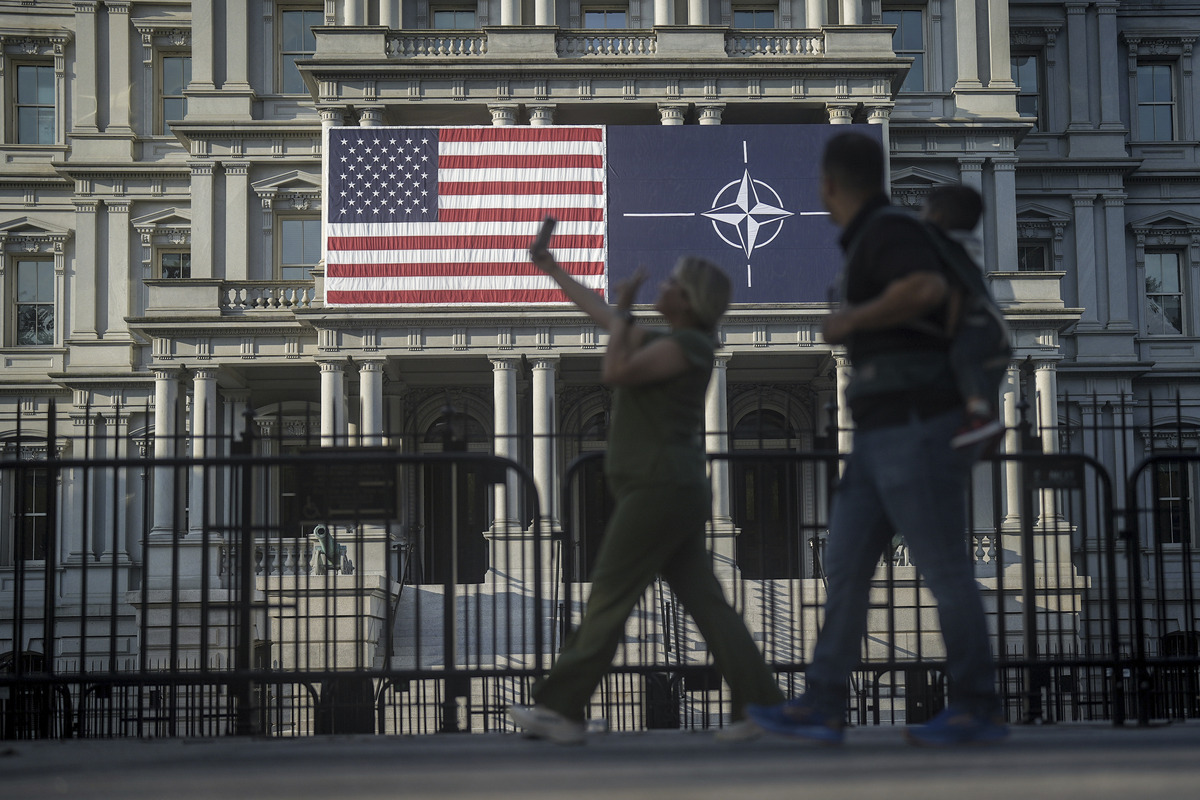
President Donald Trump and his administration’s professed plans to make Greenland “part of the United States” have set alarm bells ringing throughout NATO.
“If the United States attacks another NATO country, everything stops,” Danish Prime Minister Mette Frederiksen told the country’s DR broadcaster on Monday. Greenland, a mineral-rich and strategic Arctic island, is a semiautonomous Danish territory and therefore part of NATO.
The very basis of NATO is one of the articles in its founding treaty: Article 4 dictates that an attack on one member state is to be treated as an assault on all, and each country should respond accordingly. Underpinning this is the threat that any attacker would have to deal with the might of the U.S. military, with its vast resources and, crucially, expansive nuclear weapons arsenal.
But until now, the idea that the U.S., the most influential member of NATO, would turn on another alliance state had been unfathomable. To do so would likely spell the end of NATO altogether.
Yet the administration has doubled down on its desire to take Greenland, though it has not been clear whether it will rule out military action or somehow increase its footprint on the territory. Greenland is home to a handful of U.S. forces at the Pituffik Space Base, which is vital for tracking long-range missiles headed for U.S. soil.
White House deputy chief of staff Stephen Miller told CNN on Monday that the government’s “formal position” was that Greenland should be under U.S. control. His comments came after Danish anger over a social media post by Miller’s wife, Katie Miller, which showed the American flag overlaid on an outline of Greenland.
Trump himself said on Sunday that the U.S. would look at the issue of Greenland in the coming weeks, while reiterating that it is a vital chunk of territory for U.S. national security.
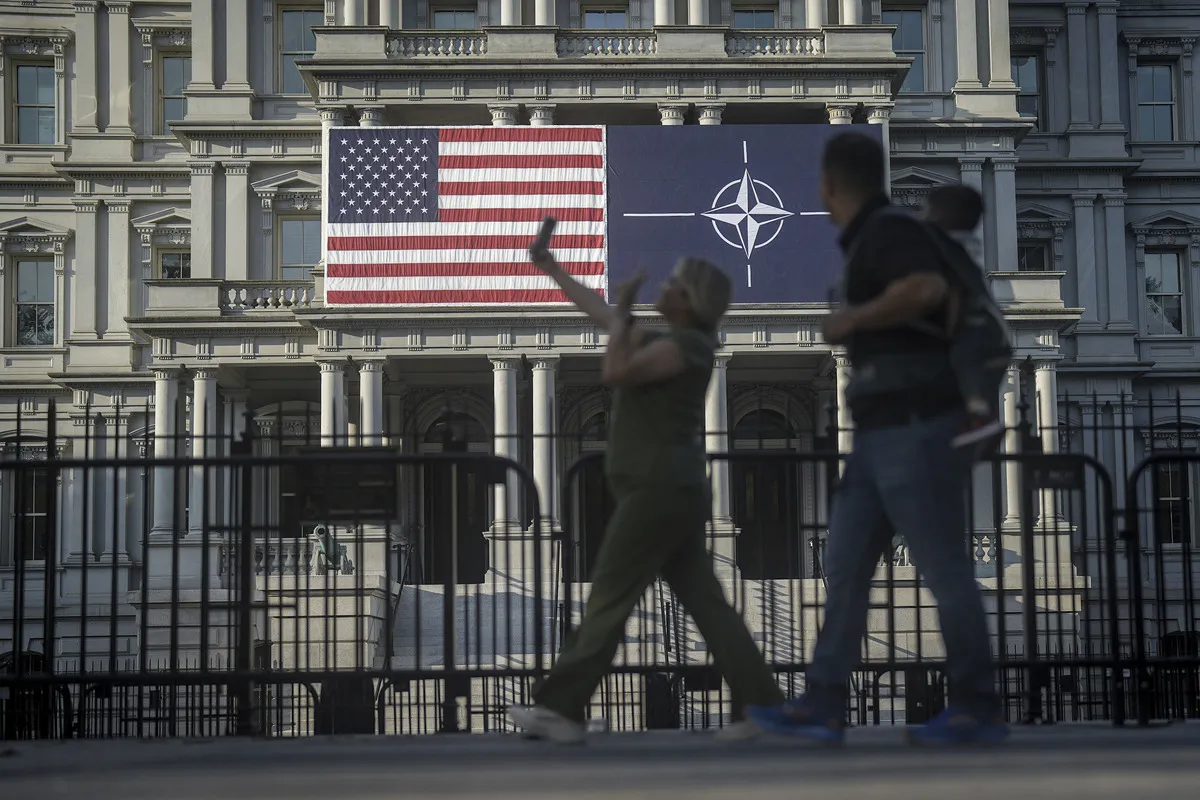 ‘The Power of NATO’
“The United States is the power of NATO,” Miller said. “For the United States to secure the Arctic region, to protect and defend NATO and NATO interests, obviously, Greenland should be part of the United States.”
The U.S. is indeed the dominant power in NATO and has historically propped up other militaries in the alliance, particularly after the Cold War. Washington has for years maintained a much higher level of defense spending in GDP terms than other NATO countries, although the alliance pledged in June last year that its members would surge defense and related spending to 5 percent in an effort to appease the White House.
There are many ways to judge the strength of a military, beyond just the figures; training, maintenance and readiness all play into how well a country’s armed forces operate. Many of the U.S.’s forces are intertwined with European militaries as well—NATO deploys multinational brigades near Russia, and the chief of all NATO forces in Europe is an American. NATO’s ethos is about collaboration, so it is difficult to separate U.S. capabilities from those of European countries and Canada.
With the U.S. taken out of the equation, NATO still has 31 members, all of which have militaries to contribute.
Based on a few numbers in isolation for individual countries, the U.S. has by far the largest air force in NATO. According to the most recent estimates from the United Kingdom-based International Institute for Strategic Studies (IISS), the U.S. Air Force has just over 1,400 combat-capable aircraft, ranging from long-range strategic bombers capable of carrying nuclear missiles to electronic warfare aircraft and helicopters.
The U.K.’s Royal Air Force (RAF) had 210 aircraft in operation as of early 2025, according to the IISS. France, meanwhile, is sitting at roughly 283, by the think tank’s count.
Turkey, a not-insignificant NATO player, is thought to have just under 300 flyable aircraft, and Poland, which has emerged as a major military spender in recent years, has an estimated 85 operational aircraft. The Canadian Air Force’s tally stands at 103.
By comparison, outside the alliance, China is estimated to have just under 3,000 combat-capable aircraft of all types in its air force.
Land Forces
The U.S. Army, close to half a million-strong, far outstrips any other land force in NATO, with more than 2,600 Abrams main battle tanks, over 10,000 armored personnel carriers (APCs) and thousands of other armored vehicles.
The British Army, meanwhile, has reached its smallest size in centuries and is currently contending with how to attract and keep new recruits. According to the IISS, the British Army has just over 200 Challenger 2 tanks, several of which have been donated to Ukraine’s war effort. Some Challenger 2 tanks are slated for upgrading to Challenger 3s.
The country’s long-awaited Ajax tracked armored vehicle program was halted in November after soldiers testing the vehicles became unwell from vibrations and noise.
France’s army has a little over 200 Leclerc tanks, plus 2,557 APCs and several hundred other armored vehicles. Canada has 74 main battle tanks, all of which are iterations of the German-made Leopard 2s.
Poland, with its army personnel numbering over 90,000, has more than 660 tanks, including the South Korean-made K2.
On and Under the Waves
The U.S. Navy is a formidable power, but it’s stretched—the U.S. maintaining its presence across the globe comes at a cost. Trump has vowed to build up American naval power, including with the new Trump-class “battleship” unveiled last month.
Currently, the IISS numbers show the Navy has 65 submarines, most of which are nuclear-powered guided-missile submarines equipped with Tomahawk land-attack cruise missiles. In early 2025, the Navy had 11 aircraft carriers, including the Gerald R. Ford, the world’s largest aircraft carrier, which has lingered off the coast of Venezuela for months as part of the massive U.S. buildup presaging U.S. operations in the country over the weekend.
Also in the mix are an estimated 74 destroyers, 11 cruisers and 26 frigates. The U.S. also has more than 100 patrol and coastal combatant ships, as well as other types of vessels, such as amphibious landing craft and support ships.
Canada has four submarines, although Ottawa said in mid-2024 it was in the market for a dozen new submarines. Canada also has a dozen frigates and four patrol vessels.
The British Royal Navy has two aircraft carriers, eight frigates and six destroyers. Under the waves, the U.K. has four submarines equipped with nuclear weapons, plus several others carrying long-range missiles. The upcoming Dreadnought-class submarines will take over the country’s nuclear deterrent, and London said last year that the country would build more attack submarines.
Nuclear Weapons
Arguably, the biggest gap between the U.S. and the rest of NATO is nuclear weapons. Combined, the U.S. and Russia have roughly 90 percent of the world’s more than 12,000 nuclear weapons.
The U.S. nuclear arsenal is made up of both tactical and strategic nuclear weapons. Strategic nuclear weapons are deployed on intercontinental ballistic missiles, submarine-launched ballistic missiles, plus those fired from bomber aircraft, and are thought of as the missiles that could level entire cities and threaten major global superpowers. The U.S. has an estimated 200 tactical nuclear weapons, with much smaller yields. Roughly half are thought to be deployed at European bases and select European-operated jets certified to carry them.
Elsewhere in NATO, only the U.K. and France have nuclear weapons, and not nearly as many as the U.S. The U.K. has nuclear weapons launched from its submarines, known as its continuous at-sea deterrent, with an estimated total of 225 warheads overall. France is thought to have 290 operational nuclear weapons.