
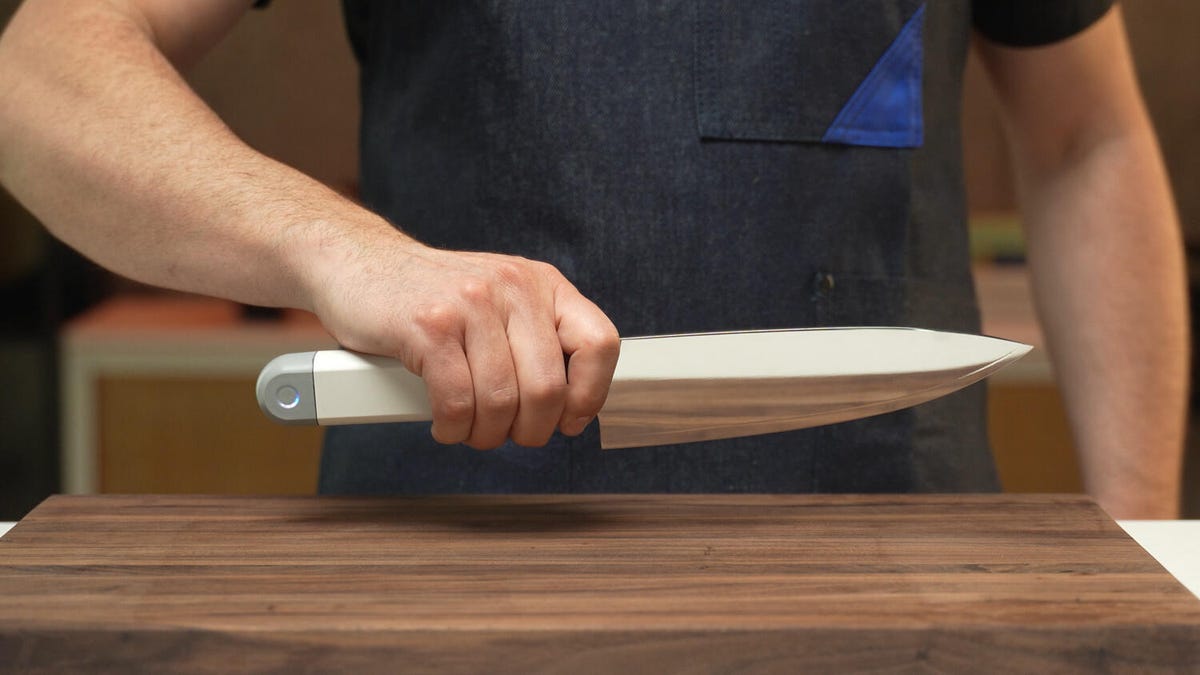
We’re tracking all the latest news out of CES, and one of the buzziest drops is a knize that, well, buzzes. OK, more like vibrates.
Last year, Seattle Ultrasonics announced the impending launch of the world’s first ultrasonic knife. This week at CES, the vibrating blade was available for testing, and I had the opportunity to get my hands on the $399 C-200 chef’s knife, which pulses over 30,000 times per second.
I’ve tested dozens of chef’s knives over the years, but never anything like this. Here’s the skinny on this fascinating new kitchen gadget and what it’s like to slice with a buzzing blade.
Why a vibrating knife?
With the push of a button, this knife starts vibrating over 30,000 times per second.
Seattle Ultrasonics
The idea behind a knife with tremendously fat vibrations helps cut through squishy tomatoes and dense potatoes without using as much pressure. The micro-buzzing also helps release food from the knife, so you’re not scraping slices off with your fingers — a dangerous affair, to be certain.
At Seattle Ultraonics’ booth at a preview event for the Las Vegas tech show, I slid my way through hordes of knife-wielding attendees to get my hands on it for the first time. Reps from the brand had a cutting board with tomatoes and potatoes available for trial.
Using it was simple. A small button on the handle of the blade activates the ultrasonic vibrations. There wasn’t a notable shake to the knife when turned on but I could feel a slight buzz, almost like a slight electric current shooting through my hand. An odd sensation but not uncomfortable in any way.
So does this thing really work?
I sliced tomatoes with precision using almost no force.
David Watsky/CNET
I put the tip of the blade, the part that reps told me is the buzziest, to a tomato. As promised, the blade slid through the fruit with almost no pressure needed. As I lifted the knife, the slice of tomato released easily from the blade. I made another, more precise cut and found that the blade was able to cut thin slices more easily than a typical knife.
So far, so good.
Next was the potato. This took significantly more pressure to slice through than the tomato but less force than I’d normally apply to a dense, starchy vegetable. I made several slices. Some of them released easily from the blade, while others stuck. For potatoes, the advantage was clearly in easier cutting, rather than in food release.
Sliced tomatoes released easily from the knife. Potatoes were a little more hit or miss.
David Watsky/CNETWould I spring for the pricey knife?
Probably not. I cook plenty, but rarely find myself tiring of chopping or slicing. It’s a cooking task I find relaxing and I’m happy with my current set of kitchen blades. This knife costs a whopping $399. A premium knife from one of my favorite manufacturers can be had for roughly a quarter of that cost.
Here’s who the knife would be good for
Since significantly less force is required to cut using the ultrasonic blade, individuals with strength or hand mobility issues may find the knife particularly helpful. Those with arthritis, carpal tunnel or repetitive strain syndrome could find relief from Seattle Ultraonics’ innovative knife.
The knife impressed several of us who tested it, earning a finalist slot on CNET’s Best of CES 2026 list.