
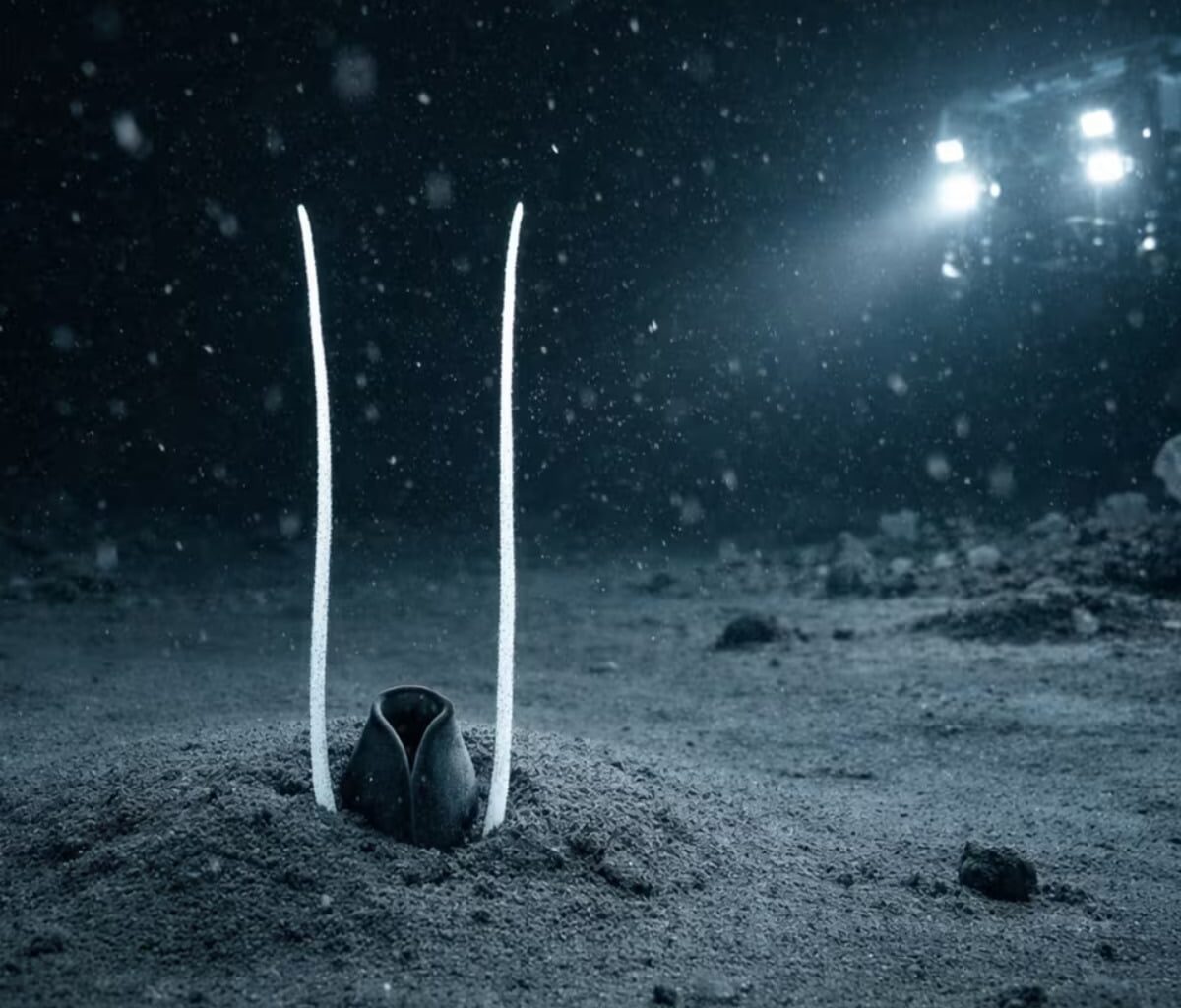
Deep in the Pacific’s darkness, scientists captured a scene no one expected: an unknown creature, motionless, half buried in mud, blending into the seafloor. This never-before-seen cephalopod behavior may be more than a curious footnote—it could reshape how we think about life in the deep.
The encounter unfolded roughly 4,100 meters down in the Clarion Clipperton Zone, an expansive plain targeted for future mining. Using a remotely operated vehicle, the team filmed a yet-undescribed deep-sea squid, likely from the whip squid group, almost completely submerged in sediment and hanging upside down. Only its siphon and two long, white tentacles poked above the seafloor.
Published on November 25 in Ecology, the account left lead author Alejandra Mejía Saenz, a deep-sea ecologist at the Scottish Association for Marine Science, genuinely puzzled. “A squid coated in silt—and upside down—was unprecedented. We hadn’t seen anything like this in cephalopods.”
While some octopuses, cuttlefish, and shallow-water squids do burrow, this is the first time such behavior has been documented in an abyssal squid, especially in that inverted posture.
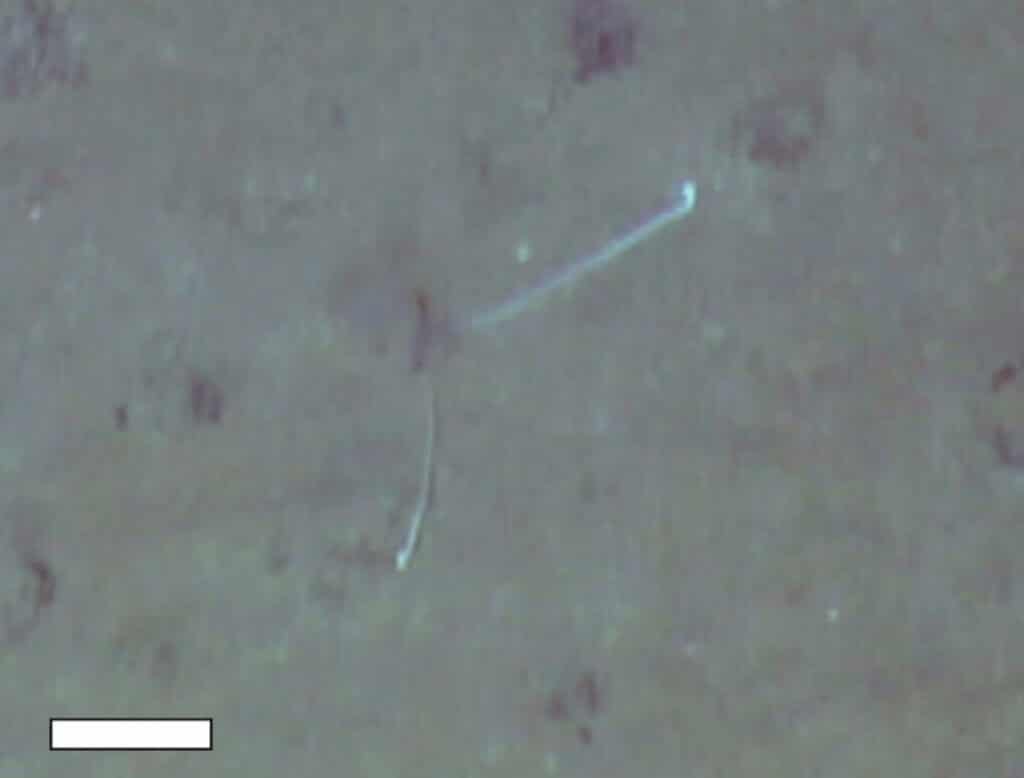
© At depths of over 4,000 m, only two tentacles betray the presence of a still unknown squid. © Mejía-Saenz et al. 2025
An abyssal masquerade to survive
The sighting came during SMARTEX, a British expedition evaluating the impact of deep-sea mining. At first, researchers thought the shapes rising from the bottom were glass sponges or tube worms. Only slight movements gave the game away: it was a squid—right before it seemed to vanish beneath the mud.
Scientists think the tactic serves a dual purpose. It may help the animal evade predators like beaked whales, or lure crustacean prey by mimicking the fixed organisms those prey circle around. As Mejía Saenz puts it, if a sponge draws in a crustacean, and the squid imitates the sponge and eats it, “that would explain everything.”
In the deep, where food is scarce and energy must be conserved, this mix of camouflage and passive trapping makes sense. Jim Barry of the Monterey Bay Aquarium Research Institute, who was not involved, notes parallels with benthic invertebrates—sponges, soft corals, polychaete worms—supporting the idea that the squid is deliberately imitating its living backdrop.
A world still largely unexplored and under threat
Abyssal plains are vast, yet among the least explored places on Earth. Even in the comparatively well studied CCZ, researchers spotted just 33 cephalopods over nearly 5,000 kilometers of ROV transects—scarcity that helps explain why startling species and behaviors still surface today.
But the finding comes with a warning. The CCZ is a prime target for extracting nickel, cobalt, and manganese. Such operations could stir up thick sediment plumes capable of smothering local fauna. As Mejía Saenz cautions, “We still don’t know how far the consequences reach.”
Bruce Robison of MBARI, also uninvolved in the study, sees a broader lesson: our understanding is still fragmentary. We’ve likely glimpsed only a sliver of abyssal squid behavior, he says, so each new tactic is a genuine surprise—a reminder of what the deep still hides, and what might vanish before we grasp it, from the Pacific floor on up.

Cécile Breton
Journalist
Since childhood, books, photography, and travel have been part of my world. Fascinated by life, by the stars, by landscapes that tell stories without a single word, I quickly realized that I needed to express what I saw and felt.
Passionate about the world around me, I first pursued a degree in History at university, driven by my fascination with the stories of the past and the great civilizations that shaped our world. But over the years, another truth became clear: I didn’t want to spend my life in archives or research. I wanted to be out in the field, behind a camera or in front of a microphone, sharing what I learned.
So, I took a new path. I chose journalism, to learn how to tell stories differently—with rigor and clarity. I learned how to write, to interview, to edit, to capture both attention and emotion.
Giving meaning and sharing what matters
Since then, I’ve worked across different media: print, web, radio, television, and video. All of this has allowed me to bring to life topics that matter deeply to me: nature, animals, space, and the major environmental and human issues of our time.
Today, I continue my journey as a journalist at Futura. As part of the editorial team, I strive to share knowledge with curiosity, clarity, and passion. My guiding thread? To make visible what deserves to be seen, understood, and shared—and to keep my sense of wonder alive.