
NVIDIA responded to our follow-up questions on its DLSS 4.5 announcement. There had been some lingering questions on what features are available across the GeForce RTX lineup, which are exclusive to the latest RTX 50-series, and exactly how some of those features work.
1) Our first question to NVIDIA was whether Dynamic Multi Frame Generation worked in some limited form on RTX 40-series / Ada, at least to automatically switch between 2x FrameGen and no FrameGen. NVIDIA says that Dynamic Multi FrameGen only works on the RTX 50-series, there’s not even a limited version of it on the RTX 40-series.
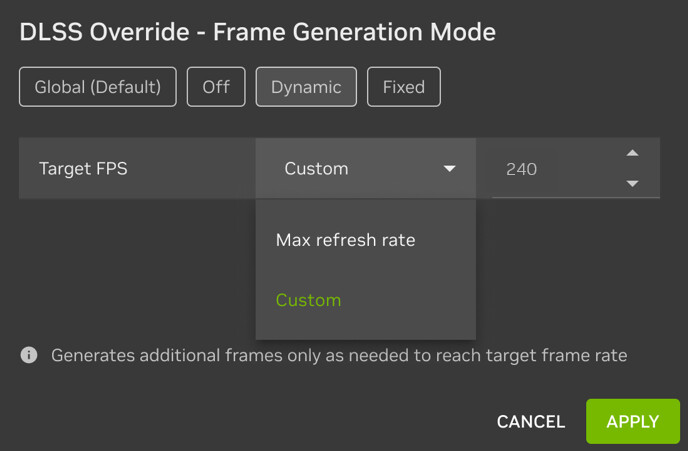
2) Our next question was to understand how the 240 FPS mode picked the default target FPS, whether it did so by looking at the supported display modes reported by the monitor to Windows, or if it’s always default to 240 FPS even when connected to a display with lower refresh rates, such as 144 Hz or 60 Hz. NVIDIA says that since DLSS Overrides are a user-initiated feature, the user has full control. You first have to select “Dynamic” in the Frame Generation Mode section of DLSS Override, and in the Target FPS dropdown, you are presented with two choices. The “Max refresh rate” option sets the target FPS to the maximum refresh rate supported by the monitor, while the “Custom” option lets you manually specify a target FPS value.
 3) Our third question was to learn whether Dynamic Multi Frame Generation requires DLSS Super Resolution to be enabled, or whether it worked independently of it. NVIDIA confirmed that Dynamic Multi Frame Generation, just like Frame Generation itself, works independently of Super Resolution (upscaling). The input can be at native resolution, or any of the DLSS modes, including DLAA.
4) The next question, related to this, was to understand whether the 2nd Generation Transformer models are required for 6x Frame Generation. This question, like the previous one, is nuanced, and is based on NVIDIA’s explanation that 6x frame-generation is made possible thanks to advances in temporal stability and reduction in ghosting introduced by the newer 2nd Gen Transformer upscaling model. NVIDIA responded that no, you do not need the 2nd Gen Transformer model to be enabled in order for 6x frame generation to function, it FG x6 works independently of upscaling. Obviously, the best visual quality results will be achieved when using the 2nd Gen Transformer model as that provides a better input image to the FrameGen algorithm.
5) Our final question in the session was to find out whether Dynamic Frame Generation only automatically adjusted the rate of frame generation (between 0x and 6x) to achieve the target framerate specified in DLSS Override, or whether it also adjusted DLSS super resolution presets (upscaling percentage). NVIDIA clarified here, that Dynamic Frame Generation only adjusts the Frame Generation factor, it doesn’t touch the super resolution factor.