
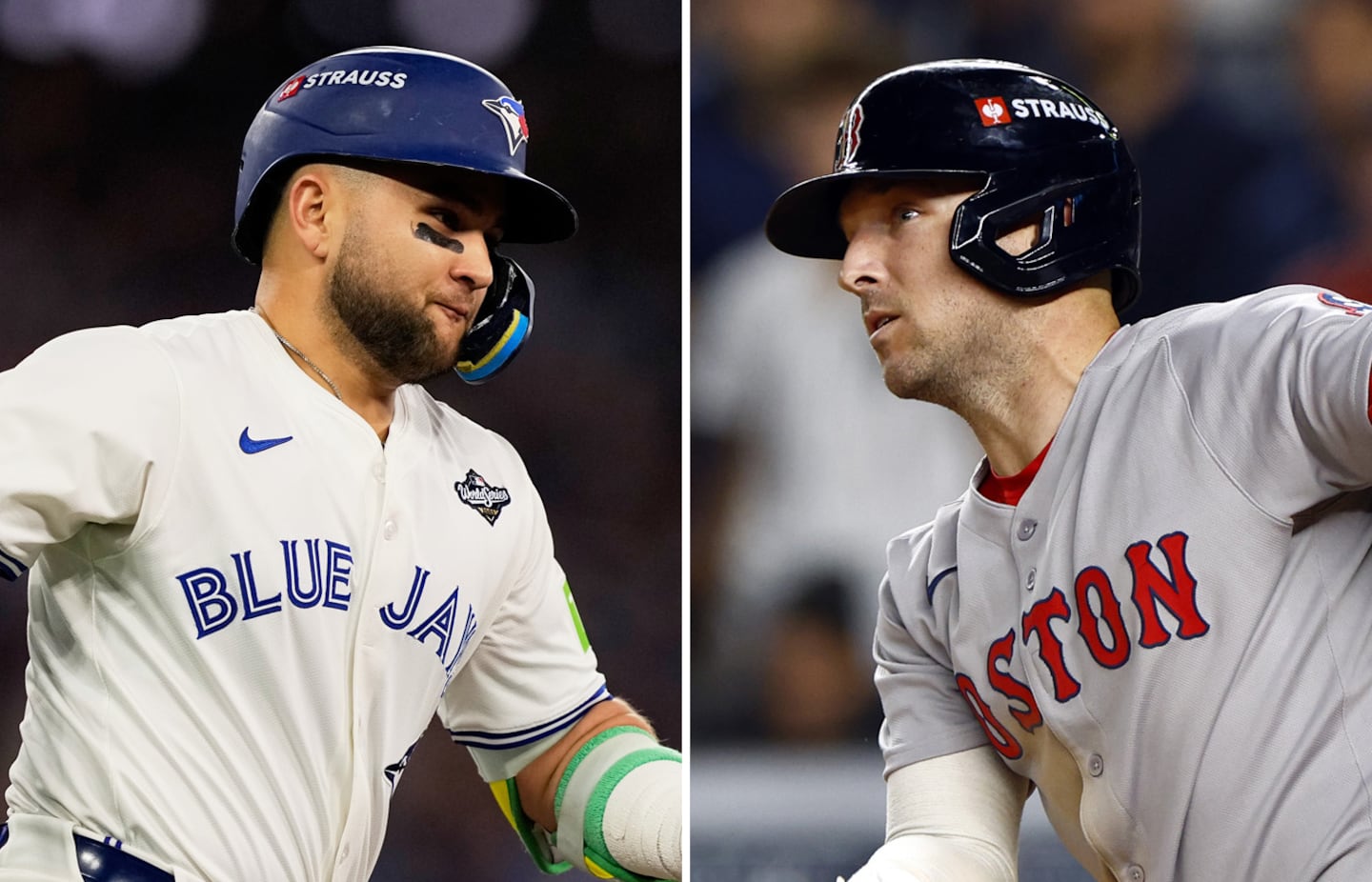
Bichette and Bregman aren’t the only players who potentially fit the Red Sox. Still, in some ways, they represent the most straightforward additions, so it’s worth considering some merits and drawbacks of each.
Alex Bregman
Get Starting Point
A guide through the most important stories of the morning, delivered Monday through Friday.
Age: 31 (turns 32 in March).
2025: .273/.360/.462, 128 OPS+, 18 HRs, 10.3 percent walk rate, 14.1 percent strikeout rate, 3 Outs Above Average.
Career: .272/.365/.481, 132 OPS+, 28 HRs per 162 games, 11.8 percent walk rate, 13.4 percent strikeout rate.
Pros: Bregman represents a turnkey solution, an established championship contributor with known offensive and defensive impact. He transformed the Red Sox last year with his play and personality as a teammate. Prior to a severe right quadriceps injury in late May, he was amid a monster season — a .299/.385/.553 line with 11 home runs, good for 2.4 WAR in the calculations of FanGraphs, a mark that ranked seventh among big league position players.
He also has skills that should hold up relatively well. He has one of the lowest chase rates in baseball, swinging at 20 percent of pitches out of the strike zone. He has great bat-to-ball skills, as he whiffed on just 15 percent of his swings. He knows how to pull the ball in the air. Both swing decisions and ball flight (in Bregman’s case, the ability to lift the ball to left field) tend to age well, suggesting a likely enduring ability to hit for average and get on base.
Cons: While Bregman’s first two months of last season offered a glimpse of his ceiling, his injury and performance thereafter offered concerns about the back end of a long-term deal.
In his final 63 games, Bregman hit .250/.338/.386. He still got on base but his power cratered.
That stretch highlighted some of the risk associated with Bregman’s offensive future. At a position (third base) where teams expect thump, it’s an open question for how long Bregman will be able to supply that element.
His 71.0-mile-per-hour average bat speed at the point of contact in 2025 was below league average. He rarely shows tape-measure power but instead has incredibly efficient pop thanks to his ability to pull the ball in the air.
But with slightly reduced bat speed after he returned from injury (70.6 m.p.h., down from 71.4 prior to his injury), his fly balls died in the outfield. Is that a harbinger for what Bregman might look like in a few years, assuming a typical mid-30s decline in bat speed?
There also was an unexpected oddity surrounding Bregman’s season: Before and after his injury, he was a better hitter on the road. Bregman hit .246/.347/.414 with six homers at Fenway, and .296/.371/.504 with 12 homers on the road.
Bo Bichette
Age: 27 (turns 28 in March).
2025: .311/.357/.483, 129 OPS+, 18 HRs, 6.4 percent walk rate, 14.5 percent strikeout rate, minus-13 OAA.
Career: .294/.337/.469, 121 OPS+, 24 HRs per 162 games, 5.7 percent walk rate, 19.4 percent strikeout rate.
Pros: Bichette is one of the best pure hitters in the game, employing a flat bat path and magnetic barrel as the basis of an all-fields, line-drive approach with plenty of doubles and the occasional homer. Throughout his career, he’s been spectacular (.330/.377/.527) with runners in scoring position — noteworthy for the Red Sox, who struggled to make contact in such situations in 2025. He’s also excelled at Fenway, posting a .329/.382/.524 line.
As good as Bichette has been — with an OPS+ of 120 or better in all but one big league season — there may be further growth potential. He’s always been an aggressive hitter who is capable of making contact on pitches out of the zone, but he reined in his approach last year to produce the lowest chase (35 percent) and strikeout rates of his career.
That development pointed to Bichette’s potential to evolve. He’s an intelligent hitter, and some evaluators believe he’s capable of trading some contact for more power.
Cons: Though four years younger than Bregman — and likely in line for a longer deal — Bichette isn’t an explosive athlete.
He actually measured as slightly slower than Bregman last year. Bichette struggled defensively at shortstop and it remains to be seen how well he’d adapt to second base. His bat speed (69.1 m.p.h.) at the point of contact also lags behind Bregman’s — partly a function of approach, since Bichette lets the ball travel deeper while using the opposite field.
Despite his production at Fenway, Bichette’s spray chart isn’t necessarily ideal for the park. Whereas Bregman had one of the highest air-pull rates in the big leagues last year (24 percent of batted balls), Bichette sat at the opposite end of the spectrum (13 percent).
Meanwhile, Bichette gets away with a high chase rate because he puts such pitches in play more than most. However, contact on pitches out of the strike zone often doesn’t age well, creating long-term risk for Bichette’s offensive profile.
Some of the appeal of signing Bichette to a long-term deal would come from his age and the notion of his potential upside should he emerge as an in-his-prime second baseman who was a well above-average hitter with above-average power. There’s a path for him to go from a very good hitter to an elite one.
But the unknown — whether with offensive adjustments, a position change, or a new team for a player who has spent his entire career with the Blue Jays — comes with risk. Of course, all big-money free agent signings come with plenty of downside. Roster upgrades are not risk-free propositions.
How much are the Red Sox willing to risk as they work to forge a contender for 2026? What shape might that risk take? Those questions await answers.
Alex Speier can be reached at alex.speier@globe.com. Follow him @alexspeier.