
I remember distinctly the first time I heard public discussion of the 1.5 degrees Celsius temperature target. It was in 2009 in Copenhagen, where the soon-to-fail climate talks were centered on getting countries to agree to cuts that would limit warming to 2 degrees above preindustrial levels — just as the science was becoming clearer that that would be disastrous. A group of the most vulnerable Pacific island and African nations were talking about aiming lower — a large group of activists outside one meeting began chanting “One point five to stay alive.”
By the time of the United Nations’ climate conference in Paris six years later, the movement had grown large enough — 400,000 of us had marched the year before in New York, for instance — that Barack Obama could not afford to come home empty-handed again. The same was true for many of his counterparts, and so the pressure to conclude a deal was immense. Under that pressure, delegates agreed to include in the text a promise to try to limit warming to the suddenly canonical degree and a half. It was a great triumph for the most vulnerable nations, and it accomplished enormous good: Now the discussion globally was about what needed to happen by 2030, not 2050. It sharpened the global climate conversation immeasurably.
Get The Gavel
A weekly SCOTUS explainer newsletter by columnist Kimberly Atkins Stohr.
But it was fairly clear from the outset that this target would be nearly impossible to meet, and that impossibility has grown in the decade since. Some of that is pure physics, chemistry, and biology — the temperature is rising faster now in part because the ice sheets are melting and the forests heating, producing “positive” feedbacks that are, in the nontechnical sense of the word, entirely negative. But most of it is political: Countries have not moved with anything like the speed that would have been necessary to reduce emissions fast enough, and now some of them (one of them in particular) are backsliding fast. We are skidding past the 1.5 degree mark and headed on our current trajectory for something closer to 3 degrees Celsius — 5 or 6 degrees Fahrenheit — by century’s end.
If we allow that to happen, we won’t have civilizations anything like the ones we’re used to. Already the jet stream and the Gulf Stream are wobbling and flickering; we’re doing deep damage to the planet’s most basic physical systems. Our hope is not exactly hope, in the sense of things turning out OK. Our hope is that we keep things from getting worse than they have to get. If you want a physical metric, by the best estimate every tenth of a degree that we increase the temperature moves 100 million humans from a relatively safe climate to a relatively dangerous one.
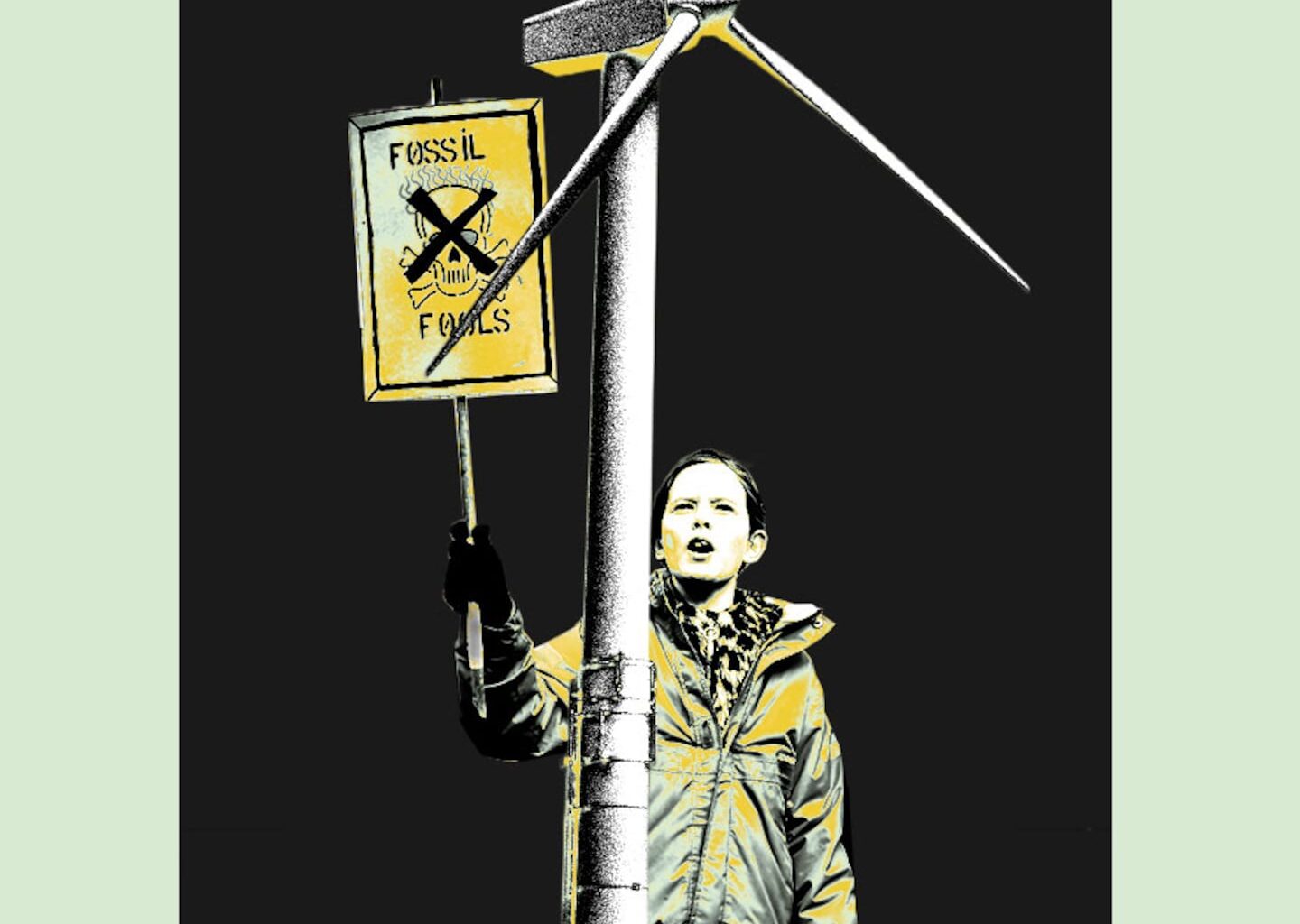
And finally we have a tool that could allow us to start shaving tenths of a degree off the eventual rise in temperature. That tool is cheap energy from the sun and wind. For almost all the global warming era, fossil fuel has been relatively cheap and clean energy relatively expensive — that was the case at Kyoto, and Copenhagen, and Paris. But about five years ago some combination of activism and engineering allowed humanity to cross a remarkable line: Suddenly the cheapest way to make power on our planet was to point a sheet of glass at the sun, and the second cheapest was to capture the breeze in a spinning turbine. The cost of batteries was plummeting at a similar pace, allowing in essence the sun to shine all night.
This is a miracle. After 700,000 years of setting things on fire, humans suddenly don’t need to: We can rely instead on the great fire burning 93 million miles up in the sky. That could produce sizable reductions in unhealthy pollution (one human death in five on this earth comes from breathing the byproducts of fossil fuel combustion) and in international tension (imagine how many wars we might have avoided in the last century if oil had been of trivial value). But the crucial hope is that this could finally take us off the curve of ever-rising emissions. In China, carbon output may have peaked this year: After installing solar panels and wind turbines at an incredible pace, China is now running its coal plants less, and most of the cars coming off the sales lots have plugs. Next door in Pakistan, people have put up so many solar panels that the country recently agreed to pay a penalty to its natural gas supplier, Qatar, rather than take the tanker-loads of natural gas it no longer needed. In California, the fourth-largest economy on earth, they’re using a third less natural gas to make electricity than they were two years ago. These are signs that renewable energy is not just adding to the world’s energy supply but beginning to hack away at our dependence on fossil fuel.
Which is good news unless you happen to own an oil well, in which case it’s dire: Some of your assets might someday be “stranded” underground. And to prevent that sad outcome (more upsetting to you than, say, melting the North and South Poles), you will apparently do anything, including fund at record levels the presidential campaign of a man willing to say that global warming is a hoax. A man willing, more important, to shut down work on nearly finished wind farms and put federal lands off-limits to solar panels even as he subsidizes the combustion of coal.
American recalcitrance couldn’t come at a worse time for our economy. We’re essentially ceding the technological and economic future to China, theoretically our main adversary, and our political leadership (the last climate conference in Belem, Brazil, which we chose not to attend, was a coming-out party for Beijing’s sudden ascension). But mostly it’s coming at just the wrong moment for the atmosphere. Our chances of slowing climate change hinge on acting fast. The Intergovernmental Panel on Climate Change, the gold standard of climate science, said not long ago that if we were to have any hope of staying on the Paris trajectory, we needed to cut emissions in half by 2030. Which is now almost exactly four years away, and three of those will be spent under Trump and his science-rejecting rule. Vaccine denial is colossally dumb, but climate denial has effects that will be measured in geological time.
Which is why we need to do all we can to speed up the adoption of clean energy, with action at the state and local levels. And there’s plenty we can do: We older activists at Third Act, an elder-led movement for climate action and democracy protection, are working hard to change permitting rules to make it much easier and cheaper to put panels on rooftops and apartment balconies. And we should be able to make a strong case for the changes, on all kinds of grounds. In Australia, for instance, they’ve now put up enough solar panels and wind turbines that all residents will get three free hours of electricity a day beginning midyear. Do you think American politicians would like to run with that on their list of achievements?
For most of the global warming era, we’ve been fighting an uphill battle, trying to overcome economic gravity. Now the economic (and literal) wind is at our back, and it’s the oil industry that must work the political system to keep its business model alive. The outcome of the fight will not “stop global warming.” It’s too late for that. But it may stop it short of where it would otherwise go. Remember — a tenth of a degree is 100 million people who get to stay in the place where they were born. Nothing matters more.