
Unlock the Editor’s Digest for free
Roula Khalaf, Editor of the FT, selects her favourite stories in this weekly newsletter.
The seemingly quixotic quest to build fully autonomous cars is a bit like Zeno’s paradox. The ancient Greek philosopher argued that to arrive at any destination you must first cover half the distance. So, logically, no matter how many times you keep setting off along a path, you will never reach your endpoint.
Over the past 15 years, industry players have spent more than $100bn trying — and failing — to achieve full Level 5 autonomy, which means that no human intervention is required. Promised deadlines have come and gone, a slew of autonomous vehicle start-ups have run out of money, several big car companies have abandoned the field — and still the industry has not reached its goal.
Yet recent advances in AI have justifiably led to a renewed flurry of excitement and investment — and just as robotaxis have become commonplace in designated areas of several US and Chinese cities. They will arrive in London this year, too. Venture capital investors have also been pouring money into many other robotics start-ups, reckoning that the automation of physics will be the next big sector to be transformed by AI.
This week, Jensen Huang, Nvidia’s chief executive, turned up the competitive dial by launching the company’s own autonomous vehicle driving software, promising a breakout moment for the robotics industry. Within a decade, Huang forecast, most of the world’s cars would be highly autonomous (creating a huge demand for Nvidia’s silicon chips). Clad in his trademark leather jacket, Huang told the Consumer Electronics Show in Las Vegas that “the ChatGPT moment for physical AI is here”.
Nvidia has simulated billions of miles of driving inside a computer, using its Cosmos world foundation model, an open platform that helps developers build customised AI models. Incorporating additional real-life video, such world models can now take account of the laws of physics, including friction, gravity and inertia. They can also develop common sense reasoning, such as understanding that a ball bouncing across a road might signal the presence of an unseen child.
Using that mass of data, Nvidia this week released Alpamayo, which Huang described as the world’s first thinking and reasoning model for autonomous driving. With Mercedes-Benz, Nvidia will pilot partially autonomous cars in the US this quarter, followed by Europe and Asia later this year. Huang said that someday “every single car, every single truck, will be autonomous”.
Elon Musk, the boss of Tesla, which is also developing full self-driving software, was quick to troll Huang, contesting Alpamayo’s novelty. “What they will find is that it’s easy to get to 99 per cent and then super hard to solve the long tail of the distribution,” he posted on his X platform.
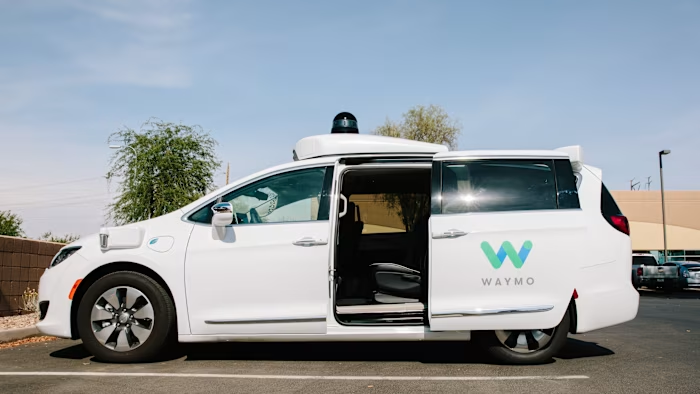
Musk is right that it is the edge cases that have made fully autonomous driving so hard. The real world is way messier than any computer simulation. A good example occurred in San Francisco in December when a power outage knocked out scores of traffic lights, causing problems for the robotaxis operated by Waymo, owned by Alphabet. In spite of its fleet clocking up more than 100mn miles of autonomous driving, Waymo’s cars froze when the lights went dark, clogging the city’s streets.
In such unexpected circumstances, remote human interventions are still needed to instruct the cars how to respond. Waymo uses an app called Honk to summon human gig workers to solve other problems too, such as shutting car doors after passengers have left them open.
The cost of that hidden army of human collaborators will challenge the business model of autonomous driving, according to the veteran roboticist Rodney Brooks. “The key metric will be human intervention rate as that will determine profitability,” he predicts.
Autonomous car companies argue that they can make money so long as their services are demonstrably safer and cheaper than human drivers — even if they never reach Zeno’s endpoint of technological perfection. Moreover, Huang argued that AI reasoning models could also be used in many other robotic systems, usually in more constrained and predictable environments.
But yet another challenge is now emerging for global robotics companies: the ferocity of Chinese competition. Ominously, iRobot, the US company that pioneered the Roomba smart vacuum cleaner, filed for bankruptcy last month. The Shenzhen-based Picea Robotics, has now bought the business out of administration for a fraction of the $3.6bn that iRobot was once worth. Developing robotics technology is hard enough; building sustainable business models may be even harder.