
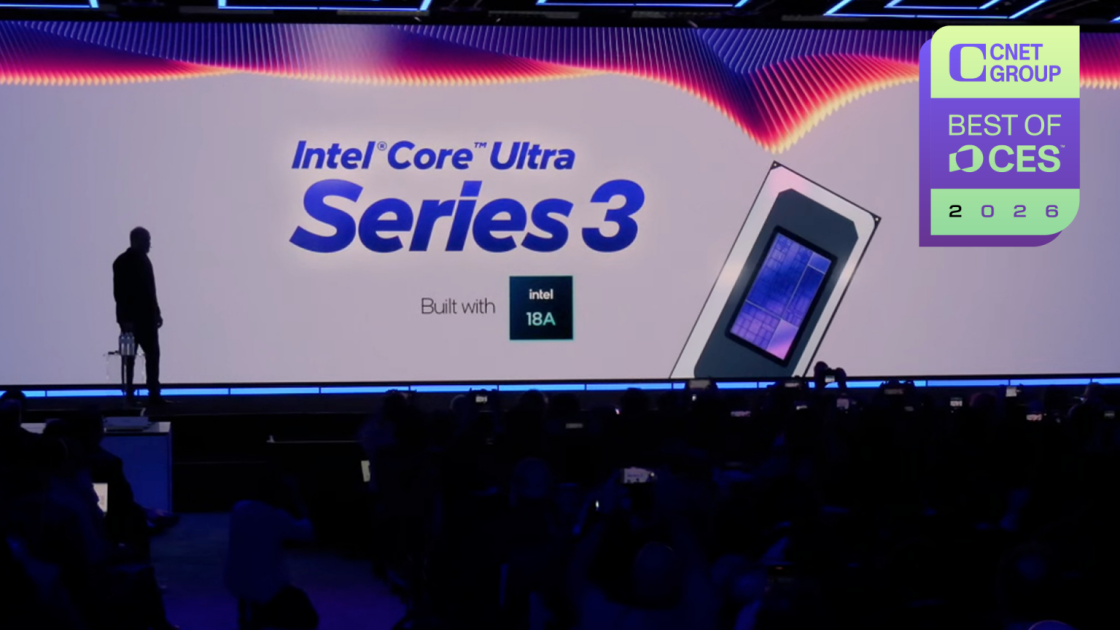
Intel’s 2-nanometer “18A” chip foundry has fired up at last, churning out the newest Core Ultra Series 3 processors for laptops and mini PCs, also known as “Panther Lake.” Winner of our Best Deep Computing Tech category at CES, these new chips are aimed at the mobile industry and feature several notable changes in design over Intel’s outgoing Core Ultra Series 2, with particular attention paid to AI performance.
At CES 2026, we now have a closer look at the launch lineup for these mobile processors, giving us a better idea of what to expect when laptops containing these CPUs ship throughout the year. Systems equipped with an Intel Core Ultra Series 3 processor will start shipping by the end of January, while preorders will open soon for those who wish to be early adopters.
Core, Eyes, and Brain
Without revealing every detail about the new Core Ultra Series 3 product line, Intel shared enough to show that it made substantial changes from the Core Ultra Series 2 line. These upgrades include an updated CPU along with an improved integrated graphics processor (IGP) and an overhauled neural processing unit (NPU).
Starting with the CPU, Intel claims improvements to both energy efficiency and processing power. Intel suggests it has achieved a fairly sizable improvement in the number of tasks each CPU core is able to perform each clock cycle. At most, a Core Ultra Series 3 processor contains up to four high-performance P-cores, up to eight high-efficiency E-cores, and up to four low-power high-efficiency LPE-cores, Intel says.
The top model is the Intel Core Ultra X9 388H, with 16 CPU cores and a peak clock speed of 5.1GHz. Intel also listed this processor with 18MB of L3 cache. On paper, the Ultra X9 388H might have a lower performance ceiling than the outgoing Core Ultra 9 285H. Both processors have 16 CPU cores, but the Ultra 9 285H has a combination of six P-cores, eight E-cores, and two LPE-cores, versus the Ultra X9 388H’s four P-core, eight E-core, and four LPE-core configuration. On top of that, the Ultra 9 285H also has more L3 cache at 24MB, because P-cores generally include more L3 cache than the E-cores. The Ultra 9 285H also has a faster clock speed at 5.4GHz.

(Credit: intel)
Added together, and on paper, the Ultra 9 285H appears to be the stronger part; however, Intel claims that the Ultra X9 388H should deliver more than 70% better gaming performance than the Ultra 9 285H. It is also supposed to have up to 60% better multithreading performance as compared with Intel’s Core Ultra 9 288V, which is part of the Ultra 2 series but has a similar four P-core, eight E-core, and four LPE-core configuration.
Panther Lake also ushers in the utmost latest standards in Wi-Fi 7 (R2) and Bluetooth (6.0). Finally, you’ll find Thunderbolt 5 support on a selection of Core Ultra 7 and Ultra 9 chips.
What’s the ‘X’ All About?
The IGP on these new processors is also a significant step up over the previous generation. Intel is introducing a new graphics architecture referred to as Xe3 to power these IGPs, improving the Arc Alchemist XeLPG graphics architecture used on Core Ultra Series 2 processors and based on Intel’s Arc Battlemage graphics architecture. Being the same graphics architecture that powers Intel’s more recent desktop GPUs, like the Intel Arc B580, the leap in performance could be massive. In addition to performance gains from any architectural improvements, the top IGP in the Core Ultra Series 3 lineup is also much larger, with 12 Xe cores representing a 50% increase over the previous generation.
Intel Core Ultra Series processors containing these Xe3 Arc Battlemage IGPs will have an “X” in their product name preceding the number denoting their performance tier, with “X9” being the highest-end chip with the most potent IGP. (One Core Ultra 5 338H chip bucks this trend with an Arc-grade IGP onboard.)
As a further plus, Intel is also introducing a new version of its screen-optimizing XeSS technology called XeSS 3. This technology uses the graphics chips’ AI hardware to upscale graphics and help boost the refresh rate. Similar to AMD’s FSR 4, Nvidia’s DLSS 3 and DLSS 4, XeSS 3 also supports multi-frame frame-generation technology that can increase your in-game frame rate significantly.
GPU + NPU + CPU = Intel’s AI Triforce?
The industry has been heavily focused on AI recently, and Intel is no exception. While discussing its CPU and IGP improvements, Intel made sure to point out that both the CPU and GPU could perform well while running AI workloads. Naturally, Intel also paid special attention to the new NPU inside its Core Ultra Series 3 processors, which is a piece of hardware dedicated solely to AI work.
The model in Core Ultra Series 3 processors uses Intel’s latest NPU 5 architecture, driving up to 50 trillion operations per second (TOPS) of AI processing power. The Arc Xe IGPs can drive up to an additional 120 TOPS of AI processing capability, reaching an impressive TOPS rating of 170 if both parts of the processor are tapped for AI tasks—perhaps more if the CPU gets roped in, too.

Get Our Best Stories!
Your Daily Dose of Our Top Tech News

Sign up for our What’s New Now newsletter to receive the latest news, best new products, and expert advice from the editors of PCMag.
Sign up for our What’s New Now newsletter to receive the latest news, best new products, and expert advice from the editors of PCMag.
By clicking Sign Me Up, you confirm you are 16+ and agree to our Terms of Use and Privacy
Policy.
Thanks for signing up!
Your subscription has been confirmed. Keep an eye on your inbox!
From my previous experience testing desktop AI hardware, the Core Ultra Series 3 processors could be compelling in this area. I test the AI performance of graphics cards now using UL’s Procyon benchmark that runs with four different AI models. These results are limited, but so far, AMD has shown to struggle the most here, while Nvidia leads the pack.
As for Intel, it appears to be on close to an even footing with Nvidia in its price range. The Intel Arc B580 competes with the $299 Nvidia GeForce RTX 5060 in AI speeds. This suggests Intel’s AI hardware is reasonably capable, and the drastically more potent AI hardware in the Core Ultra Series 3 could be an attractive feature.
Intel Core Ultra 9 and Ultra X9
Initially, Intel had just one Core Ultra 9 and one Core Ultra X9 processor each in its Core Ultra Series 3 launch lineup. These are the Intel Core Ultra 9 386H and the Core Ultra X9 388H, which have many similarities to each other. Both are 16-core processors, with the 388H being clocked slightly faster than the 386H. You’ll find only two places where these processors differ significantly from each other, and these are in their IGPs and their PCIe controllers.

(Credit: Intel)
The Core Ultra X9 388H will be the more desirable part between the two if you are buying a laptop that lacks a separate graphics processor. This is because it features an Intel Arc B390 IGP with 12 Xe3 Xe cores, the fastest IGP in the stack. The downside to the X9 388H is that its PCIe controller is limited to 12 PCIe lanes, with just four of these PCIe 5.0 and the remaining eight PCIe 4.0.
Recommended by Our Editors
This means that a laptop that has the X9 388H and a separate graphics chip from AMD or Nvidia will rely on either a PCIe 5.0 x4 or a PCIe 4.0 x8 connection for the CPU and GPU to communicate over. Both offer similar bandwidth and should provide plenty of bandwidth for many GPUs, but if you are going to buy a laptop with a GPU, you have better options.
The Core Ultra 9 386H differs from the Ultra X9 388H on both of these items, as the 386H has a less powerful IGP that is simply labeled “Intel Graphics” and contains just four Xe cores. In exchange for a weaker IGP, the 386H has a more capable PCIe controller with 12 PCIe 5.0 lanes and 8 PCIe 4.0 lanes. This makes the 386H a clearly better option for laptops that will have a discrete GPU.
Intel Core Ultra 7 and Ultra X7
The processors Intel announced in the Ultra 7 vein of the Core Ultra Series 3 processor line are also remarkably close to their Ultra 9 counterparts. The Ultra X7 368H shares all of the same specs, including core count, with the Ultra X9 388H, with the only reported difference being a 0.1GHz drop in clock speed. The Ultra 7 366H and Ultra 9 386H also match up similarly, with a 0.1 GHz difference in clock speed, and the NPU TOPS on the Ultra 7 is 49 TOPS instead of 50, like on the Ultra 9. Due to the similarities, everything I said in the section on the new Ultra 9 options can be applied to these Ultra 7 chips as well.
It’s important to note that Intel’s Ultra 7 processors in the Core Ultra Series 3 family that lack the “H” suffix are very different chips. Currently, this includes the Core Ultra 7 365 and the Core Ultra 7 355, which have just eight CPU cores each, making them far slower than the rest and likely destined for midrange laptop systems.
Intel Core Ultra 5
Intel announced six Core Ultra 5 processors in the Core Ultra Series 3 family that are split into two groups: those with an “H” suffix and those without one. The Intel Core Ultra 5 338H and the Intel Core Ultra 5 336H are the two entries that have the H suffix, and these models drive better performance than the others with their 12 CPU cores, whereas the non-H models only have eight cores. The Ultra 5 338H is also the only launch Ultra 5 model to feature the Intel Arc B370 IGP that has 10 Xe cores, which makes it notably faster than the models that just have “Intel Graphics” while still not quite as potent as those with the Arc B390 IGP.

(Credit: Intel)
The lower-end Core Ultra 5 models, like the Ultra 5 332 and Ultra 5 322, also ship with slightly different IGPs. They’re equipped with just two Xe cores, which makes them the slowest options in terms of IGP performance. However, they’re also the slowest in terms of core count and clock speed, likely to be found in systems closer to the budget region.
Preorder Soon: Panther Lake Laptops Ship Jan. 27
Preorders for laptops equipped with Panther Lake Core Ultra Series 3 processors will open on Jan. 6, though this will depend somewhat on Intel’s vendor partners, which design and build the finished devices. The actual release date for laptops containing these chips is Jan. 27. Pricing is also unknown at this point and will ultimately depend on the laptop vendors.
About Our Expert

Michael Justin Allen Sexton
Senior Writer, Hardware
Experience
I have been interested in science and technology for as long as I can remember, spurred on by a fondness for video games. I learned to work in Windows and manipulate files to get buggy games to work, and I learned to build and upgrade PCs for better performance.
In my role at PCMag for the past four years, I’ve deeply enjoyed the opportunity to share my knowledge and expertise. Before PCMag, I wrote for Tom’s Hardware for three years, where I covered tech news, deals, and wrote some hands-on reviews. After working as a PCMag contributor for a time reviewing desktops, PC cases, budget processors, and motherboards, I now focus on testing and reviewing processors and graphics cards and sharing my insights on the industry.
Latest By Michael Justin Allen Sexton