
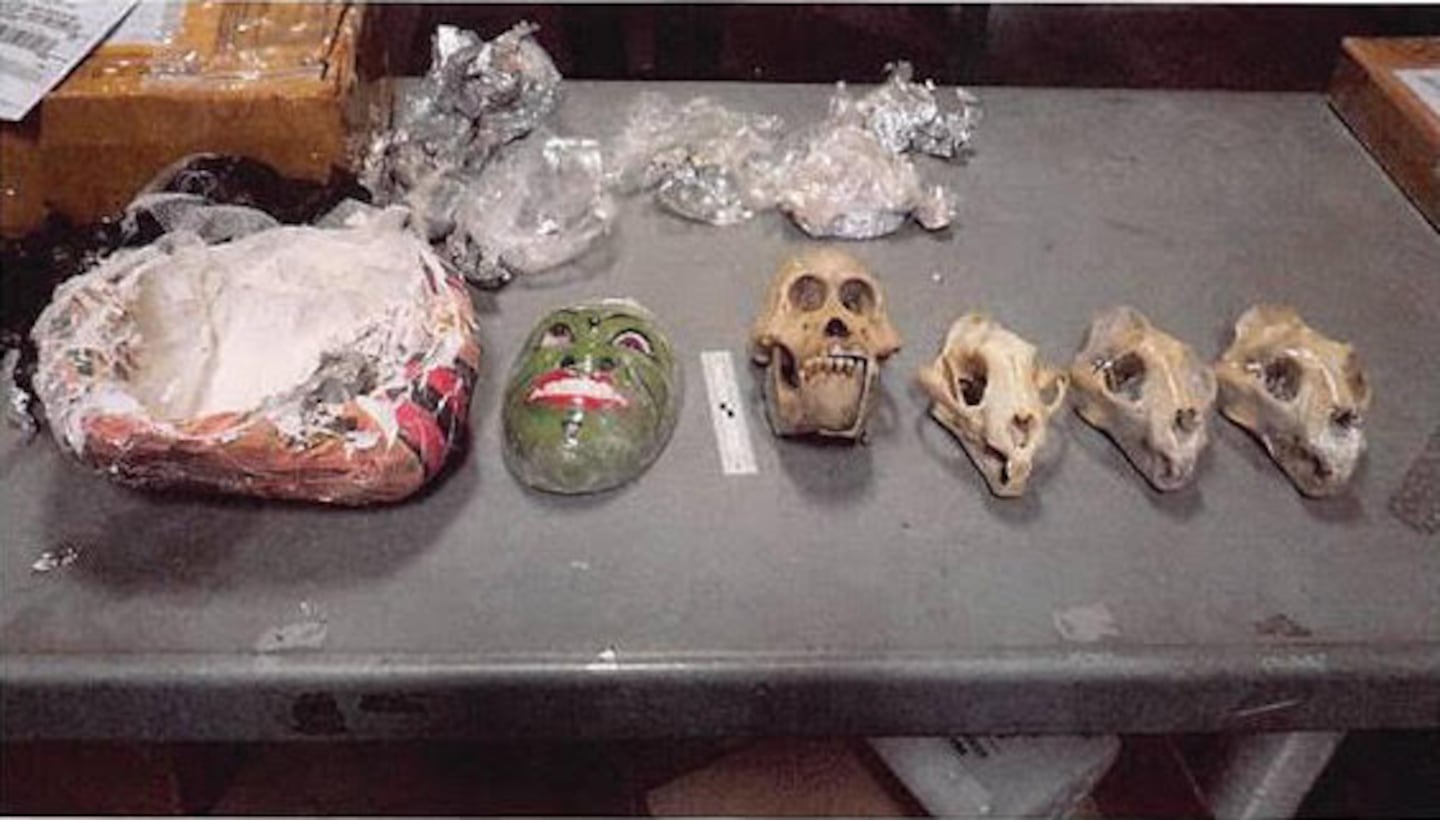
A Reading man has pleaded guilty in federal court to trafficking parts of endangered and protected species and agreed to turn over more than 100 wildlife parts — including orangutan skulls, tiger skulls, jaguar skin, and a narwhal tusk — to the government, officials said Wednesday.
Adam Bied, 40, pleaded guilty to two counts of conspiracy to smuggle goods into the United States and two counts of violating the Lacey Act, which prohibits trafficking in wildlife, according to a statement from US Attorney Leah B. Foley’s office.
His sentencing is scheduled for April 2.
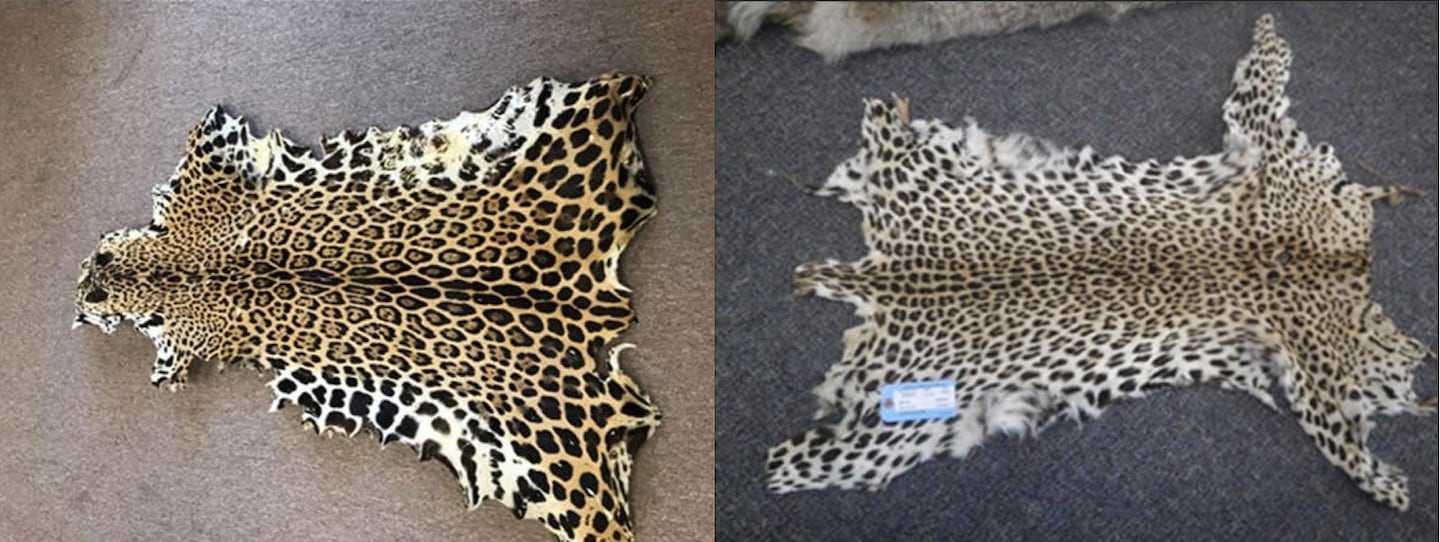 Authorities said they seized this jaguar skin (left) and leopard skin (right) from Adam Bied’s residence.Acting United States Attorney
Prosecutors said that between January 2018 and June 2021, Bied “bought, sold and traded in wildlife parts and products from threatened and endangered species” without the necessary licenses and permits and “knowingly failed” to declare the wildlife parts to the US Fish and Wildlife Service.
Bied ordered the wildlife parts from Cameroon and Indonesia, prosecutors said. He and “his co-conspirators took steps to conceal the wildlife parts from US authorities by falsely labeling them as ‘decorative masks’ and ‘rodents,’ among other things,” they said.
Prosecutors said Bied consented to the civil forfeiture of more than 100 wildlife parts that were seized from his residence, storage unit, and vehicle in July 2021.
They included orangutan skulls; tiger skulls; leopard skin, skulls and a claw; jaguar skin and skull; African lion skulls; polar bear skull; narwhal tusk; an otter skeleton; a harp seal skull; pangolin skull; South American fur seal skull; elephant seal skull; babirusa skulls; a wallaby skull, and a jackal skull, prosecutors said.
“The charges of conspiracy as well as the charges under the Lacey Act each provide for a sentence of up to five years in prison, three years of supervised release and a fine of up to $250,000,” the statement said.
Bied’s attorney, Max D. Stern, said his client had been pursuing a family hobby.
“For many years, starting when he was small child – and pursuing a multi-generational family hobby – the defendant has been a collector and student of various wildlife specimens from across the world,” Stern said in an email. “He has admitted that certain of his specimens were unlawfully obtained and possessed and also that he has improperly traded with other collectors over time. He now gives up his lifelong passion, even including the many specimens that he has lawfully acquired.”
Stern also noted that the official advisory guideline for sentencing in the case calls for up to six months of prison time, or none at all.
“Although the government in its press release has pointed out that the maximum statutory sentence for the offenses in issue here is five years, it should be noted that the official advisory guideline for sentencing in this case advises that an appropriate punishment varies from no imprisonment to up to six months,” Stern continued. “Also, while the government points out that there is a potential $250,000 fine, it should also be recognized that in the plea agreement the government and the defendant have jointly recommended a fine of $75,000. In any event, the issue of punishment will be decided by the judge at the sentencing hearing in April.”
Emily Sweeney can be reached at emily.sweeney@globe.com. Follow her @emilysweeney and on Instagram @emilysweeney22.