
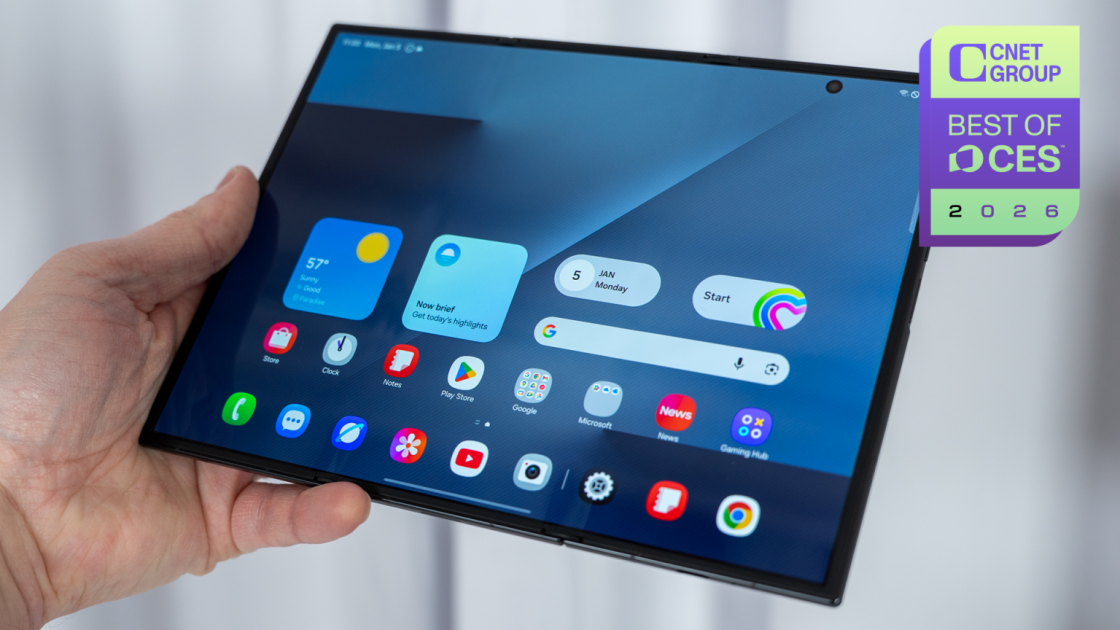
LAS VEGAS—The Samsung Galaxy Z Fold 7 has one of the largest screens you can get on a mobile phone. Its inner display measures 8 inches across, providing an expansive space for multitasking and productivity. Winner of our Best Mobile Tech category at CES, the Galaxy Z TriFold takes the folding phone concept a significant step further.
Where the Z Fold 7 has a two-panel display, the TriFold adds a third panel to make for an incredible 10-inch screen when fully opened. The Z Fold 7’s large screen is a great option if 8 inches is enough screen for you, but the 10-inch platter of the TriFold is large enough that it can serve as a pocketable laptop replacement. Of course, Samsung’s execution is top-notch.
The Samsung Galaxy Z TriFold is a Best of CES 2026 award winner.
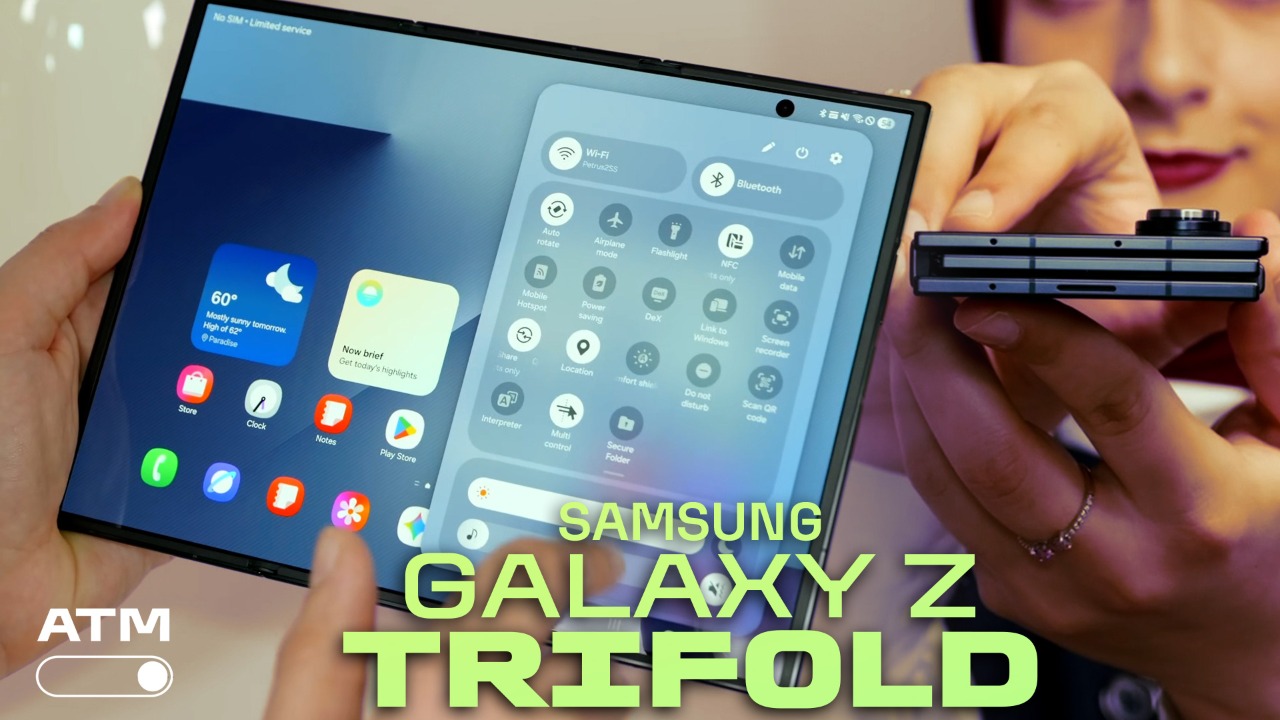

Hands-on with the Galaxy Z TriFold: A true phone-tablet hybrid
Refined Thinness
It’s one thing to see photos and videos of the TriFold, but quite another to experience it in person. It’s every bit as impressive as the Z Fold 7 in terms of the materials, the quality, the build, and its durability.

Left to right: Samsung Galaxy Z TriFold and Z Fold 7 (Credit: Eric Zeman)
The phone quite literally slaps a third panel to the Z Fold 7 form factor and is 50% thicker. The TriFold measures 3.9mm when unfolded and 12.9mm folded, whereas the Z Fold 7 measures 4.2mm unfolded and 8.9mm folded. It’s hard to put into words just how thin 3.9mm is. It feels razor-thin when you hold and use it.

The Samsung Galazy Z TriFold measures 3.9mm thick. (Credit: Eric Zeman)
When closed, you unfold it by pulling back the rear panel first, then the inner panel. The hinges are both incredibly smooth and solid. The company has been designing these hinges for years now and really knows what it’s doing. When you’re ready to close the device, you bend over the left panel first, then the right. If you accidentally start with the right panel, the phone has sensors and vibrates to let you know that you’re doing it wrong.

Get Our Best Stories!
A Smart, Bold Take on the Wireless World
Sign up for the Fully Mobilized newsletter to get our top mobile stories delivered right to your inbox.
Sign up for the Fully Mobilized newsletter to get our top mobile stories delivered right to your inbox.
By clicking Sign Me Up, you confirm you are 16+ and agree to our Terms of Use and Privacy
Policy.
Thanks for signing up!
Your subscription has been confirmed. Keep an eye on your inbox!

The three folding panels of the Galaxy TriFold (Credit: Eric Zeman)
The inner screen is really quite excellent, but I’m sure it won’t impress everyone. When opened, the two creases are plainly visible, even when the display is on. Samsung has done a great job reducing the crease of the Z Fold 7, but here it wasn’t quite as successful. As you can see in the photo below, the creases show up when you look at the screen from just about any angle other than straight on. It is, however, incredibly bright, colorful, and sharp.

(Credit: Eric Zeman)
What’s perhaps most important here is how the TriFold design impacts usability. With the Z Fold 7, you can open the phone halfway, set it on a hard surface, and use it like a little laptop. You can watch YouTube videos, peck out messages, and more. You cannot do that with the TriFold. It only opens all the way and won’t hold angles other than 0 or 180 degrees.
This is particularly noticeable when you want to use the camera for creative selfies. While you can use the outer screen to frame your shots, you can’t bend the TriFold and set it on a rock to take a selfie or frame a video shot. If those form factor uses are critical to how you use the Z Fold 7, you might want to think twice before upgrading to the TriFold.
Recommended by Our Editors


(Credit: Eric Zeman)
The screen’s huge dimensions benefit from Samsung’s DeX software, which transforms the user interface into a Chromebook-like experience. Once you get used to its quirks, DeX can be a powerful tool for pushing through emails, preparing presentations, or catching up on social media. This is what helps the TriFold stand out. I asked Samsung’s reps about these differences and they said the company really intends the TriFold to target a different user base than the Z Fold 7, thus the different set of capabilities.

(Credit: Eric Zeman)
The rest of the experience is quite similar to that of the Z Fold 7. The buttons, ports, and keys are carried over. It has the basic One UI software, Galaxy AI, Gemini, and more. The camera arrangement is similar, and you have the same powerful processor, memory, and storage configurations. The phone even meets the IP48 rating for protection from larger particles of dust and water.

(Credit: Eric Zeman)
Who is this phone for? People who really, really want a tablet in their pocket and have money to burn. Samsung hasn’t set US pricing yet, but given the $2,000 price point of the Z Fold 7, don’t expect it to be cheap. We look forward to reviewing it in full later this year.
About Our Expert

Eric Zeman
Managing Editor, Consumer Electronics
Experience
I’m PCMag’s managing editor for consumer electronics content, overseeing an experienced team of reviewers and product testers. I’ve been covering technology for about 25 years. Prior to PCMag, I worked at outlets such as Android Authority, Fortune, InformationWeek, and Phonescoop.