
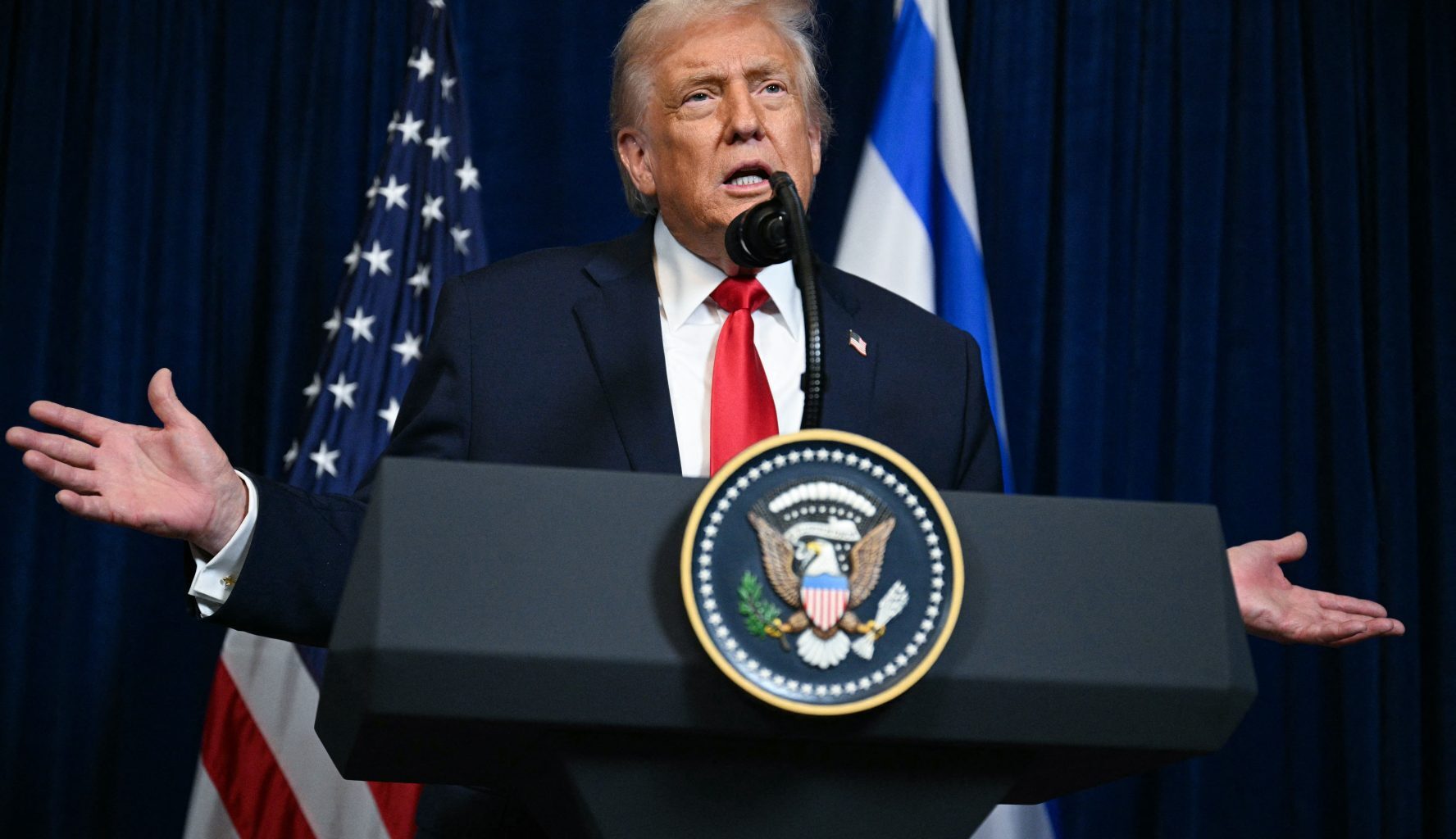
Donald Trump, the nation’s 45th and 47th president, is distinctive. He is one of only two people in history, along with Grover Cleveland, to serve presidential terms separated by someone else’s stint in the White House. But, of course, it goes well beyond that. Trump is far less committed to America’s systems of alliances and to the post-World War II global economic order than any president since the 1940s. He seems even less interested than, say, Lyndon B. Johnson or Richard Nixon, in respecting America’s checks and balances on the use of presidential power. To some, he is a threat to America’s very Constitution and democracy, given his encouragement to rioters on January 6, 2021, and his efforts to overturn the results of the November 2020 election. His use of the American armed forces in some of the nation’s cities has only fueled those concerns.
This essay does not attempt to address all those larger debates. Instead, its purpose is to examine Trump’s grand strategy and defense strategy roughly one year into his second term. It argues that despite Trump’s personalized decisionmaking methods, most of the ideas and policies he advances have antecedents in earlier presidents’ choices and congressional actions. That observation is not meant to applaud Trump. However, it may help us better understand the nation’s 47th president and provide some solace to those concerned that he operates completely outside established norms.
Analyzing this issue requires clarity about concepts. My primary focus is on Trump’s role as commander in chief and as the nation’s top diplomat. I use “grand strategy” to mean the country’s overarching concept of how to protect itself and promote its power. “Defense strategy” refers to how the United States builds and wields its military in times of both war and peace. In my new book, “To Dare Mighty Things,” I argue that the United States has had three main types of grand strategies in its history: expansionism through the 19th century, isolationism or regionalism interspersed with sporadic interventionism from roughly 1901-1945; and internationalism (sometimes called “deep engagement”) ever since. By contrast, the United States has had many defense strategies—more than 40 by my count.
As of December 2025, Trump’s second-term grand strategy and defense strategy can be summarized as follows:
Trump is globally engaged; expectations that he would govern as an isolationist president have largely been disproven.
Trump’s earlier emphasis on prioritizing nearby countries like Mexico while deemphasizing countries like Ukraine has considerably softened.
Defense spending remains robust, with rhetorical realignment toward the Western Hemisphere and selective investments in missile defense (the Golden Dome) and naval power.
America’s alliances are generally holding, though burden-sharing debates continue.
Trump treats the use of force as a presidential prerogative and a tool to create diplomatic leverage.
Trump retains a nativist view of immigration that seeks to privilege a particular ethnographic group and culture, which I note but do not emphasize further here.
Whether these objectives are wise, or whether Trump is achieving them, is debatable. My claim is that this list captures the core of how Trump appears to understand American power. The question, then, is how unusual is this worldview in historical terms?
The remainder of this essay proceeds in two parts. First, I will sketch the history of American grand and defense strategy over the nation’s 250-year history, dividing that span into 10 roughly equal periods. I then return to Trump, comparing his views and policies with that history.
A historical sketch of American grand and defense strategy
The American Revolution through 1800
The first big idea in American defense strategy came from George Washington’s recognition, after the disastrous battles of New York in 1776, that the Continental Army could not fight British forces on equal terms. Instead, Washington learned to use America’s large territory as strategic depth, harass British forces, and await the right opportunities for decisive engagements. The latter did occur, most notably at Saratoga in the fall of 1777 and at Yorktown in 1781. Yet, in each case, Washington made sure that geography and logistics (and, in the latter case, the French Navy) were properly aligned before engaging in a big fight. It was excellent generalship and showed the importance of learning from one’s own mistakes.
After independence, the United States dramatically reduced its federal military forces, but this demobilization did not signal pacifism or isolationism. Rather, the United States, using state militias and other ad hoc forces, began expanding westward. At the time, this was not domestic policy but foreign policy, since the lands were not yet won. These battles continued for another century, just as they had already been ongoing for more than a century at the time of The Revolution.
The 1790s further revealed America’s strategic restlessness. Tensions with erstwhile ally France over America’s insistence on trading with Britain (then a French adversary) nearly produced a war, prompting naval rearmament and the construction of a new generation of frigates. (Once John Adams was president, America even considered rebuilding an Army, too.) These ships were soon deployed against the Barbary Pirates in the faraway Mediterranean Sea. Already, the United States was expressing an interest in projecting power, complicating narratives about isolationism. In that regard, Trump has lots of company in the annals of American history.
From 1800 through 1825: Fighting Britain again
The early 19th century was characterized by peaceful and violent expansion. The Louisiana Purchase under President Thomas Jefferson acquired huge new territories peacefully from France, but control of those territories required sustained military campaigns against the Native Americans already living there. Big fights of the ensuing era included those led by William Henry Harrison, a future president, against Tecumseh and his Shawnee Confederation in present-day Indiana, the Ohio Valley, and neighboring regions. Those battles carried over into, and became part of, the War of 1812.
That latter conflict is remarkable to reflect upon. In a war that was likely preventable, the United States nonetheless chose to formally declare war against the most powerful country on Earth—one that it might better have left alone, given earlier history. Yes, the United States had real grievances, notably British impressment of American sailors onto British ships. But there were other means of attempting to address that problem, which, in any case, arguably were not so severe as to justify war.
Yet the United States did not back away from a fight. Indeed, the Americans of 1812, in some ways, were more enthusiastic about engaging in combat than Trump tends to be today, except when he is confident that the use of force can be kept quite limited. One need not deny the legitimacy of America’s complaints in 1812 to question why Washington chose to settle scores with the sword. The war was effectively fought to a draw. Yet its implications would reverberate for decades. Among other things, the United States Navy had some impressive performances, creating a history it would seek to build upon in the future. Andrew Jackson also made a name for himself in winning the battle of New Orleans (after the war was officially over, as it turns out).
Finally, there is the Monroe Doctrine of 1823. That a still mostly preindustrial and militarily weak United States would declare the Western Hemisphere off-limits to European powers was a breathtakingly ambitious claim. Its practical implications were modest, but it revealed an American spirit hard to square with the concepts of isolationism or strategic minimalism. The parallel with Trump, whose December 2025 National Security Strategy just advanced a “Trump Corollary” to the Monroe Doctrine, is plain to see.
1825-1850 and the Mexican-American War
For the next quarter-century, the United States consolidated and extended its control of western lands, including the infamous Trail of Tears under President Andrew Jackson, by which many Native Americans in the eastern third of the country were forcibly relocated to its center. But the Mexican-American War—the purest and most audacious land grab in American history—stands out.
Framed as a border dispute with Mexico, the United States, with strong bipartisan congressional support, declared war in 1846. The border dispute centered on Texas. Texas had passed from France and Spain to Mexico, then experienced a short period of independence, before joining the United States and then, briefly, the Confederacy in the 1860s. The crucial military operation was a U.S. amphibious assault at Veracruz led by General Winfield Scott, followed by a well-organized and complex military movement across the Mexican landmass toward Mexico City, which Scott took in 1847. President James Polk exploited the city’s capture to gain the present-day American Southwest, as well as California, from the Mexican government. Although Trump seems unlikely to militarily act on his ambitions to acquire Greenland, there has been a Polk-like quality to much of his rhetoric on the subject.
1850-1875 and the American Civil War
The dominant military event of the next quarter-century was the American Civil War—even though it was a historical anomaly for the U.S. armed forces in terms of its intensity, scale, and severity. Roughly as many Americans on the two sides died in that war as in all the nation’s other conflicts combined.
In terms of warfighting strategies, two big themes stand out. First were the panache, cleverness, and discipline of the South’s best generals, including Robert E. Lee, J.E.B. Stuart, and Stonewall Jackson. Victories at Manassas, Fredericksburg, and Chancellorsville in Virginia typified much of the war’s first two years. These generals used maneuvers, ruses, and foxlike tactics to repeatedly surprise Union forces.
But then there was Ulysses S. Grant. He wound up the victor, along with field commander General George Meade, in the Virginia campaign of 1864-1865 that concluded at Appomattox. Even before that, he had demonstrated tactical, operational, and strategic excellence in the Battle of Shiloh in April 1862—and even more with his siege of Vicksburg, Mississippi, in the first half of 1863. The Union’s victory in that battle, which gave it control of the Mississippi River, therefore contributed to the growing dismemberment and economic squeezing of the Confederacy. The victory also occurred the very same week as the Union’s win at Gettysburg. After that sequence of events, President Abraham Lincoln knew he had his next general in chief.
For his part, Grant knew that he had the numbers. The North’s much greater population and industrial might meant that its right strategy was the unwavering pursuit of Confederate forces. According to Russell Weigley, writing in the 1970s, Grant had developed what would be for a long time “the American way of war,” featuring the use of massive force created by superior industrial might to annihilate the enemy. Yet that is not Trump’s way of war. In that respect, the Civil War offers little apparent foreshadowing of his preferences.
The closing of the West, the arrival of American industrial might, and hankerings for empire
The final quarter of the 19th century was a busy time. First, in the centennial year, George Custer made his last stand at the Battle of the Little Bighorn, after being surrounded by the forces of Sitting Bull and other leaders of the Lakota (or Sioux), Northern Cheyenne, and Arapaho tribes. Custer was reckless in many ways, but his tenacity and courage were representative of the kind of fighting often witnessed on all sides throughout the hundreds of battles for the American West in the 17th, 18th, and 19th centuries. Perhaps he would have been Trump’s kind of general. After that defeat, U.S. forces would regroup, reinforce, and persevere. By 1890, the United States had definitively defeated Native American resistance throughout its present borders (while having previously reached a deal with Britain over territory in the American northwest and having acquired Alaska peacefully from Russia in 1867 as well).
With the West won, and American industry booming, the country became impatient about joining the ranks of the great powers. This was most apparent in regard to the U.S. Navy, where waves of construction starting in the 1880s would vault the United States into third place among the world’s naval powers (in warship tonnage) by World War I. The key figures of the late 19th century who drove this process—Alfred Thayer Mahan, Theodore Roosevelt, William McKinley, and others—saw such naval power as crucial for America’s standing in the world, even as the nation resisted building up much of an Army until 1917. Trump, too, likes to wield and build naval elements of military power, just as he likes Roosevelt and McKinley.
The United States did temporarily build a big enough Army to defeat Spain in 1898, winning not only Cuba and Puerto Rico but the Philippines and Guam (having annexed Hawaii earlier that same year). The United States found it did not much like outright imperialism, however, and gradually started granting the Philippines autonomy within a few years. But it certainly had found a taste for a much more far-ranging foreign and defense policy.
1900-1925 and wild swings in U.S. grand and defense strategy
The 21st century began with some continuity. President Roosevelt, previously President McKinley’s assistant secretary of the navy and vice president, succeeded McKinley in 1901 with a similar philosophy. Roosevelt coined the phrase “speak softly and carry a big stick.” Yet the U.S. stick was not really that big, except increasingly in naval terms—and the United States did not really speak that softly. The 1904 Roosevelt Corollary to the Monroe Doctrine insisted that Washington would have a say over any key political and strategic matters in the Caribbean, Mexico, and Central America. The so-called Trump Corollary, as described in the administration’s 2025 National Security Strategy, takes a remarkably similar tack. In addition to interventions in Mexico and elsewhere in the early 20th century, the United States would also ally with secessionists from Colombia, helping them form the new country of Panama, and thereby paving the way for the construction of the Panama Canal. Throughout this time, the United States was improving the professionalism of its Army, and giving it an air wing too, though its ground forces remained quite small by the standards of the Eurasian great powers.
Bigger swings in U.S. national security policy would come later. Woodrow Wilson was sickened by the pointless slaughter in World War I and felt little affinity for any of its five major participants. To him, French and British imperialism were part of the problem too, and Germany was far from the only aggressor. Accordingly, even after the sinking of the Lusitania in 1915 and other American losses of life due to German U-boats in the war’s early years, Wilson campaigned for reelection in 1916 on a platform of staying out of the conflict. Yet that same year, he had signed the Big Navy Act into law, as the United States continued to wade more deeply into the realm of great-power competition. By spring 1917, Wilson had changed his mind about staying out of the conflict, and he brought the country along with him; soon, Congress would authorize a declaration of war. By the latter part of 1918, the United States had built up a military of 4 million men, 2 million of whom were in Europe by war’s end. The United States was not yet the arsenal of democracy; in fact, most of the weapons its troops used in World War I were manufactured in France. But it was now clearly the largest and latently most powerful Western nation on Earth.
Yet right after World War I followed what is perhaps to date the greatest tragedy of American diplomacy: Wilson’s effort at Versailles to negotiate a League of Nations to prevent future war, followed by the Senate’s abject rejection of the idea. Perhaps for the only time in American history, a type of isolationism had come to define American foreign policy writ large (though small interventions continued in the nearby neighborhood). The politics of the day were nasty and personal, like today’s, further diminishing the prospects of what Wilson had sought. Theodore Roosevelt, while still alive, helped lead a vociferous anti-Wilson movement that ultimately doomed the League of Nations, perhaps unintentionally strengthening the isolationist school of thought within the Republican Party and the country in the process. The Washington Naval Treaty, followed by the U.S. naval build-down of the 1920s, was among the other key consequences. It seemed for a time that perhaps Trump, too, had an isolationist streak, but given the intensity and scope of his diplomatic and strategic initiatives all over the world in 2025, I do not really see it. The 2020s are not currently mimicking the 1920s.
1925-1950: Defense strategy rescues grand strategy in World War II
The isolationism of the 1920s and 1930s gave rise, among other things, to the Neutrality Acts in the mid-1930s that prevented the United States from even selling arms to the world’s major democracies as the threat from Adolf Hitler rose in Germany. But fortunately, there was a silver lining in terms of defense strategy, even as grand strategy and overall foreign policy floundered.
The good news was happening at places like the Naval War College in Newport, Rhode Island, as well as America’s growing and strengthening network of military institutions, training facilities, and educational centers. The Navy figured out key concepts for conducting aircraft carrier warfare and amphibious assault in this period, and modernized equipment accordingly. The Army was, on balance, less clairvoyant about what the next war would require, but it was getting good at institutional and leader development—as Dwight Eisenhower, Omar Bradley, and George Marshall would prove in the 1940s. War Plan Orange, a plan to contest Imperial Japan in the Pacific, was constantly updated and kept military leaders of the day focused on the looming threat from Tokyo.
Meanwhile, American industry, inventiveness, and technology were dominating the world in a way not seen before. By the time the United States found itself thrust into World War II, its reaction time would be impressive. Arguably, the United States was never really losing that war at all, despite a slow start. Certainly, the United States and the Allies had begun to turn things in a favorable direction by late 1942 or early 1943. The United States struggled initially in the early Battle of the Atlantic, due to incorrect priorities and concepts of operations, but it had nonetheless righted its overall strategy within 18 months of entering the war. Like the Civil War, World War II is not a conflict Trump seems to want to emulate. That probably goes for the rest of us, too.
Alas, after victory, a tired nation would spend the next five years downsizing its military commitments to excess, leaving it unready for the 1950 North Korean assault on South Korea, among other early Cold War setbacks. But at an institutional level, with the creation of the Department of Defense, the U.S. Air Force, the CIA, and NATO, the United States by mid-century had begun to set the foundations for a successful Cold War grand strategy.
1950-1975: The first part of the Cold War
During the first quarter-century of the Cold War, U.S. grand strategy centered on the containment of global Communism and internationalism. But it struggled in much of its defense strategy, especially in Korea and Vietnam. That is, the concept of organizing a group of allies to limit Soviet (and Chinese) expansionism and promote the safety and prosperity of the world’s non-Communist nations was sound in its basic logic, and it ultimately proved successful by 1989. Yet the actual choices about when, how, and how long to fight in support of that grand strategy proved very difficult. Battlefield outcomes were mediocre at best.
That said, defense strategy was better at deterring war in key places than in fighting it on the strategic periphery. Forward defense in Germany, as part of a broader NATO strategy, was ultimately very successful in deterring war. America’s alliances in East Asia, and particularly Northeast Asia, also undergirded deterrence—once the United States figured out after the North Korean attack on South Korea in 1950 that alliances and commitments would be needed in that region, too. These American alliances and commitments continue at substantial levels to this day; to date in his second term, Trump seems uninterested in drawing them very far down.
But the United States, having just established itself as perhaps the greatest military power in history in 1945, could not defeat North Korean and Chinese forces in Korea in 1950—a war it had sought to avoid, then belatedly decided it must fight. The Vietnam War was a debacle; in my opinion, the least well-fought major conflict in American history, and probably an unnecessary one at that. It was both a grand strategic mistake, in choosing to fight there, and a defense strategy failure, in that the main military concepts employed in its prosecution were very badly flawed. As the war happened during Trump’s young adult years, it likely had a powerful formative effect on his thinking about which kinds of wars the country should avoid.
1975-2000: The Reagan buildup, the Cold War’s end, and the era of American primacy
Things continued to go badly for American security interests for several more years after the withdrawal from Vietnam. The failed Iran hostage rescue mission of 1980 under President Jimmy Carter, and even more so the tragic Lebanon Marine barracks bombing in 1983 under President Ronald Reagan, revealed huge weaknesses in American military capabilities as well as chains of command. The new all-volunteer military would ultimately prove to be a very good idea, but it would take several years of the Reagan defense buildup to achieve that end.
It is tempting to look back now at the Cold War with an element of nostalgia. I believe this attitude is wrongheaded. Even in the latter years, after the Cuban Missile Crisis and Vietnam War, and even with Richard Nixon and Henry Kissinger’s opening to China, the Cold War was scary. The fall of the shah and the taking of American hostages in Iran; the Soviet invasion of Afghanistan, with questions about what that portended for Persian Gulf security; very bad tensions in the U.S.-Soviet relationship in general from the late 1970s through the early 1980s; huge problems in America’s armed forces—not to mention stagflation in the broader economy—collectively raised questions not only about America’s long-term future but even its near-term survival.
But by the latter part of the 1980s, a much better trend was underway. A confluence of positive underlying structural advantages in the American and allied economies, plus the positive effects of the Carter administration’s technology investments, the Reagan administration’s defense buildup, and the Goldwater-Nichols military reforms, made for a much better prognosis. The fall of the Berlin Wall in 1989 and the brilliant effectiveness of Operation Desert Storm in 1991 proved the culminating moments. Then later that same year, the Soviet Union fell apart altogether, sealing the victory, if that is the right word. The period was successful enough that Trump, though certainly willing to criticize the George W. Bush presidency and legacy, tends to wax fondly for the Reagan years and its “peace through strength” mantra.
The 1990s would not be all easy. It took years to figure out how to mitigate violence in the Balkans, even as terrible civil wars and genocides took place in several regions of Africa and South as well as Southeast Asia. Russian weakness became almost as much a problem as Soviet strength had been before, with fears of “loose nukes” quelling any sense that the Cold War had been definitively resolved. Tragedy in Somalia reminded Americans that their military, while excellent, was not immune to strategic mistakes by civilian leaders or operational mistakes by commanders. Saddam Hussein remained a constant headache; al-Qaida was beginning its rise. NATO expansion seemed a good way to consolidate and enlarge a zone of democratic peace and prosperity in Europe during the heady days of the early post-Cold War years, but it later contributed to a deterioration in relations with Russia (not to excuse Moscow’s central role in that process). Pentagon strategy focused somewhat myopically on so-called rogue states, without doing much about terrorist movements, on the one hand, or the potential return of great-power competition and rivalry, on the other.
The first quarter of the 21st century
We have all lived through this most recent period, so I will be brief. The nation was shocked in a way few had imagined possible on September 11, 2001. What followed was a major and prolonged U.S.-led military response in Afghanistan, Iraq, and elsewhere. The underlying fundamentals of American grand strategy had not changed. The country still sought, on a more or less bipartisan basis, to protect the United States and allies, backstop great-power peace, undergird a global economic order that would promote prosperity, and, where possible, democracy for as many as possible, in the hope that a more peaceful, prosperous, and democratic world would increasingly become a more stable one. But now there was a huge, acute threat to that vision.
The American response to 9/11 will be debated for a very long time. To try to capture a bit of the zeitgeist of the moment, I will reflect on the legacy of Richard Cheney, whom the nation has recently lost. He was a fascinating and complex figure, widely admired as secretary of defense during Operation Desert Storm in 1991, then often criticized for his role as vice president in the invasion of Iraq in the early 2000s. I did not know Cheney. But I know many of his close associates, and they tell me of a man who was very worried after 9/11 that something similar could happen again. The United States, by this view, needed to reassert itself, reestablish deterrence, reassure allies as well as American citizens, and remind foes and potential foes of American power and purpose—even at the risk of doing too much rather than too little. There may have been hubris in this thinking. But there was also simple fear. In Trump’s view, there were also lots of terrible mistakes that cost the country dearly.
Then, a decade and a half later, just as the period of maximum threat from jihadism was ebbing, the nation had to cope with the return to great-power competition. That is where we find ourselves today. The rumblings of the problem began years ago. By 2011, the Obama administration was advocating a “pivot” or rebalance to the Asia-Pacific theater to counter a growing China. By 2014, China had begun to militarize islands in the South China Sea—even as Vladimir Putin’s “little green men” stole Crimea from Ukraine, in a foreshadowing of much worse things to come. In 2015, Putin’s Russia intervened on behalf of Bashar al-Assad in the tragic Syrian civil war. In 2018, Secretary of Defense Jim Mattis proposed a new national defense strategy that prioritized deterrence of Russia and China, building on some of the ideas from President Barack Obama’s last two years in office under Secretary of Defense Ash Carter and Joint Chiefs Chairman Joseph Dunford. In the following years, Xi Jinping would call for the Chinese military to be ready to seize Taiwan by 2027, as China continued a major military modernization (including an apparent interest in joining the ranks of the nuclear superpowers, given its massive ongoing buildup). Then, in 2022, Putin would attack Ukraine with the apparent goals of overturning the government, seizing some or all of the country for Russia, and permanently neutering Ukraine as a sovereign nation.
In making this shift, continued under the Biden administration as well, U.S. defense strategy prioritized high-tech weaponry and concepts like “lethality” and “resilience,” relative to its earlier focus on rogue-state threats and terrorists. Trump liked that blunt, muscular language as Mattis, his first secretary of defense, employed it—though he did not like the worldview of Mattis or Mattis’s successor, Mark Esper, for long. His second-term secretary of defense, Pete Hegseth, has come from a much different kettle of fish. Yet the basic global dispositions, postures, and positions of the American military have not changed greatly around the world in either of Trump’s terms. Nor have its treaty obligations or allies; nor has the force structure or basic size and shape of the American armed forces.
Trump and U.S. history
What does this brief review of some of the highlights and key defining ideas of American national security policy since The Revolution tell us about today—and most specifically, the nation’s 45th and 47th president, Donald J. Trump?
Again, my place here is not to debate Trump’s overall policies. My purpose is more granular—to place Trump’s overall grand strategies and defense strategies in a historical context.
My overall conclusion is this: Trump’s national security policies are rarely unprecedented. Most echo earlier debates, earlier decisions, and previous American actions in various periods throughout history. This argument is not intended to sugarcoat the Trump legacy; many earlier decisions by U.S. presidents and Congresses were controversial, some were likely wrongheaded, and many may not be applicable to today’s world in any event.
But consider several of Trump’s big ideas with reference to the historical record, starting more or less at the beginning. That early United States—like the country at almost all subsequent periods in its history—had a healthy degree of self-confidence and plenty of ambition. Trump has a modern type of swagger all his own, to be sure, in magnitude and in style. But even in its earliest days, the United States had plenty of chutzpah.
Trump has proposed restoring U.S. control of the Panama Canal, annexing Greenland, and even pressuring Canada into some kind of new relationship with the United States. The first two ideas have roots in the McKinley/Roosevelt period at the turn of the 20th century. The last idea was contemplated by the United States during the American Revolution and the War of 1812, and even until the middle of the 19th century, as it concerned the Pacific Northwest. Trump’s willingness to entertain the possibility of military operations on Mexican soil also has precedents, not only under Polk but even under the peace-loving Wilson as well.
Trump has likened himself to McKinley and seemed to appreciate the latter’s desire not only for conquest but also for a defining technological edge in the American armed forces. For McKinley, it was a blue-water navy rivaling those of European powers; for Trump, it appears to be the U.S. Navy as well as his “Golden Dome” missile defense system. There are similarities there. Even if history does not repeat, it sometimes rhymes.
Trump certainly does not heed Theodore Roosevelt’s admonition to speak softly while carrying a big stick. As commander in chief of the contemporary American armed forces, he has a much bigger stick than Roosevelt even possessed, in absolute and relative terms. Yet he is extremely assertive on the world stage. Where he would like to emulate Roosevelt is in his desire to win a Nobel Peace Prize. The only other American presidents besides Roosevelt who have done so are Carter, who received a lifetime achievement award given two decades after he left the White House, and Obama, whose winning of the award was perhaps largely based on aspirations for the future on the part of the Nobel committee. But the fact that Trump wants the award would seem to fall well within the modern American tradition—even if his open lobbying for that recognition is sui generis.
In his relative unwillingness to consult closely with Congress on decisions about the use of force, Trump follows a strong post-World War II American tradition. Both President George H.W. Bush and President George W. Bush asked Congress for authorization to conduct Operation Desert Storm, the retaliatory campaign against al-Qaida after 9/11, and the 2003 invasion of Iraq. But Harry Truman did not bother to ask for blessing from the legislative branch for Korea; Johnson only received the Gulf of Tonkin resolution for Vietnam—a very thin reed on which to build such a massive military operation—Nixon extended the war to Cambodia on his own, and Obama chose not to request congressional blessing for a multi-month air campaign in Libya that contributed to the overthrow and execution of Moammar Gadhafi. Trump has lots of company in refusing to ask for Congress’ blessing for his operations today against Venezuela—though in my view, that is not a bragging point but a repetition of a common mistake of modern American presidents.
After showing some signs he might emulate the worldview of the Republican Senate of 1919-1920 that shot down the League of Nations, Trump has to date kept the United States within all of its preexisting alliances and military obligations. In this sense, he is more internationalist than the GOP of a hundred years ago—so far, at least.
On defense budgets, Trump is closer to the post-1945 American consensus on maintaining a vigilant and ready U.S. military than on emulating the presidents and Congresses of the 19th and early 20th centuries that usually preferred to avoid such preparations and expenditures.
But let me finish with a warning: for a president who has lived through Vietnam, Iraq, and Afghanistan, and who has made his way to political success in part by opposing those open-ended and very difficult military operations, his current willingness to flirt with sustained direct intervention on the ground in Venezuela is concerning. It is the kind of big idea that often gets American presidents into trouble. There is also a lot more work for Trump and team to do in finding policies that help end the war in Ukraine while keeping the peace in East Asia. Finally, after this country has built up an extraordinary all-volunteer military over half a century of effort, Trump and his secretary of defense, Pete Hegseth, are putting that military at risk with their gradual politicization of the nation’s military leadership. On that matter, Trump has no modern predecessor and few if any in the nation’s overall history.
Conclusion
A survey of American national security policy and history suggests that, for all of Trump’s idiosyncrasies, and all of his departures from post-World War II strategic norms about the importance of alliances and promotion of a freer, more prosperous world, Trump echoes many of the worldviews and ideas that we have seen and heard from previous American presidents. As Robert Kagan has argued in his treatment of U.S. domestic politics, this is not necessarily a good thing; there have been lots of raw periods and questionable decisions in the annals of American history. Yet after examining U.S. defense strategy in past periods in the nation’s 250 years to date, and invoking precedents set by presidents like Madison, Jackson, Polk, McKinley, Roosevelt, and perhaps Nixon, Trump does not seem quite the historical enigma that he might otherwise appear.
Why does it matter whether Trump’s national security policy is unprecedented? Different readers may draw different lessons, even among those who find my overall argument persuasive. For some, it could be a partial reassurance to think that a president who often seems so hell-bent on disrupting the existing order, and all that came before him, is actually not so unique in the annals of American foreign policy. For others, it will come as a warning that we Americans are usually far more assertive than we understand ourselves to be; after all, a year ago, there was talk that perhaps a second-term Trump would be an isolationist. That now seems to be about the last word that explains his behavior.
Another warning is this: styles and patterns of behavior that may have worked in the 19th century for the United States may not be so appropriate for the 21st. Perhaps it is best to take this argument as both a reassurance and a warning—and to remember William Faulkner’s admonition, couched in a fictional but remarkably perceptive story about the human condition, that “the past is never dead. It’s not even past.” As a personality, Trump is sui generis. As a policymaker, most of his ideas have been seen before, and many are likely to endure or reappear even after he is gone from the Oval Office.