
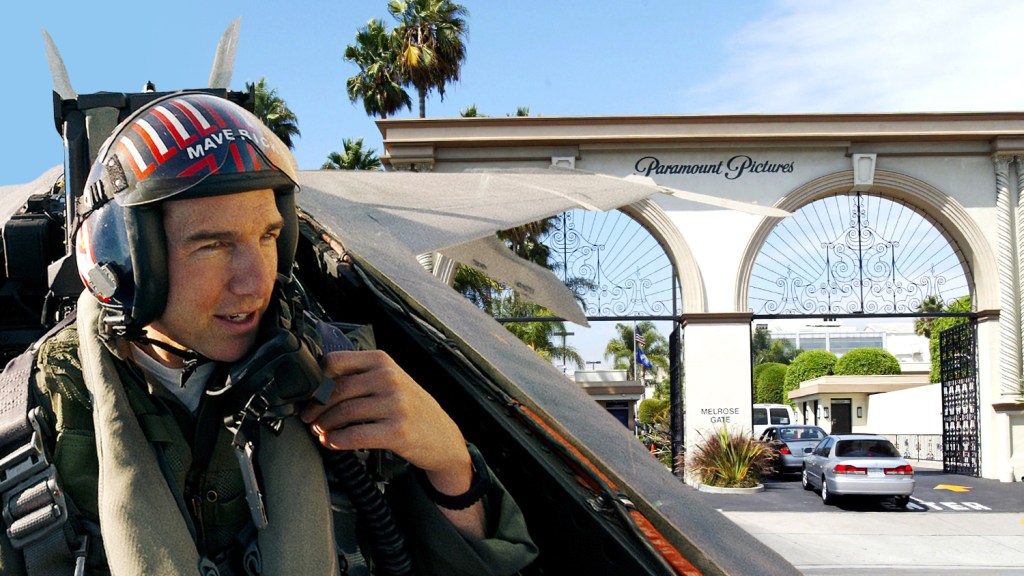
As America’s enemies learned the hard way on the big screen in the Top Gun flicks, it’s really not a smart move to mess with Pete “Maverick” Mitchell or his franchise. Now, for the second time in a week, a federal judge has grounded a lawsuit against Top Gun: Maverick.
In fact, not only has U.S. District Court Judge Jed Rakoff decided Shaun Gray’s copyright claims of contributions to the 2022 blockbuster’s script are DOA, but that Paramount‘s August filed counterclaims can push it to Mach 10.
“Paramount moves for summary judgment on Gray’s remaining claim of copyright infringement, arguing that Gray’s infringement claim must be dismissed for various reasons, one of which is that Gray’s own copyright is invalid,” Judge Rakoff writes today with some briskness in his opinion and order. “Because the Court agrees with that argument, it need not address Paramount’s other arguments.”
Having some credits of his own, Gray, the cousin and sometimes assistant to credited Maverick co-scribe Eric Warren Singer, alleged in his since slimmed down action that he worked on the script for Maverick with his cousin and the film’s director Joseph Kosinski. Pumped up by public comments on his contributions by Maverick military advisor Captain JJ “Yank” Cummings, Gray’s initial April 2025 suit insists he “wrote key scenes for the screenplay that became the Film’s central edge-of-your-seat dramatic action sequences that made it a smash hit.”
Paramount has disagreed, and noted it had no way of knowing any of this in part because by Gray’s own admission he never told anyone that he was supposedly pounding on the keys for the flyboy flick – and Judge Rakoff, who just oversaw the feds’ successful fraud and money-laundering case against Carl Rinsch for apparently ripping off Netflix for $11 million and more, agreed. “As previously noted, the original film, Top Gun, was fully copyrighted by Paramount, and it is self-evident that the Gray Scenes are materially based on the Top Gun universe, including characters, settings, and plot devices, as one would expect of such a sequel.”
He adds: “As for Paramount’s fraud counterclaim, Paramount alleges that Gray devalued Paramount’s intellectual property by intentionally concealing from Paramount that he was writing scenes and making contributions to Singer’s draft of the Top Gun: Maverick screenplay.”
“For the foregoing reasons, the Court grants Paramount’s motion for summary judgment and denies Gray’s motion for summary judgment,” the judge concludes in the 19-page missive. “Specifically, Gray’s claim for copyright infringement is dismissed, and Paramount’s counterclaims of copyright infringement and fraud are preserved for trial.”
All of which likely brought a much welcomed skip in C-suiter’s steps today down at the Melrose lot (cause, you know that WBD thing is still grinding on…). “We are pleased with the Court’s decision to dismiss Gray’s claims and allow Paramount’s counterclaims to move forward,” a Paramount spokesperson told Deadline Friday after the NYC-based Rakoff issued his summary judgement opinion and order.
Gray’s attorney Marc Taboroff did not respond to Deadline’s request for comment on Friday’s docket. Taboroff, long a copyright warrior to various degrees of success against the studios, is also the lawyer in the as-of-now unsuccessful copyright infringement attempt by the widow and son of Ehud Yonay, who penned “Top Guns” from the now-defunct California magazine’s May 1983 issue that inspired the 1986 hit movie. An Appeals Court panel shot that one down a week ago after the estate’s already lower court rejected notion that their termination rights had been violated and that Paramount, Cruise and producers like Jerry Bruckheimer and now Para kingpin David Ellison had no standing to make the Top Gun sequel or the planned Top Gun 3.
Now, it’s all primed for takeoff.