
A mixture of anxiety and excitement coursed through Keanini Aarona in the weeks before five Hawaiian crows, or ʻalalā, were released into the Kīpahulu Forest Reserve in East Maui in November 2024.
Aarona, an avian recovery specialist at Maui Bird Conservation Center in Olinda, had spent the previous year helping to raise some of the young ʻalalā — extinct in the wild for more than two decades — so that they might be able to survive on their own.
“I feel almost like a parent to them, and sending them out is kind of nerve-wracking,” Aarona said. “But it’s also so exciting, because these birds are so young, and one day there will be a point when they will have spent more of their life out in the forest than they did in captivity.”
While the sleek, black birds are endemic to Hawaiʻi island, efforts to reintroduce ʻalalā in their native range were unsuccessful. Experts were hopeful that if these five birds — among only about 110 of their kind left in the world — could learn to thrive on the leeward slopes of Haleakalā, then maybe the species could eventually soar through the skies above their home island once again.
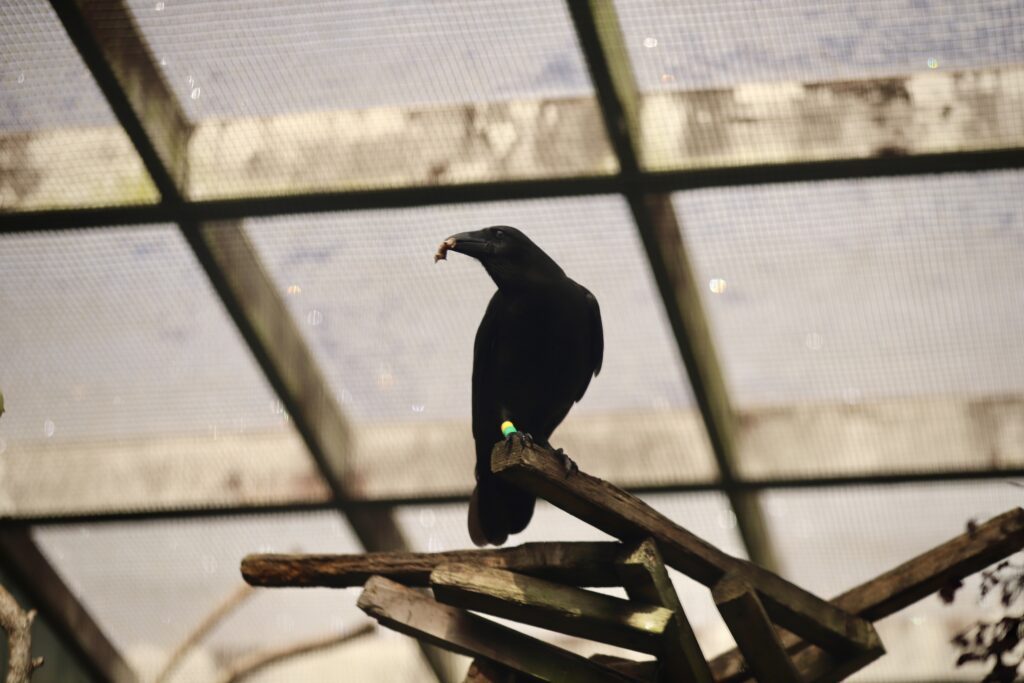 The ʻalalā, or Hawaiian crow, was deemed extinct in the wild in 2002, but there are about 110 birds in captivity on Maui and the Big Island and several have been released on Maui. Kanileo is a male ʻalalā at the Maui Bird Conservation Center in Olinda. (Erin Nolan/Civil Beat/2025)
More than a year after a group of nonprofit, state and federal partners released three male and two female ʻalalā into the forests of East Maui, all five crows are still alive and experts are optimistic that this reintroduction attempt — the first outside of the Big Island — may yield better results than those in the past.
Scientists are still closely monitoring the crows as they learn to forage, expand their flight range and continue to acclimate to their new environment, and they are preparing to release two more ʻalalā — one male and one female — into the same area, according to Tess Hebebrand, an aviculture specialist with the Maui Forest Bird Recovery Project.
“The birds are exhibiting a lot of natural behaviors,” Hebebrand said last week from the nonprofit’s office in Upcountry Maui. “They’ve had some mild things where it looks like they got a little bit sick, but then they got better.”
Releasing two more birds in the same area will help researchers learn more about how the species adapts to life in the wild, she said.
Difficult Decisions
Similar to other crow species, ʻalalā are known to be highly social, intelligent and charismatic, but they have unique bristly feathers around their prominent bills, are particularly adept tool users and are larger than their distant cousins on the mainland. They play a vital role in the local ecosystem by pruning the trees and dispersing native plant seeds so that the forest can continue to grow, according to Martin Frye, a research field supervisor for the Maui Forest Bird Recovery Project.
Native Hawaiians have long regarded the ʻalalā as ʻaumākua, or family guardians, Frye said.
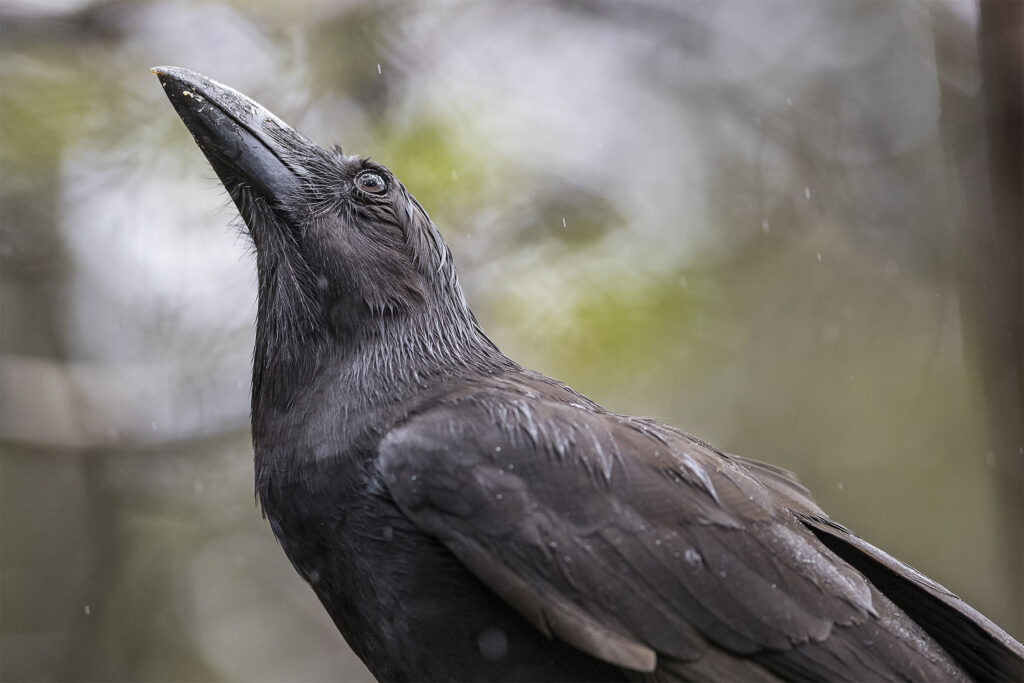 The ʻalalā are known to be highly social and intelligent, and they have unique bristly feathers around their bills. (Courtesy: San Diego Zoo Wildlife Alliance)
The ʻalalā had been declining for decades due to habitat loss, introduced diseases, increased contact with humans and other factors before it was officially declared extinct in the wild in 2002.
The last notable effort to reintroduce ʻalalā into the wild occurred between 2016 and 2020, when scientists released 30 ‘alalā from sites inside the Pu‘u Maka‘ala Natural Area Reserve on Hawai‘i island. Some of the birds survived for years in the wild, but others struggled when faced with disease and weaned off food provided by caretakers, Frye said.
When the Hawaiian hawk, or ʻio, identified the ʻalalā as a potential food source and began hunting the crows, scientists decided it was time to pause their efforts, he said. Scientists suspect 25 crows died; they recovered 18 of the bodies, according to a recent study by researchers with the San Diego Zoo Wildlife Alliance.
“Once they were getting nailed by this hawk species, the managers made the difficult decision to just pull all the birds that they could get out of the forest, because it wouldn’t serve any purpose to let them be hunted down,” Frye said. “At that point, they’re too valuable to lose to a foregone conclusion like that.”
Predicting that the crows might be more likely to thrive in an area where they were free from the threat of predators like the ʻio, researchers began to study the feasibility of releasing them on another island.
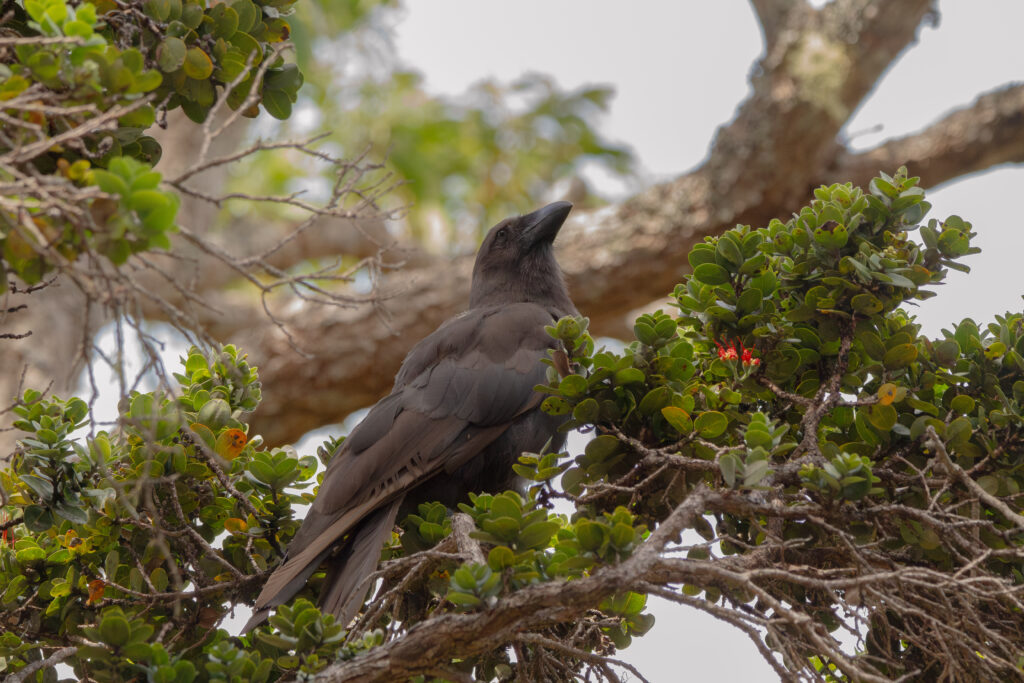 The reintroduction initiative has been the product of more than two years of planning and research organized and carried out by nonprofits and state and federal agencies. (Courtesy: Maui Forest Bird Recovery Project)
A 2024 environmental assessment investigating the potential effects of releasing ʻalalā in East Maui found that even though Kīpahulu Forest Reserve has a wetter climate than the ʻalalā’s native environment, it contained native fruits that the species would forage for on the Big Island, and it was unlikely that the introduced birds would pose a risk to the area’s other endangered species.
Even though it would have been impossible to eliminate the risk that releasing a non-native species on Maui could have unintended consequences, the alternative would have been to keep all known ʻalalā in captivity, where capacity is limited and the ʻalalā “are expected to continue to lose their wild traits and ability to persist in the wild,” according to the environmental assessment.
Finding Freedom
Before their release into a remote area inside Kīpahulu Forest Reserve, the five young ʻalalā — chosen because of their advanced social skills, breeding potential and instincts to avoid predators — spent a few weeks in a field aviary where they acclimated to wearing GPS-trackers, learned to use the feeders that would provide them with extra sustenance while they learned to forage, and settled into their new environment, said Hebebrand, one of several researchers monitoring and caring for the birds.
The ʻalalā were hesitant when the aviary doors first opened on the day of their release, but one by one, the crows slowly wandered out into the forest, according to the state Department of Land and Natural Resources.
 ʻAlalā are one of the few species that are known tool users, and they have been observed using sticks to retrieve insects to eat. (Courtesy: San Diego Zoo Wildlife Alliance)
“There were a lot of emotions on the day that they left the aviary. We were definitely shedding some tears,” Hebebrand said. “Seeing them in a captive setting for so many years and monitoring them for so long, and then just seeing how they immediately started exploring — it just felt really natural. They had their instincts, and they knew what to do. It was really beautiful to see that.”
Field researchers like Hebebrand have spent the last year monitoring the ʻalalā and servicing the automatic feeders that regularly dispense fresh fruit and dry food pellets, she said. The ʻalalā will eventually be weaned off of the food provided by their caretakers, Hebebrand said, and in the meantime, the birds have been observed eating a variety of insects, small animals, native fruits and seeds and other food found in the forest.
One of the project’s most exciting moments came in late 2025, when two of the released ʻalalā paired up and laid an egg together, Hebebrand said. The ʻalalā were still very young, so they were not expected to reproduce quite yet, she said.
“They went kind of from being just buddies to not buddies anymore, which was interesting to see,” she said. “We don’t know the status of the egg, but she appeared to sit on it the whole 21 days that they sit on an egg. The first time around, it’s not typical that it would hatch … But it’s pretty incredible to see a nest.”
Caring For The Past
The ʻalalā have a robust language consisting of dozens of different calls ranging from sweet chirps and human-like cries to rhythmic whooping noises that scientists have dubbed “the monkey call.”
“In the deep past, people picked out that voice from all the voices of the forest,” Frye said. “We can’t lose that voice. That’s the push. We need that voice to be present in order for the forest to be whole, in order for our relationship to the forest be whole, in order to preserve a link to the past.”
That can be a heavy weight to bear, Hebebrand said.
“I definitely don’t take it lightly. Every single bird that I’ve worked with out here is extremely valuable and special,” she said. “I do love them, and I don’t think of them as just numbers. They all become unique individuals. And I think that is okay to feel that… But you feel the weight of it if something happens. That’s the difficult part of the work — the responsibility that you feel and take home with you.”
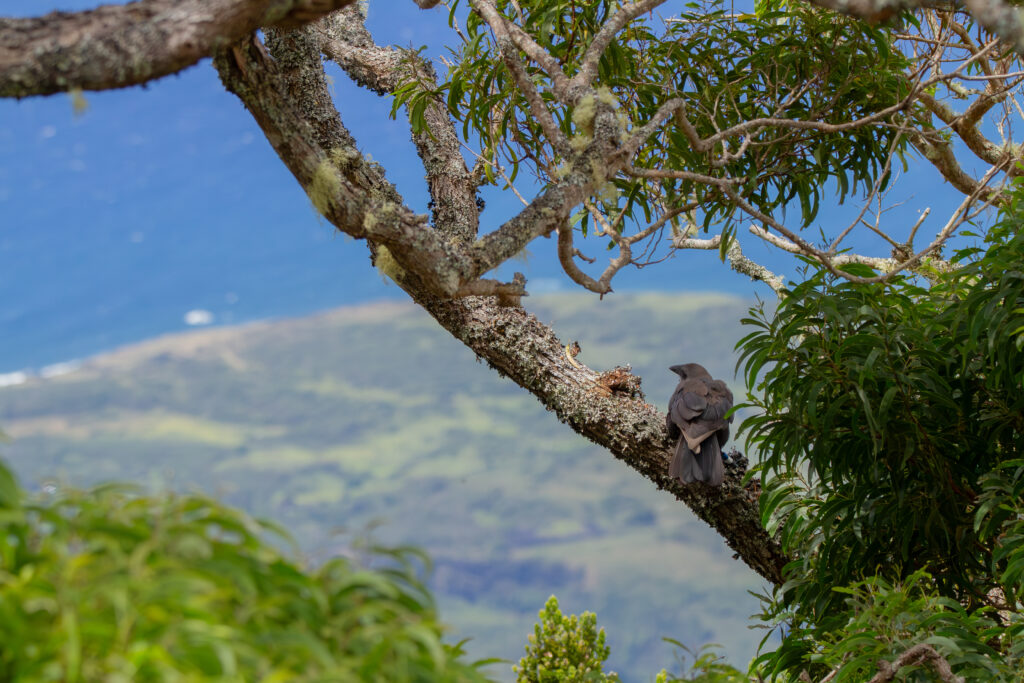 Five young ʻalalā were released in a remote area of Kīpahulu Forest Reserve, where they continue to be monitored by field researchers. (Courtesy: Maui Forest Bird Recovery Project)
Reintroducing the ʻalalā into the wild is about more than saving an endangered species, said Aarona, who cares for ʻalalā at the Olinda conservation center.
“In Hawaiian culture, everything is full circle. People can’t live without the forest, and the forest can’t live without the birds,” he said. “These birds, they are our ancestors.”
Aarona is hopeful that one day there will be ʻalalā soaring through Hawaiian forests that have never known a life in captivity.
“I’d probably cry if an egg hatched and they raised it to adulthood,” he said. “I feel like I am caring for a piece of the past that I am trying to bring back to life in the future.”
Laughing, he recalled some of the less glamorous aspects of his job, and added, “It does feel worth getting pooped on.”
Civil Beat’s coverage of Maui County is supported in part by a grant from the Nuestro Futuro Foundation; coverage of environmental issues on Maui is supported by grants from the Center for Disaster Philanthropy and the Hawai‘i Wildfires Recovery Fund and the Doris Duke Foundation; coverage of climate change and the environment is supported by The Healy Foundation, the Marisla Fund of the Hawai‘i Community Foundation and the Frost Family Foundation.

Sign up for our FREE morning newsletter and face each day more informed.
Sign Up
Sorry. That’s an invalid e-mail.
Thanks! We’ll send you a confirmation e-mail shortly.